Boundary mics

ggrantly

Veteran
I'm always looking to add versatility to my kit. Recently there has been some threads mentioning the use of boundary mics. As I understand their use, they would work well to plant on the edge of a set where traditional booming or lavs won't work. I was hoping someone might give a brief description on when you would choose this style of mic. For example, what advantage would a boundary mic have over a lav doing the same thing; hidden on a night stand for example? Is there a recommendation for a mid-range boundary mic? What features should I be seeking considering I already have a nice selection of small condensers, lavs, and shotguns?

Sorry to be so general on this, but I am really looking for some base knowledge.

TIA
Grant
 
I have used boundary mics when I want to film a group of people around a boardroom table, where it would not be possible to use lavs on every person, and I want the microphones to be as innocuous as possible. My favorite boundary mic, the Samson CM11B "Hockey-Puck" boundary mic has been discontinued, but you might be able to find some if you dig around on eBay or at pro audio places that still have stock.

Samson CM11B Omnidirectional Boundary Mic : $99

Great little mic that you can drop on to a table, and it looks almost like a drink-coaster with a thin wire coming out of it. The Samson wire is terrible, so I had Trew Audio create a few custom cables which were much better than the OEM cable.
 
Sanken's CUB-01 has worked wonders for me. Small, incredible clarity and very nice off-axis frequency response (cardiod pattern). Good for almost everywhere you need a quality plant mic - especially in the car or truck cabin, for example. It sounds like a good condenser, because it is, and at $500 or so, it's not break-the-bank territory.

I also picked up some AT871s from eBay on the cheap! While not anywhere as good for hiding (they're large by any stretch), if you need to film a group and mics in the frame are fine, plenty of old installation boundary mics are available, many use standard P48v for power so even if they come cable-less you can "roll your own." I recently saw an episode of HBO's The Newsroom where they were used as props.
 
Boundary mics are not magic. If they are too far away for example (such as on the lip of a reverberant stage, etc.) they have no special properties of violating the laws of physics and acoustics. In very specialized cases (inside a piano lid, on a boardroom table, on the visor of a car, etc. they are in their element. Alas there is a huge steaming pile of legend, lore and downright misinformation about boundary mics in absurdly ridiculous applications (*) as if the had some sort of "magic" properties. When they were first introduced (by Crown, and licensed to Radio Shack) the frenzy was unbelievable.

IMHO, boundary mics are a specialty solution for a specialty problem. They are NOT general-purpose microphones.

(*)For example: at a summer outdoor concert of a chamber orchestra, I observed a pair of ~20 ft tall stands, each with a 3ft (1m) square of clear plastic and a boundary mic attached in the middle. Of course there was absolutely no reason to even consider using a boundary mic for this kind of application, it was absurd on the face. But then, to make matters worse, a (totally predictable) light breeze came up and sailed one of the plastic squares over into the trees, and toppled the other one, fortunately, away from the audience or there would have been a huge legal mess and possibly a decapitation or two.

On the road in Johannesburg, ZA
 
Thanks for the replies.

What would a boundary mic do for me that a lav wouldn't, given a similar pattern; omni or cardioid?

Grant
 
Boundary microphones are excellent pieces of kit - the problem is, that good ones are expensive (eg: Neumann and Schoeps) - my Neumann GFM 132 are about £4,000 a pair!

Cheaper ones tend to be designed either for table-top conference use or for instruments like the bass drum.

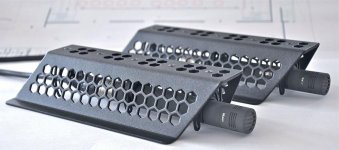
A good alternative is the "Turtle" - this is a boundary adaptor that will change just about any small diaphragm condenser mic. into a boundary mic. It was reviewed recently in Sound On Sound HERE.

It has a tough metal construction to protect the microphone and incorporates Rycote "Lyre" suspension elements to eliminate footfall and other structure-borne noise.

And - the great advantage is that you can use your normal SDC condenser and when you don't need the boundary mic. you can pack the "Turtles"s away and use the mic. as normal.

I hope this helps.

OT_03_MaierTurtle.jpg
 
The Turtle looks interesting. The way it is described, a small condensor omni would do the same work as a boundary mic unless you needed the puck shape for a table top 360 degree situation; am I reading that right? Does the Turtle, as built, add any audio advantage, or is it just a guard with mount? Are there any US distributors? It wouldn't be hard to form one in a sheet metal shop but I hate to reinvent the wheel.

Grant
 
The Turtle looks interesting. The way it is described, a small condensor omni would do the same work as a boundary mic unless you needed the puck shape for a table top 360 degree situation; am I reading that right? Does the Turtle, as built, add any audio advantage, or is it just a guard with mount? Are there any US distributors? It wouldn't be hard to form one in a sheet metal shop but I hate to reinvent the wheel.

Grant

The Turtle shape is to protect the mic. and the Rycote "Lyre" suspension prevents/reduces structure-borne noise.

The Turtle is patented, by the way - and the designer had a lot of help from Schoeps when he designed it.

If you use an omni SDC mic. you wll get a full 360° hemispherical response (though with a HF droop to the rear thats inherent with the original mic.)

If you use a cardioid SDC you will get a half-cardioid response.

The idea is that it's very flexible and you can use the mic. normally when you don't need a boundary mic.

I thought it an excellent idea when I saw it at ProLight+Sound in Frankfurt last year.

If there is no US distributor, you can purchase from the UK distributor or from Germany.
 
The Boundary Effect comes from the spacing of the mic capsule a short distance above the flat surface the mic is resting on ... the capsule is not actually in contact with the surface. Looks like the Turtle holds a mic so its capsule is at the proper distance viz a vie the surface it's resting on. One thing that's confusing in the pics though is that a proper boundary mic has its diaphragm parallel to the surface the mic is on but with these devices it appears the plane of the diaphragm would be at 90 degrees to the surface.
 
Last edited:
The boundary effect is sensing the pressure right at the boundary surface. One way is to recess the microphone into the surface so that the diaphragm is level with the surface. Of course, this pretty much requires a fixed installation.

Mounting the diaphragm facing the surface is a work-around to avoid drilling a hole in your surface. But the volume enclosed by the space between the mic capsule and the surface forms a Helmholtz resonator which affects frequency response at high frequencies. They try to minimize this volume to raise the resonant frequency as high as possible.

Another work-around is to mount the microphone with the diaphragm at right angles to the surface, but as close as practical. This method avoids the resonant space problem, but adds the problem of different parts of the diaphragm picking up reflections from the surface at different distances which creates a kind of comb-filter effect. But this method allows you to use your regular microphones for other things when you don't need a boundary mic.

All the various methods have their benefits and disadvantages. Practically everything in life amounts to a trade-off decision that you must make in light of your own circumstances.
 
Thanks for the great responses guys. Last question, I promise. How does a good quality lav fit into this picture?

Grant
 
I will admit that I don't understand the question. What picture are you fitting here?

I do not agree with the factuality of the original premise: "work well to plant on the edge of a set where traditional booming or lavs won't work." As I said before, there is nothing about being a boundary mic that makes them any better at distinguishing diffuse sound at a distance than any other non-boundary microphone. Repeating: boundary mics have NO magical properties.
 
Sorry, for any confusion.

What I am asking is if a good lav, placed and used like a boundary mic, would do the same work?

Grant
 
Thanks Richard,

Thinking about a stage setup, similar to the way the Turtle might be used, if you put a omni lav close to, but slightly off the floor, how might it perform relative to a boundary mic like the Cub or AT?

Or, mounted in a flower pot near the talent, realizing distance is the enemy, what advantages would a boundary mic have over a lav?

I suppose I shouldn't be so lazy and just do some testing....

Grant
 
An omni (or card, for that matter) microphone (SDC, lav, dynamic, whatever) will perform approximately equivalent to a specialty boundary microphone IF you observe the caution to get the capsule as close to the boundary as possible. Sitting right on it would be ideal, but rarely practical for mechanical noise issues. I must say that for the kinds of things I shoot (and record) I can count on my fingers the number of times a boundary microphone was useful. If a microphone is too far away and/or the sound is too diffuse/reverberant, NO microphone is going to save your bacon from poor placement.

I can not imagine any way to properly deploy a boundary microphone in a flower pot. Remember that a boundary microphone does NOT work on its own. It REQUIRES a BOUNDARY to perform properly. I've never seen a flower pot with any sort of boundary, even an insufficient one. The "diameter" of the boundary around the microphone determines the low frequency performance of the boundary microphone which is why people do stupid things like make big artificial boundaries with pieces of clear plastic, etc. If you have to CREATE a boundary to use a boundary microphone, then a boundary microphone is not the right choice for the situation.
 
Thanks again for hangin in there with me everyone. I was very uncertain how to use something like this and now feel informed enough to be really dangerous. Said with tongue in cheek.

Grant
 
The Boundary Effect comes from the spacing of the mic capsule a short distance above the flat surface the mic is resting on ... the capsule is not actually in contact with the surface. Looks like the Turtle holds a mic so its capsule is at the proper distance viz a vie the surface it's resting on. One thing that's confusing in the pics though is that a proper boundary mic has its diaphragm parallel to the surface the mic is on but with these devices it appears the plane of the diaphragm would be at 90 degrees to the surface.

The boundary effect is at the boundary, so you need to get a microphone into this zone.

Crown do it with their (patented) PZM by having the capsule just above the boundary looking back at it. Neumann and Schoeps (and others) have the capsule at the boundary surface.

The Turtle does this by pitting the mic. at the boubdary in a different way.

But thay are all boundary mics.


The boundary effect is sensing the pressure right at the boundary surface. One way is to recess the microphone into the surface so that the diaphragm is level with the surface. Of course, this pretty much requires a fixed installation.

Mounting the diaphragm facing the surface is a work-around to avoid drilling a hole in your surface. But the volume enclosed by the space between the mic capsule and the surface forms a Helmholtz resonator which affects frequency response at high frequencies. They try to minimize this volume to raise the resonant frequency as high as possible.

Another work-around is to mount the microphone with the diaphragm at right angles to the surface, but as close as practical. This method avoids the resonant space problem, but adds the problem of different parts of the diaphragm picking up reflections from the surface at different distances which creates a kind of comb-filter effect. But this method allows you to use your regular microphones for other things when you don't need a boundary mic.

All the various methods have their benefits and disadvantages. Practically everything in life amounts to a trade-off decision that you must make in light of your own circumstances.


All this is absolutely correct. :thumbup:


Thanks for the great responses guys. Last question, I promise. How does a good quality lav fit into this picture?

You can use a tie mic. as a boundary mic. by sticking it to the surface.

A couple of DPA 4060s, for example, make great boundary mics for recording a grand piano when stuck to the inside of the open piano lid. Actually DPA supply boundary adaptors in the kit.
 
Back
Top