bought this led light its giving me a green tint

Like Matt said, it really depends on the light. Having a color temp meter handy would be helpful.
I have found that Different LED lights can take anywhere from 1/8 minus green to 1/2 minus green to remove the green spike.
But also usually also require additional CTO gel from 1/8 to 1/2 to remove enough blue to bring the light down to 5600k.

The light you linked to list's it's color temp at 6000k, but I wouldn't be surprised if it were even bluer than that.


All the Best!

Dave
 
Having a color temp meter handy would be helpful.

Color temp meters are not much help correcting LEDs of the type that Tony404 is using. Color meters are designed to read continuous spectrum sources such as Tungsten, HMI, or Fluorescent lights. The color spikes that LEDs of this type produce mislead color meters. Unfortunately, a “vector-scope” is the only reliable means of testing color correction with LED sources of this type. For a detailed analysis of the color rendering capability of LED fixtures see The Academy of Motion Picture Arts and Sciences' “Solid State Lighting Technical Assessment" - a research project in which they systematically tested and compared the LED technology available at the time to Incandescent and HMI light sources. On their website they have posted not only side by side comparisons of chip charts exposed under each light source but also set pieces, wardrobe, and make-up. To maintain neutrality, no brand names are mentioned in their results, but they chose lights that reflect the various approaches taken by the major manufacturers of LED fixtures for motion picture applications. You can find a link to the Academy of Motion Picture Arts and Sciences’ “Solid State Lighting Project Technical Assessment", as well as other information regarding LEDS on our website at http://www.screenlightandgrip.com/html/emailnewsletter_generators.html.

- Guy Holt, Gaffer, ScreenLight & Grip, Lighting and Grip Rental & Sales in Boston
 
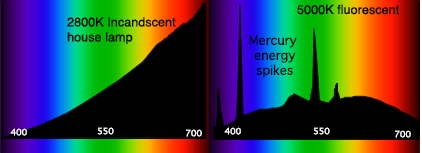
Good advice, Guy. Color temperature meters measure intensity at two or three colors and use them to infer the over all color temperature of a source. That works when spectra are continuous but where there are color spikes such as with fluorescents and LEDs that's not possible. That's why correlated color temperature, CCT, has to be used, and it is a subjective, not an objective measure: it is human perceived color temperature.

Because of the discontinuous spectra of non-incandescent sources we have had to invent color rendering index, CRI, as well. It is another subjective way to suggest the faithfulness of a discontinuous source in illuminating and therefore rendering color.

All who work in this area seriously -- DPs, gaffers, etc., -- ought to become very familiar with spectral power distributions of the light sources we use. The only way to grasp them overall is to examine and understand graphs such as this:

Spectral_Power_Distributions.png
 
I just looked at the light.
Those are T-9 package bulb. It saddens me to see companies pawning off LED lights for video that constantly shift and change.
As the bulb ages it will color shift and the lums will drop of rapidly.

Look for lights using SMT or SMD (Surface mount) . These are better in design and will not have the color and lum drop off.
Great site for R&D is here:
http://www.redbirdled.com/articles.asp?id=143
 
Back
Top