
Postmaster
Dark Side of the Camera
this is why we need a foveon video camera!
+1 I´really wonder why they don´t doing that.

Follow along with the video below to see how to install our site as a web app on your home screen.
Note: This feature may not be available in some browsers.
this is why we need a foveon video camera!

It is an understandable presentation of a Bayer color filter array. I wouldn't call it "overly simplistic" any more than I'd call your assessment "overly complex". AThis is an overly simplistic view of Bayer color filter arrays. The color filters are not pure blue, red, and green like a 3 chip sensor array. Blue passes a percentage of all three primaries with a blue bias, same with red and green filters.
"much" higher? No. Maybe a little bleedover, which (when countered by the resolution loss) results in a relatively higher proportion of color to actual resolved detail, which is why I already said it would be a little better than 4:2:0. But not a lot. And I doubt it'd have more color information than the NOMINAL resolution would dictate. It may have synthesized up-rezzed intermediate pixels, but not higher actual sampled information. How can it?4:4:4 encoded video file from a Bayer sensor will have much higher color resolution than a 4:2:0 encoded video file.
You keep saying this, we all understand it, but what I want to know is -- why keep saying this? What does this have to do with the notion of whether or not the DBolex (or the Red One, for that matter) actually deliver 4:4:4?A Bayer sensor can at best match the relative red / blue color resolution of human vision, which is comparably lower than green too. It is still the closest and most efficient mechanical mimic for how human vision samples resolution and color which is why Bayer sensors are so universally popular in all kinds of cameras.

Graeme Nattress has written as to why. It was really rather funny how he blatantly pointed it out. The Foveon is basically three chips sandwiched together, as opposed to a conventional three-chip camera where there's an optical prism that splits the light and sends each wavelength to the appropriate chip. So what splits the light in the Foveon? The silicon itself! And Silicon is a fairly lousy light filter, at least as compared to an optically pure prism. There are reasons that Foveon has had very limited acceptance in photography in general. It's one of those ideas that seems perfect, but in reality, well, there's always tradeoffs and compromises. There's no one simple magic bullet that solves all problems.+1 I´really wonder why they don´t doing that.


my take: this is a hacked version of that industrial camera (GX2300C), what they added is: a film-making friendly casing, an audio recorder, an interface to easily control the industrial camera, a simple way to record the RAW signal that the industrial camera outputs through its ethernet port, and a small screen that displays the analog image-out from the industrial camera *** GENIUS!! *** (as long as that GX2300C can be bought for $1K or so, which I'm not sure is the case...) *** http://www.1stvision.com/cameras/AVT/Prosilica-GX2300-GX2300C.html http://www.1stvision.com/cameras/AVT/dataman/70-0067_GX_TechMan.pdf
and also ive read somewhere foveon sensors are much expensive to makeGraeme Nattress has written as to why. It was really rather funny how he blatantly pointed it out. The Foveon is basically three chips sandwiched together, as opposed to a conventional three-chip camera where there's an optical prism that splits the light and sends each wavelength to the appropriate chip. So what splits the light in the Foveon? The silicon itself! And Silicon is a fairly lousy light filter, at least as compared to an optically pure prism. There are reasons that Foveon has had very limited acceptance in photography in general. It's one of those ideas that seems perfect, but in reality, well, there's always tradeoffs and compromises. There's no one simple magic bullet that solves all problems.
Well, yes, that would be kind of fantastic actually...wouldnt an S35 with 2k photosite foveon sensor be awesome? those pixels would be huuge. may compensate for foveon's sensitivity.
Okay, last thing -- on the SDI output, man, that's a head-scratcher. I've been scratching my noggin about that one, and here's my current theory -- I doubt (sincerely, a lot) that the DBolex would ever offer what we all come to think of as a true, real SDI output -- meaning, full-resolution, full-color, broadcast-caliber, the whole nine yards. I rather suspect that what the SDI option would mean is that it would be an alternative output for the black and white "video tap" that the DBolex already has. Which is nice, it'd let you plug the camera directly into your SDI monitor instead of whatever oddball 1/8" output it already has (which, I suspect, is the same type of connector that palmcorders use, probably a 1/8" minijack-to-RCA for a composite video output). So I would guess that the SDI option would be an SDI connector instead, but that the video signal (640x480 black & white) would probably still be the same...
... That's what I expect the DBolex guys have in mind for their video output -- the functional equivalent of a video tap. Hence why it's standard-def and black and white, because -- that's what a video tap was. I don't think they'll make it flicker like a movie camera did, that'd be silly...
The downside? The camera will do NO work for you, folks. You have to do everything that you're used to the camera doing for you. Raw images are ugly images. Flat, unprocessed, soft... look back on some of Jim Jannard's threads where he tried to explain to people that you must never look at raw footage, because it's not made to be looked at. It's made to be graded. You should only look at footage after you've processed it -- which means you have to run a de-noise process on the footage yourself. You have to apply gamma curves yourself. If you want smooth highlight rolloffs, you'll have to apply a color grade that rolls highlights off smoothly yourself, because the chip doesn't do anything about that. If you want daylight color temperature, you'll have to color-balance the footage (not the camera, not the sensor, but the footage) yourself. If you want to shoot footage under tungsten light, you'll have to color-balance the footage yourself. If you want the footage sharper, you'll have to apply edge-enhancement or an unsharp mask yourself. If you want compressed footage, you'll have to compress it yourself.
If you want to shoot sports or news for the local TV station, you definitely don't want this camera. If you want to shoot weddings and events, and turn around a same-day edit, you couldn't possibly (reasonably) do it with a raw camera.
But if you want to shoot raw images and grade the daylights out of it in post, and you have the time and budget resources to allow for such a grading process, then raw's your friend. I can't believe we haven't seen Perrone Ford in here yet, seems like this would be exactly the type of camera he's always been looking for.
I wouldn't replace my "A" video camera with something like this. But for the right project, it looks like just what the doctor ordered, at a great price. If someone is shooting cinema and wants to shoot just like we always used to shoot film in the old days, and is willing to budget the time and money for the post-production grading process, the DBolex (on paper) looks like it'll fill that niche with no competition at its price point.
Also, since I'm in to this, what's up with the whole old Bolex look actually. I mean, does anyone really want an old school looking camera - or has he just done it to get some sort of brand behind him. Because I can't imagine many modern-day filmmakers really careing about this nolstalegic value he keeps going on about. I may be wrong, but that crank - on a 2K digital camera, just looks weird to me. I'd say that most guys just want a decent looking black box...
I don't think the look really matters that much to most people. (Well if it looks like a Star Trek hair dryer it may matter to some.) The Retro thing will go over good with the hipsters though.
 rogar-Dum(DBG):... but seriously, they may need to answer to this.
Yes, it does. Now, look, I'm going out on a limb here because I don't know what the engineers are doing, but if I was doing it (and I'm not a hardware engineer, I'm an ex software engineer) I would think it would be relatively easy to scan the image to just pull out the green pixels and display that as a rough black & white. But doing an entire Bayer de-mosaic? That's not a trivial task. That will take some processing horsepower to do, which means work, and chips, and then it'll start to spiral out of control. And from their design philosophy of "keep it as simple as possible" -- I don't think they'll do that.I don't really understand why they're going for a B/W output. I mean, is it solely for nostalgic purposes? Does it really take that much processing and effort to show colour (color) video.
Well, right, but -- think of the can of worms they avoid by not trying to provide a "decent" monitoring solution. I am frankly quite surprised that they are including XLRs, they must have found an inexpensive all-in-one solution that just dumps digital data out that they can then simply embed in their stream. I'm glad it's there, but I'm surprised it's there!I mean, they speak about how little effort it is to get XLR audio added to a camera (in Phillip Bloom's interview) but then they can't provide a decent monitoring solution.
Well, and that goes to the core of people not understanding what a cinema camera is. If someone thinks that a "cinema camera" must inherently be more powerful or higher on the scale than a "video camera", that's that person's error. A cinema camera is different from a video camera, which is different from a DSLR. A regular video camera (like the HPX3700) does things a Red One can't dream about doing, but the Red One is a "cinema camer" and the HPX3700 is a "video camera". I said earlier that a DSLR doesn't do a tenth of the things a regular video camera does, and I also said that the DBolex won't do a tenth of the things that a DSLR does. And I stand by that. The DBolex is going to be the most stripped-down thing you can imagine. All the features are going to be done not by the camera, but by you, in post.To be honest, it's kind of a deal-breaker to have a camera without decent real-time video monitoring. I mean, even my 550D provides better monitoring then this spec-based DBolex, and that's not even a "cinema camera"...
Which is why I said earlier, this unit is not going to replace an AF100 or F3 as your "A" camera, even though this shoots raw. This is a special-purpose tool, not an all-purpose tool. And yes, I fully believe that 95% of the folks on this site who evaluate this unit, at its MSRP of $3200, against an AF100 at its current street price of $3500, will be better off and happier with the AF100 type of product.Film is the hardest way to get an image. I don't see our current generation trying to use this thing like a 16mm film camera... along with B/W video tap...
That is exactly what I anticipate happening, yes.If I go by what you're saying, Barry, then I'd have to assume that there will be many dissapointed people coming from the world of hacked and feature-rich DSLRs and Video Cams.
I predict this is exactly what will happen. Which is why I say, the key to the DBolex's success will be for them to manage expectations. They have to let people understand what it is they're really getting. And that's hard to do nowadays. There are people out there who think that a DSLR is "better" than a video camera, and now there are those who will think that the DBolex is "better" than a video camera too. And they're in for a real surprise.I've seen (actually spoken to - come to think of it) people who think that the REDs produce horrible flat images and that their DSLRS and AF100s give you a better picture. And they're the people, the exact kind of people, that would jump onto this and throw money at it. I wouldn't be able to begin to imagine the disappointment that these guys are going to experience when they watch B/W video at 640 x 480 on a field LCD and then play it back on their PCs (packed to the brink with HDDs, btw) in 2k with almost no contrast at face-value (and not to mention the effects of using their 50mm EF lenses). I think the guys making the camera are trying to be honest, but hype and the mere word "RAW" attracts a certain crowd who knows not what RAW is.
I'm surprised the guys are as young as they are, if they were old coots who used to shoot on the Bolex then I guess I'd understand it better. The Bolex was a revolution when it came out, specifically because it was such a simple thing. But man, it was NOT an "A" camera by any stretch of the imagination! It sounded like a coffee grinder, you couldn't shoot sync sound on it, the prism in it robbed you of about 1/3 of your total light, I wasn't ever really a big fan of the Bolex. This unit seems closer to what I want, but it's definitely in the spirit of the old Bolex.Also, since I'm in to this, what's up with the whole old Bolex look actually. I mean, does anyone really want an old school looking camera - or has he just done it to get some sort of brand behind him. Because I can't imagine many modern-day filmmakers really careing about this nolstalegic value he keeps going on about. I may be wrong, but that crank - on a 2K digital camera, just looks weird to me. I'd say that most guys just want a decent looking black box...
That's exactly how I see it, although I also acknowledge that it does have that 12-bit raw, and that's a nice bonus.I see it as a potentially wonderful creative tool for the low end indi and student market as well as people looking for that nostalgic feel in a fun little camera.
Make that suggestion on the Kickstarter page! A three-lens c-mount turret would be great, or, better yet, a three-hole universal-mount that we could add our own mount to. But a new-old-stock Angenieux 17-70 f/2.2 zoom is going for $799, and that zoom is tiny, so that one zoom is probably enough that I'm not gonna be stressed if they don't offer the turret. But a turret would be fun.... oh and if it had a three lens turret with removable mounts for each hole(pl,cmount,b4... cannon?) that would just be my dream mini run and gun camera.
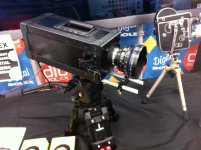
Yes, it does. Now, look, I'm going out on a limb here because I don't know what the engineers are doing, but if I was doing it (and I'm not a hardware engineer, I'm an ex software engineer) I would think it would be relatively easy to scan the image to just pull out the green pixels and display that as a rough black & white. But doing an entire Bayer de-mosaic? That's not a trivial task. That will take some processing horsepower to do, which means work, and chips, and then it'll start to spiral out of control. And from their design philosophy of "keep it as simple as possible" -- I don't think they'll do that.
Here, let me give you an example. The Red One has an SDI output, and an HDMI output. The video quality is fairly lousy. Why? Because they never meant for you to use it! It's a quick and dirty de-bayer, it's a scratch color grade, it's something you can slap up on a monitor to at least see AN image, but it is in no way representative of what the real recorded image will be. The engineers understood that. I understood it. But the public in general? They'd look at the monitor output and say "that looks like @$$, this Red's a piece of junk." That was a grossly unfair characterization, but I've seen it happen over and over. I've even seen people try to use an SDI recorder to record the Red's output! I try to tell them it's pointless, but they do it anyway. So here we have a case of Red spending more than they probably shoud, to create something, which bit them in the butt. I bet they almost wish they'd gone with a black and white output, because it would have kept expectations in check. People would have realized "oh, this is just a video tap" instead of "this is what your image looks like? That's awful!"
So, without putting words in the DBolex guys' mouths, I suspect that they're keeping it as simple as possible, and that probably means a quick grab of the sensor, and scratching something together to show basic framing. About all the processing you're likely to get will be a focus assist, which I would guess would be a black and white extraction of the center of the sensor, so even then not really any processing at all.