Blown away by lighting?

I'm teaching a cinematography course at a university and for the next class i'm looking for examples where light makes the scene. We've all seen examples where light "adds" to the scene's meaning but what are examples where without the light there would be no scene??
 
First off, I’d hardly call ET a film for kids. But that’s just me.

Second, if you don’t like the idea of using ET, how about Empire of the Sun by the same director and DP? There are a number of gorgeously lit scenes in that film that are particularly driven by that lighting.

Also, much of what people think consider great lighting in Blade Runner is really great production design. Not to take away anything from Jordan Cronenweth, but it is a common mistake.
 
Ideally we would stay away from eye candy of mass culture and concentrate on meaning that's build with lighting in more obscure works. The pop culture is so engulfing that i'm certain the students will encounter its omnipotent menainglessness at some point whether they want to or not. I would rather try to inspire by showing examples from films they might have not experienced otherwise.
 
Casino - I always liked the look of the big light blowing out the tables and using the bounce to light several scenes.
I would say it's more of a technique rather than the "scene maker". I think we can both imagine those scenes lit more traditionally and still retaining much of their power.
 
Mainstream, but these are the first two that come to mind:

SkyFall:

Drive:

I'll try think of some lesser-known titles to share.
 
College and university kids are just big kids, and the snooty attitude is usually (certainly in the uK) provided by the teaching staff who determine 'quality'. If you want to show lighting off, then the examples here are great - but also consider the movies with amazing problems to solve. My favourite, teaching wise, was the movie Star Gate. All the huge vistas where the angle of the sun, created real problem solving approaches to filling in shadows. Then they had to recreate the feel in the inside scenes. Very good in terms of visuals, but of course a terrible movie. You can also look at things like movies such as Alien and Predator where the lighting people work miracles in preventing rather than revealing content. Blade Runner is probably the most obvious and well know by film buffs, but I bet many students have never watched it. On the subject of kids movies - ET is great, as is First Encounters. Most of the later Star Trek movies have sections lighting design students would find fascinating and probably unable to analyse. If you want to really criticise lighting - watch things like the Queen movie and consider the differences in lighting between the original period and how recreating it actually was pretty tough. Look at how they did 2001, and how to light a crater being revealed by the rising sun.

If you really want to stretch things - then find a copy of the original puppet Thunderbirds movies and consider how you simulate real life and light when shooting puppets a foot tall and making a fresnel emulate the sun. Do not be afraid of the target age group of evidence, and my experience of older students is they're rather watch ET than watch the excellent lighting in an Orson Wells movie, or worse, Shakespeare! engage their interest, and they will learn. Be a bit too sophisticated in your reading and watching list is a serious mistake (in my humble view from teaching and examining Higher Education here in the UK)
 
Black and white films tend to be more about lighting for story.

Color films can rely on other factors a little more. So, if your aim is to talk about lighting, then a black and white film may be a good addition to some of the other great suggestions.
 
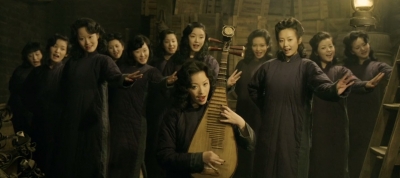
The flowers of war

images

Christian+Bale+and+Ni+Ni+in+the+flowers+of+war+by+oceans+movie+reviews.jpg

7ed41566187e13962dc9e28e79808bc6.jpg

5-841f9805.jpg

196c3dfb206b364fe176a56d98ced7b6ede283e3.jpg
 
I think you could do a section on the battle scenes in the final season of Game of Thrones. There was enough discussion about why certain lighting choices were chosen and how it affected the viewer.
 
Any scene from Barry Lyndon. There are of course the famous scenes lit only by candles and shot with an f .7 lens provided by NASA. But also many of the interiors, which appear lit by natural light, are done by lining the windows with tracing paper and blasting them with artificial light. The Shining also uses the same technique, all the interior hotel scenes actually shot on a soundstage.
 
This one might be too "mainstream" for your taste Patty, but few scenes are as dependant on lighting for their effectiveness as this one from Close Encounters.

 
This one might be too "mainstream" for your taste Patty, but few scenes are as dependant on lighting for their effectiveness as this one from Close Encounters.


I'm not questioning "effectiveness" of lighting in that film (just as in pretty much any mainstream film) but rather meaning beyond its effectiveness. In many ways visual candy is probably a bad teaching tool because it's so hard for the mind to go beyond its 'wow' effect.

"Barry Lyndon" is definitely on my list as i contrast it against paintings.
 
Back
Top