Blackmagic Raises Price of Many Items

. Abe, one day, you too will be a stinking old man, and you will like it.

Anyway, it's no one stinking group that is driving up the market. It's all of us.

I'll either become a stinking old man or I'll die young. Wanna know my preference?

I'm not actually accusing boomers of driving up prices. I'm just defending millennials from that accusation. I also find millennial-bashing to be distasteful not just because they're my cohort but because we got screwed by the great recession.

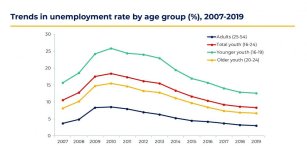
This chart says it all. i graduated college in 2009 at the age of 20. The 16-24 year-old age group had over a 15% unemployment rate for years after the great recession. You know what it is today? 8%.
Click image for larger version  Name:	youth-unemployment-blog__fig1.jpg Views:	0 Size:	42.2 KB ID:	5700430

https://www.statista.com/statistics/...sonal%20trends.

My point to run&gun is twofold. For one thing, I don't think that the crazy run up in housing prices is necessarily a bubble. I think the market has shifted and it's more likely for prices to stall and erode from inflation than for us to see a crash.

The second point is that people with deep pockets who could pay cash were steering the market. This wasn't just older folks. It was also institutional investors.

One addendum - I've also read statistics abput an increase in the proportion of first-time home buyers who were previously living with family. The takeaway? Those folks who moved back into their parents' basements funneled their saved rent money into down payments. I personally know one guy who did that.
 
Last edited:
There's already an overabundance of people and we still can't fill the jobs. One of the big problems is so many people have an inflated sense of self-worth, that's been fed and stoked by the last few decades of being led to believe that they're "special" and that they should always get things their way. All the kids now want to walk in the door as upper management, work two or three days a week and make six figures a year.

I remember reading an interview with Jimmy Garoppolo when he played on the same team as Tom Brady. People were giving him heat because he wanted to supplant Brady as the starting QB. But he said that if you don't want to take the lead and feel like you can do a better job, then you're not the type of person who will ever get it.

I think it's also a youth hormonal thing. I read an article a while back about a guy with a glandular problem who was administered exogenous hormones. They had to experiment with his dosage, and apparently at one point they accidentally overdosed him and gave him the raging hormones of a teenager. He said he was chronically impatient, felt like everyone around him was an idiot, and thought about sex constantly. And I was like, yeah I remember those days.

But the truth is that Run&Gun's description doesn't match the offices I pass through. Typically, they have a small layer of gray-haired men in management. And the majority of the junior staff is women. And the women I've known in these positions are typically less aggressive when it comes to asking for promotions and raises. And women are now getting literally 60% of college degrees.
 
I think it is so cool for the young folks to make a living being an 'influencer' or a travel vlogger or any number of seemingly simple things. But they are not simple. It is a lot of work putting out videos on a regular basis. My hat is off to them. Nice work if you have the talent for it.

We were also wired differently than our parents. The mantra back then was they were 'the establishment' and they were evil and were slaves to 'the man' earning a wage. 'Don't trust anyone over 30' was a popular saying. So stupid, but there it was.

I often wonder how much the Vietnam War and specifically the draft influenced youth mentality in the 60s and 70s. Since the draft ended, we've never really repeated that same societal dynamic
 
Next time ask about the context instead of annoying me.

Gets a lol because it’s a clever answer, it made the edit for a reason. Not many people would say that.

Some other answers were being more tired, bones hurting a little more, it's nice getting free stuff, one guy said he feels just like when he was 20 but he looks like this (pointing to himself).

It was an answer mixed with 10-15 others.
 
I often wonder how much the Vietnam War and specifically the draft influenced youth mentality in the 60s and 70s. Since the draft ended, we've never really repeated that same societal dynamic

Huh, I never thought of that. Having gone through it, I don't have specific recollections. It was certainly on our minds, but I don't think it affected us much until you got drafted. I think most guys still had a sense of duty back then. Not all certainly. There were draft dodgers who went to Canada. One guy in our class got drafted. He freaked. Disappeared. We never heard from him again. I drew a big number, so no worries for me.
 
Huh, I never thought of that. Having gone through it, I don't have specific recollections. It was certainly on our minds, but I don't think it affected us much until you got drafted. I think most guys still had a sense of duty back then. Not all certainly. There were draft dodgers who went to Canada. One guy in our class got drafted. He freaked. Disappeared. We never heard from him again. I drew a big number, so no worries for me.

The sense I got from my parents, who were born in '57/'58, was that part of the reason you wanted to go to college was so that you could get a deferment. It seems to me like the threat of being sent to war was looming over people's heads whether or not it was likely to happen to them. "During the Vietnam War era, between 1964 and 1973, the U.S. military drafted 2.2 million American men out of an eligible pool of 27 million." https://michiganintheworld.history....draft brought the,eligible pool of 27 million.

So, I feel like the anti-establishmentarianism of the time and the general distrust of their elders might be rooted in or at least influenced by the fact that young people were being sent to fight a war of questionable justification. Maybe there was a dichotomy between the guy you describe as having a sense of duty and the people who said don't trust anyone over 30.

The Big Lebowski sort of explores the variety of ways the war left its mark on that generation. Basically everyone was dealing was PTSD. The hippy drop-out pacifists like the Dude; the rigid militants like Walter; the big Lebowski who lost the use of his legs in the Korean War. And basically none of them could get over it.

And it's one, two, three,
What are we fighting for ?
Don't ask me, I don't give a damn,
Next stop is Vietnam;
And it's five, six, seven,
Open up the pearly gates,
Well there ain't no time to wonder why,
Whoopee! we're all gonna die.
 
I don't think anyone who experiences combat can come out of it in one piece. Neither my father (WWII front lines for 130 days) nor my brother in law (Vietnam - helicopter gunship) would ever talk about it. I know they suffered nightmares for many years.

Speaking of sense of duty and how my father's generation thought; my father broke his back while training in the States. He knew something was wrong after an accident, but he didn't know what. He had a lot of pain after an accident. He never said a word through the war. One didn't want to let their mates down or look like a chicken. Only after he got back to the States did he seek help. It took the army two years to figure it out and they fused two vertebrae together.
 
There's old and there's bold. They seldom intersect unless the risks taken are calculated. There was little opportunity for calculation in the eras of wartime drafts. Service, deferments or Canada were completely different calculations.
 
The sense I got from my parents, who were born in '57/'58, was that part of the reason you wanted to go to college was so that you could get a deferment.

And then there were people like my Dad who, uhmm… stretched the truth about their age a bit, to enlist early.
 
No, to go to Gettysburg with Robert E Lee...... :2vrolijk_08:

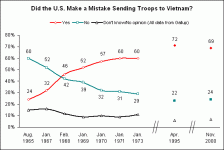
part of the reason I asked was because I thought the Vietnam war was unpopular. I would have been less surprised about lying to enlist in WWII. But it turns out that the war was popular initially and it took about 3 years for opinion to turn against it, around the time my parents were 10.

1420-2.gif
 
part of the reason I asked was because I thought the Vietnam war was unpopular. I would have been less surprised about lying to enlist in WWII. But it turns out that the war was popular initially and it took about 3 years for opinion to turn against it, around the time my parents were 10.

Every day is a school day! The impression I have, from the UK, is that the Vietnam was was always unpopular in the US. Als I believe it started in 1964 with "advisors" who were mainly US SF and CIA types eg MACV-SOG but doing a lot more than "advising"
 
Last edited:
Tangentially, it looks like yesterday (Feb 28) was the 40th anniversary of the MASH finale. Korean War, not Vietnam of course

the "M*A*S*H" finale drew 106 million viewers, still a record for any episodic series.

More staggeringly, the finale was watched in over 60% of US homes, commanding the attention of more than three out of four TV sets in use (that is, its share of audience), meaning that every other programmer might as well have been running a test pattern.
https://www.google.com/amp/s/amp.cnn...ale/index.html
 
Back
Top