Blackmagic Raises Price of Many Items

The prices on EVERYTHING are going up. At least BM told people rather than just increasing the dealer price and letting people find out when they actually need something. I do lots of sales of imported equipment and every single order goes up each time. Usually 3-5% hikes, but a few products where the chip shortage hit them have gone up nearly 100%. It just creeps up and up a few pounds at a time and as soon as new stock arrives, I up the price to maintain the margin.
 
Buy:

The richest got that way not through tax deferrals but through wealth creation, typically starting corporations that sell shares of common stock. The shares appreciate in value, Apple, Facebook, Amazon et al.

Borrow:

Rather than sell the shares right away and realize capital gains tax liabilities all at once, they borrow the money they need to live on with the shares secured as collateral, up to the amount of the gain. They use the proceeds to pay the interest. The interest paid for each year is less than capital gains tax rate for one year, but 3% a year for 5 years is 15%, so it eventually catches up and they may have to sell some of the asset (and pay capital gains tax) in order to avoid the interest becoming more than the capital gains tax. If the asset is appreciating in value, the bank will continue loaning more money in accordance with its debt to equity ratio cap. Meanwhile, the interest income earned by the bank is taxable income to the government. For this to work, the asset has to appreciate in value for if it is not, there is no capital gain anyway and you are just paying interest.

Die:

A flaw in the theory is that the successors can use the stepped up basis that avoided the capital gains tax to pay off the loan. That's not true because it ignores that they don't receive the distributions until after the estate was already settled. The estate tax return already paid huge sums of capital gains tax (after a small exclusion amount), before any distributions are made to the successors. The successors only receeive the stepped up basis because the capital gains tax liability was already paid by the estate. So if they sold the shares right away, they would realize no capital gains.

Conclusion:

Buy Borrow Die for the rich is an example of the envy train alaskacameradude aptly coined. It hasn't avoided the federal government receiving the income it is due. BBD can be useful to defer taxes being taken in any one year from capital gains, but not avoid them altogether.
 
I I'm laughing my butt off that I was smart enough not to fall for the Roth IRA, which would have had me paying taxes up front instead of socking that away for my retirement.

YES!!! I have done the same thing. Although, I'm not retired yet, I didn't fall for the Roth scheme and I don't expect to be paying very much tax on that money when I need it, if I need it. Since my IRA contributions came before taxes were applied I've had 30%-35% more principle in the account to grow year after year. That adds up quickly. There's no way the Roth would have been a better deal.

BTW, if I was 40 years younger and just heading off to college. I wouldn't work my ass off 60-70 hours a week in the summers trying to save as much as I can for school. I wouldn't work any part time jobs during the school year to keep myself afloat. I wouldn't live in a cheap apartment with roommates. No, I'd just take on as much debt as I could get peole to lend me. The more student loans the merrier, If I could borrow more than I need for tuition, room, and board, I'd buy some nice electronics and maybe a new car. And then I'd count on the government to wipe the slate clean at some point after graduation. That is now the American way. Why pull yourself up by your bootstraps if you can have your neighbors pay your debts? It's a great country.
 
Last edited:
BTW, if I was 40 years younger and just heading off to college. I wouldn't work my ass off 60-70 hours a week in the summers trying to save as much as I can for school. I wouldn't work any part time jobs during the school year to keep myself afloat. I wouldn't live in a cheap apartment with roommates. No, I'd just take on as much debt as I could get peole to lend me. The more student loans the merrier, If I could borrow more than I need for tuition, room, and board, I'd buy some nice electronics and maybe a new car. And then I'd count on the government to wipe the slate clean at some point after graduation. That is now the American way. Why pull yourself up by your bootstraps if you can have your neighbors pay your debts? It's a great country.

oh please with that b.s.,The myth of pulling up your bootstraps alone. Nothing you ever did was done alone. years ago you wouldn’t have the debt . One because most colleges were free and the others weren’t gouging students as they are now. It’s a problem a lot of people never had but what the hell screw everyone else because you pulled yourself up by your bootstraps but you forgot to mention that allot of people weren’t pulling bootstraps up alone , there was a system that allowed you to have a affordable education. Right get off your lawn .
 
Last edited:
oh please with that b.s.,The myth of pulling up your bootstraps alone. Nothing you ever did was done alone. years ago you wouldn’t have the debt . One because most colleges were free and the others weren’t gouging students as they are now. It’s a problem a lot of people never had but what the hell screw everyone else because you pulled yourself up by your bootstraps but you forgot to mention that allot of people weren’t pulling bootstraps up alone , there was a system that allowed you to have a affordable education. Right get off your lawn .

You know nothing about me and you're completely wrong. I won't waste my time explaining why. If you don't get it already, you never will. Go back in your hole.
 
. Are ‘the masters of the universe’
paying a higher percentage than ZERO? I think
we both know the answer to that question.]

It depends on the year. There was at least one recent year that we know of when Musk paid $0 income tax, and at least 2 recent years where that was true of Bezos and Icahn

Most of the people who pay no income taxes are super poor

And I'll say it again - you're forgetting about payroll taxes

But the thing about buy, borrow, die is that you can pass your wealth down from generation to generation without ever paying capital gains taxes. That situation seems to me like it's ripe for reform

If you think that working stiffs and poor people are unfairly gaming the tax system then -- are there some reforms you'd like to suggest? Or do we for some reason just accept that this completely artifical system can never change and improve

The masters of the universe are constantly reforming the tax code to benefit themselves via their political influence. Pay attention to the last-minute backroom changes on every tax bill
 
Last edited:
I haven't paid a dime of taxes in years and my income hovers around $70,000. That includes the IRA money I withdraw each year in retirement that was supposed to be taxed when I withdraw it. I'm laughing my butt off that I was smart enough not to fall for the Roth IRA, which would have had me paying taxes up front instead of socking that away for my retirement.

The rich don't have anything on the rest of us, who are getting away with paying nothing. Yes, NOTHING. A full 50%* of us horrible rich people (if $70,000 is being rich) are not paying taxes! You've seen my tax return. I posted it in a previous discussion. There's a lot of complaining about the rich, but the reality is that they are by far, paying the bulk of the tax burden.

*It varies between reports but the lowest I've read is 47% and the highest I've read is in the low 60% range.

Dude you're retired. We quizzed you on your situation in that previous thread and it became clear that retirees enjoy certain tax benefits but that you would pay taxes on that income if it were all earned this year
 
The prices on EVERYTHING are going up. At least BM told people rather than just increasing the dealer price and letting people find out when they actually need something. I do lots of sales of imported equipment and every single order goes up each time. Usually 3-5% hikes, but a few products where the chip shortage hit them have gone up nearly 100%. It just creeps up and up a few pounds at a time and as soon as new stock arrives, I up the price to maintain the margin.

The thing is - and I need to find citations for this but I believe it's true based on my recollection of news reports- that many industries hit by inflation and supply chain issues have actually increased their profit margins in recent years. Which means that the increased prices they pass to their customers more than make up for their increased production costs. And that's fine by me, they can charge whatever they can get. But I don't like being lied to and I won't be a patsy who falls for their line. The whole reason they can squeeze their buyers so much is because the customers are too gullible and lazy to figure out they're being screwed
 
But the thing about buy, borrow, die is that you can pass your wealth down from generation to generation without ever paying capital gains taxes. That situation seems to me like it's ripe for reform

You are wrong about this and I gave the reason in my post above but I'll simplify it here, when you die there is a final tax return on your estate that happens before your wealth is distributed to your successors. The capital gains tax is paid on your estate tax return, then the remaining assets are passed to the successors tax free. That's the reason for the 'die' part of the theory, because if you passed your wealth to your kids while you were still living, there would not be an estate tax return, therefore your kids basis would be what you paid for the asset, and if they sold it right away they would have to pay the same capital gains tax that you would have had to pay. But if you die, the capitals gains tax is paid by your estate, and whatever is left goes to them tax free at that point. There is an exclusion amount the estate does not have to pay before capital gains are triggered, no different than a standard deduction, child tax credit or any of the other tax credits for the middle class. But if Bezos doesn't take a salary, doesn't sell any assets, doesn't earn dividends or interest on any other investments he owns, and this is not unusual when you're 100% all in on your own company, you don't pay any income tax.
 
.

Die:

A flaw in the theory is that the successors can use the stepped up basis that avoided the capital gains tax to pay off the loan. That's not true because it ignores that they don't receive the distributions until after the estate was already settled. The estate tax return already paid huge sums of capital gains tax (after a small exclusion amount), before any distributions are made to the successors.

I just looked at a half dozen articles (from conservative, financial planning websites) that said that the capital gains on inherited securities is reset to their value on the day of death. If you have a source that says otherwise, I'd like to see it. Or maybe you're just saying that some stock was sold to pay off the loan, but I don't think that's a given (depending on the terms of the loan) or that the loan is necessarily that large relative to the assets

As for estate taxes - there are already myriad ways of avoiding these

I think the crux of BBD is that your heirs will hold onto the assets in their original form and just continue the strategy

I agree that the wealth that fuels this strategy originally comes typically from a successful business venture. But that doesn't mean they shouldn't pay tax on it. Likewise, it's only a valuable strategy if the assets continue to increase in value. But likewise, I don't think that people who labor for their earnings should pay higher tax rates than capitalists do. How is that fair
 
Dude you're retired. We quizzed you on your situation in that previous thread and it became clear that retirees enjoy certain tax benefits but that you would pay taxes on that income if it were all earned this year

Yep. And what is so stupid is that Social Security, like IRAs and 401ks supposedly defer the tax. But they deferred it to infinity because I don't pay any tax.

But I wonder who the others are. A full 50% of taxpayers don't pay tax. That can't just be retirees and the rich. I think it's sick that I don't pay taxes; not that I'm going to volunteer. Worse yet, my wife gets a social security check worth half the value of my check (spousal benefit) even though she only earned 1/3 of that on her own. She gets a benefit for which she made no contribution. So the loopholes are all around for rich and poor.
 
I just looked at a half dozen articles (from conservative, financial planning websites) that said that the capital gains on inherited securities is reset to their value on the day of death.

Example 1.) You inherit stock when Dad died.

Your wealthy dad bought stock in Amazon when it was $15. On the day he died it was worth $265. The stock was passed to you his heir at $265. You sold it the same day for $265. You had no capital gain and owed no tax . But before you got the stock it had a capital gain of $250 from when Dad held it, on which tax was owed. This was due and paid on dad's final tax return (called the estate tax return.) The executor of the estate had to sell some of the shares, or take some of the cash leftover in Dad's bank accounts to pay the capital gains tax owed. This was cash, or these were shares you didn't get because they went toward paying the tax owed, lowered the remainder that you got. So even though what you got had no tax owed, you didn't get it all, you only got the after-tax remainder. If down the road you sold it for $400, your gain would be $135 and you would owe tax on that gain.

As for estate taxes - there are already myriad ways of avoiding these

Example 2.) He gifts you the stock before he dies

There is no capital gain when you receive the gift, but if you sell the stock he gifted you on the same day he dies, you have a capital gain of $250. You would owe tax on that right away. Estate taxes were avoided but *you* were taxed on the gain instead. If down the road you sold it for $400 your gain would be $385 and you would owe tax on that amount of gain.

I think the crux of BBD is that your heirs will hold onto the assets in their original form and just continue the strategy

Unfortunately, every time someone holding the stock to be passed to their heir dies, it is deemed to be a taxable event, and the capital gain is owed on the decedant's final return. After it is paid the residual goes to the heir.
 
It depends on the year. There was at least one recent year that we know of when Musk paid $0 income tax, and at least 2 recent years where that was true of Bezos and Icahn

Most of the people who pay no income taxes are super poor

And I'll say it again - you're forgetting about payroll taxes

But the thing about buy, borrow, die is that you can pass your wealth down from generation to generation without ever paying capital gains taxes. That situation seems to me like it's ripe for reform

If you think that working stiffs and poor people are unfairly gaming the tax system then -- are there some reforms you'd like to suggest? Or do we for some reason just accept that this completely artifical system can never change and improve

The masters of the universe are constantly reforming the tax code to benefit themselves via their political influence. Pay attention to the last-minute backroom changes on every tax bill

Not sure how you think most of the people who pay
no income tax are super poor? I literally linked you to
a CNBC article (hardly a conservative news site) which
said that last year the bottom 57% of Americans paid
NO federal income tax. So do you now consider
all or most of the bottom 57% ‘super poor’?

As for payroll taxes, half is paid by the employer, half
by the employee. Most ‘super poor’ people do not
hire others so it seems like maybe a wash there as far
as who is paying those taxes.

And yes, I have a suggestion of a change. My suggestion
was that everyone pay some percentage of their income
in taxes so there aren’t people getting a literal free ride.
I don’t care if the percentage scales up so ‘the rich’ pay
a higher percentage. But 57% of Americans paying nothing?
Nah man, I can’t support that.
 
Abe, I'm sorry, I was partly wrong only in example 1.) It's not a tax on the capital gain if the stock was not sold before he died; the estate tax is a tax on the fair market value of the stock. Everything else was correct, more or less. There are exempt amounts so it's difficult to generalize. You point that it's a giant loophole for the wealthy, cannot be rebutted except on the interpretation of whatever "giant" means. In a way, it's the same thing, if the decedant dies today the fair market value of the stock is likely a lot more than it would have been if he died 10 years earlier, so the estate tax behaves like a tax on capital gains.
 
ahalpert said:
But the thing about buy, borrow, die is that you can pass your wealth down from generation to generation without ever paying capital gains taxes. That situation seems to me like it's ripe for reform

This is correct. You can avoid the capital gains taxes, but not the estate tax on fair market value unless the FMV is less than the exempt amount. The thing is, the reform has been going the other direction since the Taxpayer Relief Act of 1997 and several times since, the exemption from this tax on wealthy has increased several times.
 
Abe, I'm sorry, I was partly wrong only in example 1.) It's not a tax on the capital gain if the stock was not sold before he died; the estate tax is a tax on the fair market value of the stock. Everything else was correct, more or less. There are exempt amounts so it's difficult to generalize. You point that it's a giant loophole for the wealthy, cannot be rebutted except on the interpretation of whatever "giant" means. In a way, it's the same thing, if the decedant dies today the fair market value of the stock is likely a lot more than it would have been if he died 10 years earlier, so the estate tax behaves like a tax on capital gains.

right, I didn't think the capital gains would be taxed if the stock was never sold and the gains never realized

but aren't there ways to avoid estate taxes? namely, through the use of trusts? so, in theory, the heir could dodge both capital gains taxes and estate taxes, at the cost of making complex financial arrangements and also possibly not being able to access all of their inheritance at once (if it's tied up in trusts)

Gary Cohn (former President of Goldman Sachs): "Only stupid people pay estate tax"
 
Not sure how you think most of the people who pay
no income tax are super poor? I literally linked you to
a CNBC article (hardly a conservative news site) which
said that last year the bottom 57% of Americans paid
NO federal income tax. So do you now consider
all or most of the bottom 57% ‘super poor’?

As for payroll taxes, half is paid by the employer, half
by the employee. Most ‘super poor’ people do not
hire others so it seems like maybe a wash there as far
as who is paying those taxes.

And yes, I have a suggestion of a change. My suggestion
was that everyone pay some percentage of their income
in taxes so there aren’t people getting a literal free ride.
I don’t care if the percentage scales up so ‘the rich’ pay
a higher percentage. But 57% of Americans paying nothing?
Nah man, I can’t support that.

from the article you referenced, which was primarily about the effects of covid stimulus policies on taxation:

  • More than half of American households paid no federal income tax last year due to Covid-relief funds, tax credits and stimulus, according to a new report.
  • The nonpartisan Tax Policy Center estimates that 57% of U.S. households paid no federal income taxes for 2021, up substantially from the 44% before the pandemic.
  • Since most workers pay payroll taxes, the share of Americans who pay neither payroll nor federal income taxes was only 19% in 2021, slightly higher than the 17% rate before the crisis.
so, only 17% of Americans paid neither payroll nor federal income taxes before the pandemic

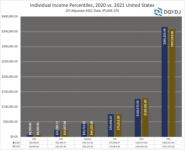
25% of Americans make $23k or less per year. and I would consider that to be super poor - https://cdn.dqydj.com/wp-content/uploads/2021/09/individual-income-us-2021-vs-2020.png

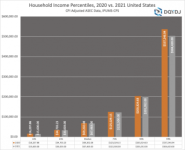
25% of American households make $34k or less per year. and I would also consider that to be super poor. it's difficult to live on that amount of money for a single person, let alone multiple people - https://cdn.dqydj.com/wp-content/uploads/2021/09/household-income-us-2021-vs-2020.png

if these people are getting a "literal free ride," it is my opinion that the only way they are gaming the system is by...having no money to begin with

re: payroll taxes, "most economists agree that employees bear the true cost of employer payroll taxes in the form of lower wages" - https://www.cbpp.org/research/feder...nd employers both pay,the form of lower wages.

Basically, salaries are adjusted lower to compensate for the cost of employer payroll taxes. Six of one, half a dozen of another. The benefits of eliminating payroll taxes would actually flow entirely to employees
 

Attachments

  • individual-income-us-2021-vs-2020.png
    individual-income-us-2021-vs-2020.png
    69.7 KB · Views: 0
  • household-income-us-2021-vs-2020.png
    household-income-us-2021-vs-2020.png
    67.4 KB · Views: 0
Attention everyone . . . these are issues you can't change. Put the keyboard down today and go shoot something for fun this afternoon. it is good for the soul!
 
Back
Top