Bigger factory LCD screens?

Doug: for someone who's never used the Gratical EVF (but I've used pretty good EVFs on other cameras), can you elaborate on the quality difference compared to the stock FX6/FX9 screen as used with the loupe? I don't doubt the difference but I was under the impression that the resolutions were similar (both 1280 vertical) so I'm curious to know how the Zacuto sets itself apart (aside from the better customization). I've been eyeing (pun intended) used Gratical EVFs on eBay for some time now but have yet to pull the trigger, mostly because I've been getting by just fine with the FX6 LCD screen, the FX9 loupe, and a 5" monitor if needed.

Good question, but very hard to answer because it's really something that must be experienced to appreciate. I don't think just comparing specifications tells the story because you're talking about two very different types of displays.

Here's what Zacuto says about the gratical:

Screen Dimension- 0.61” diagonal
Resolution - Full Display 1280x1024
Contrast Ratio - 10,000:1
Refresh Rate - 60Hz
Color Depth - 24 bit RGB
Luminance - 120-250 cd/m^2
Pixel Info - 2687.21 PPI
5.4 million pixels
16.7 million colors


Notice the number of pixels. That's 5.4 million dots packed into a .61" OLED screen that also has a10,000:1 contrast ratio. The glass diopter is optically very, very good, with plenty of range and very easy to change when someone else needs to look through. I use mine in workshops with several students so that's an important feature to me.

Compare that to the FX6's LCD panel (not OLED) which only has 2.76 million dots (50% fewer) spread out over a 3.5" area. Sony doesn't give any other specifications for the LCD, but I promise you it does not have 10,000:1 contrast or 24 bit color depth.

On top of superior picture quality, the Gratical also provides:

Custom Scaling/User Presets
Color Processor - RGB, saturation, brightness, contrast
Zebra Stripes - Customize width, color, thresholds
Vectorscope
Waveform (3D)
Histogram (RGB, Luma)
Audio Meters
Proximity Screen Saver
Outboard Tally Light
LUT import, creating & editing
Red Line Peaking (multi-color)
intense focus assist peaking --- (including edge enhance peaking)

False Color
Frame Store Feature
Test Pattern (color bars & Macbeth)
Four programmable buttons
Frame Rates - 23.98p, 23.98PsF, 24p, 24PsF, 25p, 25PsF, 29.97PsF, 30 PsF,50i, 50p, 59.94i, 60i, 60p


That's a lot of punch for a $1700 viewfinder. The only viewfinder I've ever used that comes close to the Gratical is the EL30 that I have on my Z750. And that is a $6200 viewfinder.
 
Last edited:
I should add that I've always been a fan of the LCD + diopter extension tube design of the FS7 and FS9, so I'm not complaining about that design. In fact, I still use the stock viewfinder setup on my FS7 and have no complaints. But on the FX6 there is no diopter extension tube for the LCD, so a solution needs to be found so that you have a proper EVF. Also, even if the FX6 did have a diopter to go over the LCD panel -- how are you gonna use touch-tracking?? And anyone who says they won't use touch-tracking on the FX6 is a fool. So, with all things considered, the Gratical or Kameleon are great additions to the FX6.
 
Thanks for the replies, Doug. I'll have to try out a Gratical for myself.

I used touch tracking for the first time at a track event last weekend (cars) and it was fantastic. Much like the internal variable ND it's become a feature that I now can't imagine living without.
 
The issue for the manufacturer isn't cost of the LCD or its size. It's all about power. The bigger, brighter, great contrast, higher resolution, etc. the more power the panel will consume. Most of the time the restrictions on a camera as to what features are offered is a question of power management. There's only so much available juice so decisions are made. There is usually a list of hundreds of little items and functions and they all have associated power draws. Then decisions are made. This is especially restrictive in mirrorless and other tiny cameras that use the tiny little "chocolate bar" batteries. These batteries can only output a relatively modest amount of power. It's not a question of buying more batteries because you'd run through them quickly -- they can only blast out so many amps at a time before they would overheat.

It's all about power management.

Thanks Mitch. I was thinking of run time which is not a big problem with the large optional batteries many of these cameras can use, and not amp draw of a ~5 inch screen. I see where this could be a problem now.

I would still prefer using a larger/heavier battery capable of the load. It would be heavier, but still less hassle than to rig up a 2ndary monitor and power for it. How about you guys?

Is it possible in something like a CX350 or FX6 style camera to have a removable/replaceable monitor?
You could run it with the 3" screen with the regular batteries when you want to,
but then you could pull off the small screen and plug on a larger screen in it's place and also swap battery with a longer one that it also capable of higher amp load?
 
...as part of a larger push by camera companies to make cameras that do not need to be rigged out with external monitors, recorders, ND filters, etc. All of that is in the name of story & art, not tech toys. I want the tool to disappear, and as soon as you are on the field as a solo op and have too many things attached or dangling about, the rig gets cumbersome and takes a lot of time to re-adapt for different scenarios.

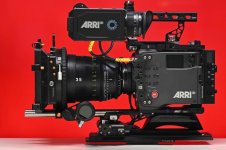
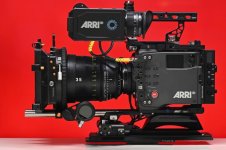
ARRI-ALEXA-35_05-1536x1023.jpg


Internal ND, Records ProRes and ARRIRAW Internally, so no need for external recorder, Awesome VF and 4" Flip-Out Screen. The way the real estate market is right now, you could probably sell your house and get a couple of these. Keep one and re-sell the others for more than you paid and get another house. :cool:

Or if you don't want to sell your house, grab a used Amira, if you can accept the smaller flip-out. :wink:
 

Attachments

  • ARRI-ALEXA-35_05-1536x1023.jpg
    ARRI-ALEXA-35_05-1536x1023.jpg
    70.5 KB · Views: 0
Filmguy123 said it better than me
"Now, look at the GH6 - able to record ALL-I 800mbps codecs internally to CF Express, and even ProRes. Nice. And IBIS means you can often forego physical stabilization for many scenarios. If you added to that a 5" super bright, high resolution HDR display you'd completely kill of the need for external monitors/recorders for most people while keeping a very small, light, streamlined package. If you added that to an internal electronic VND, or sensor-level ND dimming (a feature of future organic sensors) then we'd really be talking."

Yes. That is what I want. But then we wouldn't buy another camera for a long time, now would we? :thumbsup:
 
I want the tool to disappear, and as soon as you are on the field as a solo op and have too many things attached or dangling about, the rig gets cumbersome and takes a lot of time to re-adapt for different scenarios.

This was part of why I ultimately moved from a GH5 to an Fs5, and now FX6—although both of the latter could benefit from better LCD screens. Needing to attach an XLR unit, carry various ND filers in various sizes and with various step-up rings, attach a cage, etc., was really slowing me down in certain situations.

My not-so-hot take is that we could have had a world in which large-sensor camcorders covered all that you're asking for, but the DSLR/mirrorless craze meant companies (and consumers) moved away from the camcorder market.
 
Back
Top