Best portable hardware for interviewing people while travelling.

kcomplex

New member
Hope this is the correct section i'm posting in. I will be travelling around asia and i want to interview the locals that i meet on the way. I want equipment that will enable me to do it to a professional standard if possible. I have about 1500 GBP to spend.

This is my first step researching this so i;m really looking for a foothold. Obviously i will need a camcorder capable of recording long periods, decent mics and reliable storage devices for backup.

I already have a laptop and editing software. Do you think portable lighting equipment would be necessary as well? It would be much appreciated if someone could be so kind as to give me some advice on what sort equipment i should be looking at. Thanks.
 
With that money, I'd consider this setup. There are some downsides, but you can get great picture and sound quality. (Note: I own all of the equipment I'm talking about here, and am currently using it to shoot a documentary in Asia)

Canon 60d (body only) -- £722.40
Canon 50mm f/1.4 -- £294.48
Zoom h4n --
£259.00

Then add on to that whatever lav mic you'd like, and a cable, you can probably find that for around 200 GBP. Check out the Countryman EMW, it will be a bit less than that and is still quite good; I've heard the B3 and B6 are also good. And there are plenty of other companies that make good lavs too. I like the countryman lavs because the quality is good and they are tiny. So, so small.

Advantages of this kit:

Ultra-portable.
You can fit all this stuff into a very small camera bag, even with extra batteries and SD cards. And it's relatively light. If you're traveling a lot, that's a huge plus. Trust me, after dragging around a big camcorder through crowded train stations and stuff, you're going to hate your life. The OTHER camera we shoot with is an HMC 150, and I love it, but it's big and bulky compared to a 60d, and the weight gets old after a while. Carrying the 60d and a lens, some batteries, and a zoom h4n, you can fit all that stuff in a medium-to-large sized purse if you wanted to. And it's not heavy. We carry the 60d with the double battery grip, three additional batteries, and two lenses in our bag and it's still both small and quite light, especially compared to the giant hard case the HMC and our wireless and shotgun mics are in.

Low Light Friendly. DSLRs are great in low light, and with this f/ 1.4 lens you'll be able to shoot in basically any conditions, which (believe me) is helpful in Asia. Depending on who you're shooting (poor people?) you're often going to be in apartments that are poorly lit, may or may not have windows at all, and you're going to need something that can shoot in those conditions without getting all noisy. DSLRs are basically your only option for that in this price range. Having this setup allows you not to worry about lighting -- or at least, not worry about your image being underexposed. You can always buy an LED light with a dimmer switch to put on top of the camera if you want to carry lights with you, but any more than that is gonna get heavy fast, and be a pain in the ass cuz you'll need more batteries, etc....

Upgradable. If in the future you want to shoot other things, all you need to do is buy another lens. This one is really only going to work for interviews -- and you'll need a tripod -- because with the crop factor it's more like 75mm and if you shoot handheld it will be too shaky. However, you can buy a more versatile zoom lens to add to the kit for pretty cheap if you like, and if in the future you want to upgrade to a full frame camera like the 5D Mark II, your 50mm f/1.4 will still work. So both the body and the lens are "upgradable". Similarly, if you want to upgrade to a more expensive mic in the future and even use two mics at once, the zoom h4n has two XLR inputs and so can easily accommodate your needs.

Disadvantages of this kit:

Separate sound. Setting up sound separately can be a pain, and you have to sync it in post. However, syncing it really isn't that hard even if you're doing it by hand. You can also get programs to do it for you (FCP X does it automatically, Pluraleyes plugin for most editors also does) but I still do it by hand because it only takes two seconds anyway. And doing sound separately by yourself is doable as long as you're only shooting interviews. It's not ideal, but every kit is a compromise.

Recording time limit. As I'm sure you know, these cameras can only record for 12 minutes at a time. This is a pain in the ass for interviews, but assuming you don't need footage of yourself asking the questions, it can be fine. Ask a few questions, and when you're getting close to the 12m mark (there's a counter on the camera of how long you've been recording) wait till you're asking your next question, then stop and start it again. This is a pain in the ass in post because you have to sync a bunch of clips instead of one, but again, it's definitely doable. (Note: this may not be an issue if you get a Panasonic GH2 instead; see below)

Not very versatile. If all you have is the 50mm lens, bascially all you can shoot is interviews. I mean, you can shoot other stuff with it, but it will be a challenge and you'll need the camera on a tripod because of the crop factor, handheld is just too shaky unless you're a ghost and can glide around or something. And it's terrible for shooting a whole room or a huge bit of outdoor scenery, again because it's so zoomed in. It really works best shooting people, and best when those people aren't moving around too much. But you said you wanted to shoot interviews -- it's great for that -- and if you want to shoot other stuff, as mentioned above, all you have to do is buy another lens (if you're pressed for money, you can get old manual Nikon lenses (be sure it has a manual aperture) for cheap off ebay, and then use a cheap converter to mount it on your Canon (or any camera, really).


Like all kits, it's a compromise. But if you're traveling, having something light is important, and the image quality you can get from a DSLR (as you probably know) is amazing. It means a little extra work in post, and a little extra setup before your interview for sound, but I think it's worth it. I've shot plenty of interviews like this, and while it's not perfect, I've shot things I couldn't get otherwise. For example, two of our subjects live in apartments that are simply too dark to shoot with our HMC 150, period. WIthout the 60d and the f/1.4 lens, we'd have to shoot them outside or something (which presents its own set of problems, especially in Asia where private space is hard to come by and there's lots of noise pollution in cities.

That said, I'd also HIGHLY RECOMMEND you look into the Panasonic GH2. I haven't used it, but I've heard very good things, and it does solve a few of the problems of the Canon DSLRs (for example, if you use it with the panasonic lenses, you can actually autofocus in video and it works; this is not possible with the Canons). I think that it also doesn't have the 12-minute time limit, but I'm not sure about that as I've never used one. That would be another advantage to it. It's also cheaper. However, I don't know how well it does in low light. Because the sensor is smaller, I assume it's not as good as the 60D, but I'm not sure whether it's a significant difference. But you can get a GH2 with 14-44mm kit lens for about the same as the Canon 60d body, so if you want to shoot other things too, that might be a good option (get that, and buy a good fast portrait lens for your interviews.)

You could also go the camcorder route, but depending on the quality you're looking for, it's going to be hard to get something good in that price range. Plus there's the low-light issue, and even with a great camcorder, you still have to buy a good mic! I think the 60D (or GH2) are the perfect marriage of manual controls, image quality, and portability. Plus, they're very innocuous so it's easy to sneak around with them if you're trying to stay under the radar!

Anyway, like I said, I've used the 60D for interviews in China, and I've also used a larger and more expensive HD camcorder (the Panasonic HMC 150). Let me know if there's anything else I can help with. I just shot an interview with the 60D the other day and may have some footage up soon if you'd like to see. But you can easily find tons and tons of canon dslr interview footage on vimeo. (remember, t2i, t3i, 60d, and 7d are all the same sensor, so the image is basically the same on all of them; the difference is more control as you get higher in price, and also the 60d and t3i have the rotating swivel screen, which is super useful for video, though you may not need it for interviews too much...)

Oh, one more thing: buy this stuff before you go! Pro audio and video gear can be a pain in the ass to find in Asia, depending on what country you're in, and sometimes it's also way expensive because it's imported and/or rare. Definitely, definitely buy before you go if at all possible. If not, well, I can recommend a trustworthy camera shop in Beijing, but I hear Hong Kong and Singapore are the best places to go for this kind of great.
 
Last edited:
...Because you are working on a small budget, I would recommend startiing with the Panasonic GH-2 plus the 14-42mm kit lens which is a bit slow but a good general purpose zoom. ( especially when you are only paying £ 70 for it ) There is a great hack available for the GH-2 that enables European users to have unlimited filming time ( unlike the Canon DSLRs ), so you can film as long as your battery lasts and memory card has room. A new rumor has popped up that Panasonic will be adding the 25P PAL frame rate to the GH-2 via a new firmware upgrade.

Panasonic GH-2 Body + 14-42mm kit lens £ 615.00

Next I would buy a good Nikon F mount to Micro 4/3 lens adapter, so you can then buy used Nikon AI-S manual focus lenses which are sharp, fast, and fairly cheap. This MetaBones adapter is a clone of the more expensive Voightlander adapter, and provides a solid fit for any manual focus Nikon F mount lens. ( You can also use it with autofocus Nikon lenses, which cost more and don't offer any benefit over a used Nikon AI-S manual focus lens ) A Nikon AI-S 50mm f/1.4 is a great low-light interview lens, that should not be too hard to find used.

Metabones Nikon F to M4/3 Adapter £ 55

NIKKOR 50mm F1.4 FAST Nikon Ai-S £ 150+

For audio you might want to look at buying a Zoom H1 ( great little recorder for £ 77 ) and a Rode VideoMic Pro ( £ 135 compact mini shot-gun with very good sound ), you will then have the option of sending the VideoMic Pro signal directly to the GH-2 ( something I do quite often, just be sure to check your levels visually, as there is no easy way to monitor when the audio is going directly to the camera ) or to the Zoom H1, or you can record with both units simultaneously. ( Rode VideoMic Pro in to the GH-2, Zoom H1 placed just out of shot as a second audio recording ) You can also purchase a low cost LAV mic which will plug-in to the Zoom H1, and hide the Zoom H1 as a body-pack on the person being interviewed. You will have to investigate cheap LAV mics, as all of the ones I am familiar with are fairly expensive. NOTE: The GH-2 uses a 2.5mm audio input so you will need to purchase a 3.5mm to 2.5mm audio adapter to feed signal to the GH-2 camera directly.

Zoom H1 Recorder £ 77

Rode VideoMic Pro
£ 135

Lastly you might want to look at buying a Manfrotto 561BHDV-1 Fluid Video Monopod which costs about £ 145. This is one of the most useful pieces of video gear that I have ever bought. It's fairly compact, enables smooth panning shots, and even works as a make-shift steady-cam in a pinch. Make sure the model you buy has the RED base ( this is the new model ) as the old model has the BLACK base which tends to stick when panning.

Manfrotto 561BHDV-1 £ 145

How to Use a Video MonoPod
 
In my opinion, unless you are a still photographer go with a camcorder not a video dslr

I strongly disagree, for the reasons stated in my first post. Camcorder that can rival DSLR image quality is going to be bigger, and the low light issue can be MURDER traveling in asia. If you carry a camcorder, you're going to have to carry lights, too. If a $3,000 HMC 150 can't handle half of the interview settings I run into in China, there's no way this guy is going to be able to find a camcorder that can deal with that that's anywhere near his budget. And carrying lights just means more heavy crap that breaks easily -- not a great thing when you're trying to squeeze through a single door alongside 5,000 other people at a train station.

I'd also recommend against the rode videomic. It might be convenient, but plugged straight into a DSLR you can't monitor the sound, so you won't know till after the interview is OVER that some glitch ruined it. Plus, I've never been super impressed with its sound quality, and for an interview where your subject is stationary, you can get MUCH better sound just as easily with a wired lav, for the same price. If you want moving interviews, then you'd need a wireless kit, and probably wouldn't want a DSLR either, but that's going to be out of your budget.
 
Last edited:
To OP: Unless you love photography and have done a lot of shooting with DSLR already, be cool. No need to go with a DSLR camera.

You have about 1500 GP => US $2500. My suggestion is:

1) Go with a high-end consumer camcorder, such as Panasonic TM900K. as your main video camera.
2) Get a waterproof, weather proof, dust proof 1080p-capable P&S camera, such as Panasonic TS3, as your 2nd video camera.
3) Get Sony PCM M10 audio recorder as your main audio recorder (with the 2 built-in mic on the 2 cameras, you now have 3 audio recorders!).
4) Get one or two battery-operated LED video lights (with 126 to 160 small LED lights), a small video (not photo) tripod system, a small but sturdy monopod, a pair of monitoring headphones (for monitoring your recorder), Audio Technica lavaliere ATR-3350 (or similar), Rode Video Mic Pro or Rode NTG-2 shotgun microphone, enough AA rechargeable batteries with charger, at least 2x 3TB external hard drives, a gorilla pod (for running 2 cameras at the same time), and other needed accessories such as a backpack, from Amazon.com (or somewhere else) for lowest possible price.


:cheesy:You'll be set to shoot video and record audio with a dual A/V system under all weather, all terrain, all lighting conditions, anywhere and any time!:cheesy:
Isn't it cool?:love4:

FYI:

- Why not Zoom H4n? For the price, H4n has relatively noisy preamp and weak gain. If you want pristine audio quality, go for Sony M10, which is cheaper than H4n. Among all audio recorders under $300, M10 is about the best from the point of view of recording quality. Also, M10 is very small, very easy to use, and has a very long battery life. The only relevant feature that H4n has but M10 doesn't is 12-48V phantom power supply. But if you don't use a microphone that requires phantom power, then that feature is irrelevant. BTW, I just ordered my M10 from B&H, which will be delivered in 2 days.

- A high-end consumer camcorder like TM900K, can shoot very well in very low light. My TM700K can shoot subject a few feet away lit with just the light from a 9" or 12" small LCD TV. And TM900K performs officially 50% better in low light than my TM700K. With 1 or 2 portable video lights, you can use TM900K to do interviews in the otherwise completely dark environment.

- Actually, even if you do love photography and have 1 or 2 dSLR bodies already, you could still go with my suggestion for getting your job done. You can then switch between different cameras for different looks.

- BTW, if you really want to go for a cheap Canon video DSLR, and if you just want one and only one cheap lens, get a Sigma 30mm or a Zeiss 35mm lens or similar, as opposed to a 50mm lens (too long for you). Or go with a wide constant-aperture zoom lens, such as 17-55mm/f2.8.


In my opinion, unless you are a still photographer go with a camcorder not a video dslr

I second this.
 
...A camcorder would be a lot easier to shoot with, but you have to live with pretty much everything in focus all the time. ( great when you want it, but useless when you're trying to isolate your interview subject from a busy environment )

The Canon G10 camcorder ( 1/3 inch large photo-site/low-light sensor ) is very good in dim-light, but it will eat up most of your budget once you've added on a few long-lasting batteries, and this camcorder only shoots low-res 2 Mpx still photos.

The Panasonic TM900K ( 1/4 inch sensor ) is a lot cheaper, has fantastic stabilization, produces a beautiful image provided there is enough light ( it's not a great dim-light camera), and shoots 14 Mpx still photos. This would be my first choice for a camcorder within your budget range, so you are able to add on audio gear and a good monopod or tripod.

For audio recorders, the Sony M10 is affordable and records great line-in audio, but the built-in mics are pretty limited. This is why I would choose the Zoom H1 over the Sony M10, the H1 mics are suprisingly good for a cheap recorder.

Compact LED lights produce pretty ugly looking light. ( too contrasty and low CRI rating ) I would only use these if I had no other option. Personally I would look at a small 32 inch collapsible silver reflector, that folds down to a 10 inch disc. This makes for a handy fill-light to reduce contrast when shooting under a directional light source. Some people like the silver/gold combo reflectors, but I usually find the "gold" reflection a bit fake looking, so I opt for the silver/white version instead.
 
I'd also recommend against the rode videomic. It might be convenient, but plugged straight into a DSLR you can't monitor the sound, so you won't know till after the interview is OVER that some glitch ruined it.

Which is why I would recommend always using two or more audio recorders. ( Rode VideMic Pro plugged in to the camera, and a Zoom H1 out of frame or used as a body-pack with a LAV mic. You now have two audio tracks to choose from ) If you absolutely must monitor your audio ( it's a good idea when you can ), you can plug the Rode mic into a portable digital recorder and monitor with the headphone output. BTW, the Panasonic GH-2 built-in stereo mics sound pretty good, but your subject has to be right on top of the camera or the sound source has to be quite loud. ( the Canon camera mic pales in comparison )

Plus, I've never been super impressed with its sound quality, and for an interview where your subject is stationary, you can get MUCH better sound just as easily with a wired lav, for the same price.

It's worth checking out. Philip Bloom uses this Rode mic in many of his films. ( check his site for a review and many samples of this mic in action ) Yes it's not as good as a mid-priced LAV mic, but LAV mics have their own problems with clothing noise if the subject moves around during the shoot. Personally I've had more noise issues from LAV mics than external mics.
 
heh .. heh. I've been in some hairy situations in asia. In several different countries.. I can just imagine myself now, fumbling with lens swaps and audio sync during the pouring rain of monsoon or a rickshaw mad market place in par ganj. And did you know monkeys get trained to steal from your luggage while you're sleeping on a train? Asia is beautiful, wild, wonderful and unpredictable. Be prepared for anything and travel light.

Then again you might be only shooting from the comfort of your hotel room. What do I know?
 
Then again you might be only shooting from the comfort of your hotel room. What do I know?

The original poster stated that the primary purpose for this camera is: "i want to interview the locals that i meet on the way", and they also want to produce something close to a professional standard. Built-in consumer camcorder mics are not going to cut it, though a good consumer camcorder like the TM900K can shoot a beautiful image, you still have to add good mics and a digital audio recorder if you want usable sound.
 
- A high-end consumer camcorder like TM900K, can shoot very well in very low light. My TM700K can shoot subject a few feet away lit with just the light from a 9" or 12" small LCD TV. And TM900K performs officially 50% better in low light than my TM700K. With 1 or 2 portable video lights, you can use TM900K to do interviews in the otherwise completely dark environment.

Yeah, but they still don't come anywhere close to DSLR capabilities. The sensors are just too small. Sure, you can use LED lights but then (1) that's extra gear to carry and (2) they usually look pretty awful. I suppose it depends on the look you want, but I've got a portable LED light myself, and the only situation I'd ever use it in would be pitch black, if I absolutely needed the shot and there was no other way. Of course, you can buy more expensive ones that are nicer, but again, that's more money and more to carry (and break) while traveling.

Plus, OP said he wants professional-standard footage. Even the best consumer camcorder really isn't going to provide that, and as someone else said, if you're shooting in an area where you want to make the subject pop out of the background using shallow DOF, good luck pulling that off with a consumer camcorder....

- BTW, if you really want to go for a cheap Canon video DSLR, and if you just want one and only one cheap lens, get a Sigma 30mm or a Zeiss 35mm lens or similar, as opposed to a 50mm lens (too long for you). Or go with a wide constant-aperture zoom lens, such as 17-55mm/f2.8.
Those lenses would be fine too, but the 50mm works great. OP said he just wanted it for interviews, and the 50mm is not too long for that, even on a crop sensor. I shoot all my interviews with that lens, and they look fantastic. Many of them are shot in pretty small spaces, but for a typical interview framing, you really only need to place the camera 4 or 5 feet away from the subject even with a 50mm lens and a 1.6 crop factor.

That said, a 17-55 zoom could be great. Only thing is that f/2.8 is still a little slow for some of the situations one might encounter.
 
To OP: Unless you love photography and have done a lot of shooting with DSLR already, be cool. No need to go with a DSLR camera.

You have about 1500 GP => US $2500. My suggestion is:

1) Go with a high-end consumer camcorder, such as Panasonic TM900K. as your main video camera.
2) Get a waterproof, weather proof, dust proof 1080p-capable P&S camera, such as Panasonic TS3, as your 2nd video camera.
3) Get Sony PCM M10 audio recorder as your main audio recorder (with the 2 built-in mic on the 2 cameras, you now have 3 audio recorders!).
4) Get one or two battery-operated LED video lights (with 126 to 160 small LED lights), a small video (not photo) tripod system, a small but sturdy monopod, a pair of monitoring headphones (for monitoring your recorder), Audio Technica lavaliere ATR-3350 (or similar), Rode Video Mic Pro or Rode NTG-2 shotgun microphone, enough AA rechargeable batteries with charger, at least 2x 3TB external hard drives, a gorilla pod (for running 2 cameras at the same time), and other needed accessories such as a backpack, from Amazon.com (or somewhere else) for lowest possible price.


:cheesy:You'll be set to shoot video and record audio with a dual A/V system under all weather, all terrain, all lighting conditions, anywhere and any time!:cheesy:
Isn't it cool?:love4:

FYI:

- Why not Zoom H4n? For the price, H4n has relatively noisy preamp and weak gain. If you want pristine audio quality, go for Sony M10, which is cheaper than H4n. Among all audio recorders under $300, M10 is about the best from the point of view of recording quality. Also, M10 is very small, very easy to use, and has a very long battery life. The only relevant feature that H4n has but M10 doesn't is 12-48V phantom power supply. But if you don't use a microphone that requires phantom power, then that feature is irrelevant. BTW, I just ordered my M10 from B&H, which will be delivered in 2 days.

- A high-end consumer camcorder like TM900K, can shoot very well in very low light. My TM700K can shoot subject a few feet away lit with just the light from a 9" or 12" small LCD TV. And TM900K performs officially 50% better in low light than my TM700K. With 1 or 2 portable video lights, you can use TM900K to do interviews in the otherwise completely dark environment.

- Actually, even if you do love photography and have 1 or 2 dSLR bodies already, you could still go with my suggestion for getting your job done. You can then switch between different cameras for different looks.

- BTW, if you really want to go for a cheap Canon video DSLR, and if you just want one and only one cheap lens, get a Sigma 30mm or a Zeiss 35mm lens or similar, as opposed to a 50mm lens (too long for you). Or go with a wide constant-aperture zoom lens, such as 17-55mm/f2.8.


I just had to stick my nose in this. Ordinarily, I think video cams are the way to go. The recommended Panny TM900k has the same chips and guts as my HMC40, which is a terrific cam except for one thing; it really isn't very good in low light. And most any DSLR with a fast lens will do much better. So while I think the TM900k or the HMC40 are good choices for video, if low light performance is needed, then not so much. The HMC40 is larger than the TM900, but has much more manual control and for the most part runs like a pro video cam. It does have a couple of quirks, but the IQ can be stunningly good as it sports a full raster image. When traveling, I pack one in a small sling and can get a pretty complete kit in it. With the MY30 audio widget, you can power and use XLR microphones which is a huge advantage. If the OP is going to go solo, with no help, having the audio on the cam is going to much much easier. So here is an alternative suggestion:

HMC40 + Audio Adapter $2000USD and there are quite a few used available also.
AT875 XLR shotgun mic + shock mount, fuzzy, mini-boom pole. $350USD This is about the smallest real shotgun out there.
Countryman EMW lav $175. A very good, durable, entry level lav.

Add a modest portable LCD on cam light $100.

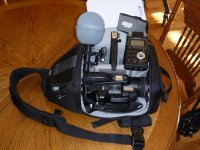
OK, with memory and battery I have run your budget a little north of $2500USD, but this is a kit which can really deliver and has much fewer compromises than a DSLR. In the photo, it shows a DR-100 with a hyper and baby ball gag, but you get the idea. A 5 section boom pole or monopod easily straps on the outside I can pack this rig all day and not feel any burden at all.

Grant
 

Attachments

  • CompactKit.jpg
    CompactKit.jpg
    111 KB · Views: 0
I just had to stick my nose in this. Ordinarily, I think video cams are the way to go. The recommended Panny TM900k has the same chips and guts as my HMC40, which is a terrific cam except for one thing; it really isn't very good in low light. And most any DSLR with a fast lens will do much better.

I did not find a direction video comparison between HMC40 and TM900K. But I found a comparative video review of HMC150, HMC40 and TM300. The link: http://www.youtube.com/watch?v=M_mR_uQymd8&feature=related. The reviewer, who obviously knows how to shoot video professionally, made a comment that TM300 (2 generations older than TM900) appears to be doing a little better in low light than HMC 40 (though he also said he wasn't sure). If TM300 performs so well as compared to HMC40 and HMC150, TM900 can only do a much better job in low light.

Video review of TM900 in extreme low light: http://www.youtube.com/watch?v=M_mR_uQymd8&feature=related and http://vimeo.com/20962097 : this test shows how well TM300 is able to capture a scene of an entire room from front to back that is lit by just LCD monitors. His test implies that if someone interviews people close to a LCD monitor with a TM900 (technically) you don't need any extra lighting to get the shot.

Additionally, TM300/700/900 all have a special night mode, which allows them to shoot just about everything in the dark that our naked eyes can see. Surely the footage shot in this mode is very noisy, but the good thing is: they are able to get the shot with available light (more accurately, with lack of light). For a video DSLR camera to do that, you will need a very fast lens, and very likely have to use extra high ISO (12800 to 102400) just to get the shot. I know 1D Mark IV can do that without any problem, but the footage is also very noisy.

Here is an unedited footage showing the performance of TM900K in capturing a night scene on a dimly lit street: http://www.youtube.com/watch?v=rLi4q2Unt48&feature=related.

In terms of image quality and low light performance, I doubt HMC 40 (quite old now) is better than TM900 (2011 product). I think the only advantage of HMC40 over my TM700 (let alone 900) is that it's bigger so it is easier to handle/operate. But TM900 can be controlled fully manually (just like HMC40), can capture beautiful 28Mbps Full HD video at 1080p60p (superior to HMC40), and is a lot cheaper (than HMC40). Additionally, TM900 can be used to shoot 3D footage.

I don't want to sound like TM900 is the best option to OP, as I really don't know anything about him or her, about what interviews s/he will be doing, etc. My point is: even if s/he doesn't pick it for whatever reason, TM900 is a camera more than good enough for shooting interviews, up to whatever professional standard on your mind that is not beyond the reach of the budget of merely $2500.
 
Yeah, but they still don't come anywhere close to DSLR capabilities. The sensors are just too small.

TM900 has 3 chips with 9MP total, more than enough to capture and render beautiful 2MP video at 1080p 60p full time. If you see this in action, you will unlikely say that again.

It's not an SLR, so it looks different, which is neither good or bad by itself. For interview shooting purposes, decent camcorders like TM900 have certain advantages where none of Canon SLR cameras can even compete at the time: for example, TM900 doesn't have the record limit of 12min, doesn't overheat, doesn't suffer a lot from all sorts of aliasing issues that have been plaguing those SLRs. It has butter smooth 12x optical zoom, very fast and accurate AF, is easier to get steady shots without shoulder/tripod support, etc. The only big thing it can't do is to achieve shallow DoF in normal to wide shots, so it can't produce beautiful bokeh that easily. It also typically has more noise in low light compared to DSLR footage shot at high ISO with expensive lens and body. However, it can capture nearly everything your eyes can see and your ears can hear, without additional equipment - and all shots can be done in 1080p resolution at 60p with 5.1 realistic surround - this is the greatest advantage over all video DSLR on the current market. My only big complain about TM700 is that it won't allow me to manually adjust audio level without stopping recording, and TM900 probably has the same issue too. Surely, if you want that cinema look without a big budget, 5D2, 7D, GH2, etc, are the only way to go at this time. My 700K does support a cinema color mode (I believe 900 does too), but the result doesn't look as good. Anyway, merely for the purpose of documenting something (such as an event or an interview), I believe TM900 is more than good enough.

Here is a side by side comparison of TM900 (~$1000) with HMC40 (~$1700 at this time): http://ctest.slashcam.com/compare-what-i-cmp-u-cmd-i-view-u-mode-i-docompare-u-lang-i-en-u-id-i-130-y-185-u-name-i-Panasonic HDC-TM900-u-bname-i-Panasonic AG-HMC40-u-cmd-i-vergleich.html As you can see, in many ways TM900 has surpassed HMC40. However, despite its technical capabilities, TM900 is still a consumer camera. If you do a big job with a TM900, you probably can't expect others to take you seriously.
 
Last edited:
TM900 has 3 chips with 9MP total, more than enough to capture and render beautiful 2MP video at 1080p 60p full time. If you see this in action, you will unlikely say that again.

I'm not saying the IQ is bad, I'm saying it can't handle low light as well as a DSLR because a DSLR has a bigger sensor.

It's not an SLR, so it looks different, which is neither good or bad by itself. For interview shooting purposes, decent camcorders like TM900 have certain advantages where none of Canon SLR cameras can even compete at the time: for example, TM900 doesn't have the record limit of 12min, doesn't overheat, doesn't suffer a lot from all sorts of aliasing issues that have been plaguing those SLRs. It has butter smooth 12x optical zoom, very fast and accurate AF, is easier to get steady shots without shoulder/tripod support, etc. The only big thing it can't do is to achieve shallow DoF in normal to wide shots, so it can't produce beautiful bokeh that easily. It also typically has more noise in low light compared to DSLR footage shot at high ISO with expensive lens and body. However, it can capture nearly everything your eyes can see and your ears can hear, without additional equipment - and all shots can be done in 1080p resolution at 60p with 5.1 realistic surround - this is the greatest advantage over all video DSLR on the current market. My only big complain about TM700 is that it won't allow me to manually adjust audio level without stopping recording, and TM900 probably has the same issue too. Surely, if you want that cinema look without a big budget, 5D2, 7D, GH2, etc, are the only way to go at this time. My 700K does support a cinema color mode (I believe 900 does too), but the result doesn't look as good. Anyway, merely for the purpose of documenting something (such as an event or an interview), I believe TM900 is more than good enough.
I'm sure it is good enough. These days, there are hundreds of cameras that are "good enough". In fact, OP could probably get the job done with a good ol' DVX-100. But we're talking about which option is best.

Here is a side by side comparison of TM900 (~$1000) with HMC40 (~$1700 at this time): http://ctest.slashcam.com/compare-w...e-i-Panasonic AG-HMC40-u-cmd-i-vergleich.html As you can see, in many ways TM900 has surpassed HMC40. However, despite its technical capabilities, TM900 is still a consumer camera. If you do a big job with a TM900, you probably can't expect others to take you seriously.

The TM900 doesn't have ND filters? Yikes. To be honest, built in NDs is one of the big reasons I might advise someone to choose a camcorder over DSLR these days, because dealing with separate filters can be a pain. It also doesn't have expanded focus, waveform view, XLR inputs, no external white balance control....it does look like it's capable of similar IQ to the HMC40, but it's missing a lot of the features that make shooting with a camcorder so convenient (mostly ND filters and XLR inputs). And since neither of them can really compete with a DSLR in terms of cinematic look or in terms of low light capabilty.

For example, check out this test video we shot with the canon 60d and 50mm f1.4 lens. It's in a city, so there's a bit more natural light than in your test videos, but most of this was shot at extremely low ISOs (100-300, mostly). The last shot is 1600 ISO (the 60D goes up to 3200) and even with that you can see that there's really no noise (although the compression for web has muddied-up the colors a bit, especially the brown of the sweatshirt).

http://vimeo.com/22608692
 
I did not find a direction video comparison between HMC40 and TM900K. But I found a comparative video review of HMC150, HMC40 and TM300. The link: http://www.youtube.com/watch?v=M_mR_uQymd8&feature=related. The reviewer, who obviously knows how to shoot video professionally, made a comment that TM300 (2 generations older than TM900) appears to be doing a little better in low light than HMC 40 (though he also said he wasn't sure). If TM300 performs so well as compared to HMC40 and HMC150, TM900 can only do a much better job in low light.

Video review of TM900 in extreme low light: http://www.youtube.com/watch?v=M_mR_uQymd8&feature=related and http://vimeo.com/20962097 : this test shows how well TM300 is able to capture a scene of an entire room from front to back that is lit by just LCD monitors. His test implies that if someone interviews people close to a LCD monitor with a TM900 (technically) you don't need any extra lighting to get the shot.

Additionally, TM300/700/900 all have a special night mode, which allows them to shoot just about everything in the dark that our naked eyes can see. Surely the footage shot in this mode is very noisy, but the good thing is: they are able to get the shot with available light (more accurately, with lack of light). For a video DSLR camera to do that, you will need a very fast lens, and very likely have to use extra high ISO (12800 to 102400) just to get the shot. I know 1D Mark IV can do that without any problem, but the footage is also very noisy.

Here is an unedited footage showing the performance of TM900K in capturing a night scene on a dimly lit street: http://www.youtube.com/watch?v=rLi4q2Unt48&feature=related.

In terms of image quality and low light performance, I doubt HMC 40 (quite old now) is better than TM900 (2011 product). I think the only advantage of HMC40 over my TM700 (let alone 900) is that it's bigger so it is easier to handle/operate. But TM900 can be controlled fully manually (just like HMC40), can capture beautiful 28Mbps Full HD video at 1080p60p (superior to HMC40), and is a lot cheaper (than HMC40). Additionally, TM900 can be used to shoot 3D footage.

I don't want to sound like TM900 is the best option to OP, as I really don't know anything about him or her, about what interviews s/he will be doing, etc. My point is: even if s/he doesn't pick it for whatever reason, TM900 is a camera more than good enough for shooting interviews, up to whatever professional standard on your mind that is not beyond the reach of the budget of merely $2500.


Henry,

The TM900 has the same chips and codec as the HMC40, this has been discussed in some detail in the HMC40 threads. The TM900 will record 1080/60P, though editing that footage is another question, and not everyone in the world would prefer 60fps except for action. The TM900 has some consumer oriented features which the more professional HMC40 might not have like some electronic image enhancement for night shooting. But that is all it is. It is still a 1/4" sensor x3 cam recording to AVCHD. Even if the IQ is equal, the HMC40 has more manual controls which will make location shooting easier, and the audio abilities cannot be compared at all; phantom powered XLR vs 1/8".

Much of what you state, that the high end Panny consumer cams are very good, is true. There might be good reasons to use the TM-900 such as budget and size. But I feel you are reaching a bit (quite a bit) to say that the TM900 would be the better cam for professional use.

Grant
 
Here is an unedited footage showing the performance of TM900K in capturing a night scene on a dimly lit street: http://www.youtube.com/watch?v=rLi4q2Unt48&feature=related.

...Owning a HS700 ( the hard-drive version of the TM700 ), a HMC-150, and a GH-2, I have to say that the YouTube sample you linked to is horrible when it comes to low-light shooting. All you see are the areas that are well lit, everything else goes solid black. The GH-2 would show you much more detail when shooting the same scene. The difference becomes huge when you put a fast lens ( like f/1.4 or f/0.95 ) on the camera.

The TM900 is a great camera, but it would be my last choice when shooting in dim light. Three 1/4 inch sensors just can't compete with a single Micro 4/3 sensor.
 
A lot depends if you were 'adventure' travelling - with backpack, roughing it. Or if you are just staying in a hotel in a safe area.
They key is in knowing how much exposure to damage and danger you and your equipment will be in. The original poster never stated the circumstances so really it is up to the individual to make their own call. But Asia is a place not to be underestimated.

When I travelled there it was long before pocket sized camcorders existed and I travelled in a lot of situations where equipment could get damaged or stolen. A $500 handheld camera would have represented more money than most locals would see in a lifetime and my hotel cost something like 50c a night. If you're travelling on your own in wild exotic places then take something palm sized and inconspicuous like an HF100 and an external mic. If your a still photographer and need DSLR stills anyway then maybe consider going the DSLR route, so much depends on your individual situation.


Now THAT would be a good reason to go with a palmcorder.

Grant
 
Back
Top