Best Lens to use with Steadicam Pilot w/Dvx100b

benjaminsink

New member
Greetings forums, I'm new to the place.

I've been doing alot of real estate open house video tours where I use my steadicam to do a walkthrough of the particular house. I'm wondering what would be a good lens to purchase to better the shots. I know I need some type of wide angle I don't think I want to go fisheye as that would create more distortion than the average viewer online would want to see.

If you guys could throw me a few suggestions I would appreciate it, or direct me to a Topic that has already answered my question.
Welcome to the boards!


Wide angle lenses that handle perspective very well, are great tools for real estate video. The wide angle allows a good view of orientation and feeling of space, and at times may allow the space to appear larger. Wide angle also emphasizes movement when in relation to proximal objects, such as hallways and such. The key is to get as wide as possible with as little distortion as possible.

First of all, are you using a lens adapter? Or are you looking for an attachment, such as a wide angle converter? The DVX100b has a fixed lens, as you well know.

Unless you use a lens adapter, you'll have to use a wide angle converter. There are a couple types to pick from, and in the end if you don't find one that gives appropriate accurate perspective, you might need to create a 'mapping' post effect that accurately counters the perspective distortion your particular lens attachment gives.
 
0.jpg

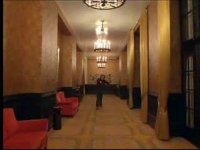
In the shining I like the perspective Brown uses throughout most of his shots. Keeping a a wide look through the halls, and giving a good perspective through the maze as he follows the wife and kid. I used to have a Century Optics .3x Mark 1 for my Vx1000. I don't want something so distorted though. What's a quality lens I could get for my Dvx to get shot perspective as shown in this screen shot.? I know I need some sort of wide angle but I just want specifics if any are out there.
 
John Alcott, BSC did a great job shooting that film. Strangely enough, I suppose because he is British, he didn't discuss lensing much at all in his 1980 American Cinematographer interview. They shot on an Arri 35BL and IIC, and sometimes, like in the hedge maze, were on a 24mm Zeiss Distagon, gathered from a joke in the AC article. That's all I remember. Looking at the film, I would gather they used a substantially wide lens, past the 24mm. But I do not know what it is.

Regarding your fixed lens camera, you have very little options with the wide angle converters.
 
Last edited:
View attachment 31971

In the shining I like the perspective Brown uses throughout most of his shots. Keeping a a wide look through the halls, and giving a good perspective through the maze as he follows the wife and kid. I used to have a Century Optics .3x Mark 1 for my Vx1000. I don't want something so distorted though. What's a quality lens I could get for my Dvx to get shot perspective as shown in this screen shot.? I know I need some sort of wide angle but I just want specifics if any are out there.

While others may have a specific lens that would work, the Wife had to get a $1500 Nikon lens for her wedding still photo work that had sufficient distortion correction to avoid 'bowing', etc. because of the wide angle.

When I did 4x5 work back in the olden days I had a 90mm Schneider Super Angulon, again to get the wide angle of view, and minimize distortion...

The problem that I've seen with the DVX100 which I have and the HMC-150(I think the HMC was worse...) which I rented, was the major distortion at 'wide angles'... As I say, I don't have a solution, other than the non-cheap Nikon lens
with an adapter...
 
So, the lenses were Zeiss SuperSpeeds... They used an Arri 35BL (and IIc) for steadicam work.

The IIc was bayonet mount in 1980, as was the Arri 35BL. However in 1980 the Arri 35BL-III was first offered in PL, but considering the film was released in 1980, they probably didn't use it, nor would it be compatible with IIc at that time. So there is a tiny chance it was PL, but since the IIc would have certainly been bayonet mount.

With that said, the SuperSpeeds MK. I were bayonet mount, while Mk II, and MkIII's were PL, but I think could be bought in bayonet. And I'm not sure when the MkII's were released. They might not have even been available either.

The article also mentions T/stops of T/1.4 at times, thus Superspeeds must have been the lenses.

All things considered, I'm 90% sure they must have used an Arri BL or Arri BL-II, with an Arri IIc for some steadicam work, all using SuperSpeed Mk.I bayonet mount lenses which were available in the following lengths:
Distagon 18, 25, 35mm
Planar: 50mm, 85mm

Perhaps, for really wide angles, they went to the older Standard Speeds, which had Standard speed MkII lenses at T/2.1 Distigon 10mm, 12mm, 14mm, 16mm, 20mm and 24mm... Notice 24mm versus the Super Speed Distigon 25mm.

The article mentioned the Distigon 25mm, so we know superspeeds were used because of this reason and T/1.4 maximum aperture.


So to answer your question.... the superspeeds widest was 18mm. The standard speed theory could go as low as 10mm. The FOV would be in relation to spherical 35mm motion picture film negative.
 
Last edited:
So can someone give me a link to what I should get and can it work with am hvx200 as well?

So, the lenses were Zeiss SuperSpeeds... They used an Arri 35BL (and IIc) for steadicam work.

The IIc was bayonet mount in 1980, as was the Arri 35BL. However in 1980 the Arri 35BL-III was first offered in PL, but considering the film was released in 1980, they probably didn't use it, nor would it be compatible with IIc at that time. So there is a tiny chance it was PL, but since the IIc would have certainly been bayonet mount.

With that said, the SuperSpeeds MK. I were bayonet mount, while Mk II, and MkIII's were PL, but I think could be bought in bayonet. And I'm not sure when the MkII's were released. They might not have even been available either.

The article also mentions T/stops of T/1.4 at times, thus Superspeeds must have been the lenses.

All things considered, I'm 90% sure they must have used an Arri BL or Arri BL-II, with an Arri IIc for some steadicam work, all using SuperSpeed Mk.I bayonet mount lenses which were available in the following lengths:
Distagon 18, 25, 35mm
Planar: 50mm, 85mm

Perhaps, for really wide angles, they went to the older Standard Speeds, which had Standard speed MkII lenses at T/2.1 Distigon 10mm, 12mm, 14mm, 16mm, 20mm and 24mm... Notice 24mm versus the Super Speed Distigon 25mm.

The article mentioned the Distigon 25mm, so we know superspeeds were used because of this reason and T/1.4 maximum aperture.


So to answer your question.... the superspeeds widest was 18mm. The standard speed theory could go as low as 10mm. The FOV would be in relation to spherical 35mm motion picture film negative.
 
Back
Top