Barry on the box

Did I read correctly that there will be an adapter soon for current Canon lenses that have no manual aperture control? That the adapter and camera will be able adjust aperture on current Canon lenses ?

If correct thats huge for anyone with alot of canon glass.
 
Did I read correctly that there will be an adapter soon for current Canon lenses that have no manual aperture control? That the adapter and camera will be able adjust aperture on current Canon lenses ?

If correct thats huge for anyone with alot of canon glass.

Yes.. You did read correctly.
 
Nikon adapter to follow

Nikon adapter to follow

A Nikon adapter is also in the melting pot but I forgot to ask Barry....Does it matter if you have full 35mm glass lenses or APS glass in other words is there a magnification to worry about like the 1.6x magnification using APS glass on a 35mm sensor.
 
If you put a 28mm APS lens on your camera, and then pulled that off and put a 28mm full-frame lens on that same camera, you'll find that the field of view is identical. Different types of lenses don't deliver a different field of view; only different focal lengths can do that. So a 50mm lens is 50mm is 50mm, whether it was made for APS-C, Super16, 35mm cinema, 35mm full-frame, 8x10 large-frame photography, or a 1/3" video camera.

What changes is that the smaller sensor sees less of the frame that the lens is generating.

So if you took an APS-C camera and put an 18mm EF-S lens on it, you would see a regular picture. If you then replaced that lens with an 18mm "full frame" lens, you'd see -- exactly the same picture. If you then replaced that lens with an 18mm Super16 lens -- you'd see exactly the same picture, but smaller and with a black vignetting circle around the frame.

Hope that makes sense. Usually people think about it the other way -- changing sensors, and then blaming the field of view difference on the lens. But the lens is the same field of view, regardless; what changes in the lens is the physical surface area of how big it projects its image.

If you took a 50mm APS-C lens and put it on an APS-C camera, it will project a regular image that fills the frame. If you took a picture on slide film, you'd have a 22x15mm color image. Okay, so now take that same APS-C lens and put it on a "full frame" stills camera loaded with slide film and take a shot, and you'll see that same image on the slide, but with heavy vignetting all around. So get out your scissors and slice off all the excess, and trim that 36mm x 24mm slide down to its central 22mm x 15mm, and guess what -- you'll have an absolutely identical image as what you shot on the APS-C camera.
 
Last edited:
Barry that is nonsense Canon, Nikon Sigma have two types of lenses one set for full frame and one set for APS-C. You can use full frame 50mm lens on APS-C sensor cameras but you get a 1.6x increase in magnification (80mm), likewise if you put an APS-C 50mm lens on a full frame camera you get vignetting. Back to my point what problems are we going to see using 35mm or APS-C lenses on the new AF101 camcorder.
Now I have had time to think it over the 35mm glass should work fine with a possible 0.4x magnification but I don't think the APS-C glass will work just as well as the APS sensor is a fair bit smaller than the Panasonic sensor.
 
Last edited:
If you put a 28mm APS lens on your camera, and then pulled that off and put a 28mm full-frame lens on that same camera, you'll find that the field of view is identical. .

Barry, (I won't for the sake of others copy the entire post)

The way you describe this to anyone on this forum, and I've seen everyone do it. Just messes with someone who doesn't know how a lens acts.

Everyone needs to come up with a better way to describe it. Putting a 50mm FF lens on a APC sensor will "MAKE" (NO WON"T CHANGE THE LENS) it will appear it was shot with a 86mm lens... You need to drill that into everyone's, explaining this, head.

I've dealt with alot of kids who read what people have said (A 50mm is a 50mm) and they are lead to believe that any 50mm on ANY camera will yield the same field of view, when in fact it will either be cropped in or out to suit the sensor.
 
Barry that is nonsense
It's not nonsense. It's an accurate description of how things work. Read it again.

Canon, Nikon Sigma have two types of lenses one set for full frame and one set for APS-C. You can use full frame 50mm lens on APS-C sensor cameras but you get a 1.6x increase in magnification (80mm)
That's the common description, but it's not an accurate description. The only reason you get "magnification" is because you're blowing up a smaller picture to the same size as a larger picture.

All I'm trying to get across is that the properties of a lens don't magically change when used on another format. The lens renders its image identically, whether you're pointing it at a 35mm piece of film, a 1/3" sensor, or a wall.

What changes is how much of the lens's image is captured by any particular sensor. The lens doesn't change. The image from the lens doesn't change (think about it -- it can't possibly). The only thing that changes is how much of the image the sensor sees.

Back to my point what problems are we going to see using 35mm or APS-C lenses on the new AF101 camcorder.
There will be no problems. Any 35mm, APS-C, or 35mm cinema lens will have enough coverage to cover the entire frame.

The AF101's sensor is slightly smaller than APS-C/35mm cine, so you'll see a slightly narrower field of view, on the order of a "Cinema Crop Factor" of 1.18.

but I don't think the APS-C glass will work just as well as the APS sensor is a fair bit smaller than the Panasonic sensor.
Not correct, the APS-C is 22mm wide and the Panasonic is 19mm wide, so it's the Panasonic sensor that's slightly smaller than the APS-C.
 
duhhh ... and so the same old debate goes on ...

Barry is correct and HDwarrior is wrong in saying Barry's description is nonsense. I think Barry described it alright.

My way of describing it is to say the only difference between a full frame 28mm lens and an aps-c 28mm lens is the size of the image circle it projects on the sensor.
THUS - an aps-c 28mm lens on an aps-c sensor will give a 1.6 crop field of view when compared with a full frame 28mm lens on a full frame camera.

now please can move on from all this crop factor nonsense. Full frame is for still shooters anyway, I don't want to have to stop down just to keep my actors in focus ...
 
Barry that is nonsense Canon, Nikon Sigma have two types of lenses one set for full frame and one set for APS-C. You can use full frame 50mm lens on APS-C sensor cameras but you get a 1.6x increase in magnification (80mm), likewise if you put an APS-C 50mm lens on a full frame camera you get vignetting. Back to my point what problems are we going to see using 35mm or APS-C lenses on the new AF101 camcorder.
Now I have had time to think it over the 35mm glass should work fine with a possible 0.4x magnification but I don't think the APS-C glass will work just as well as the APS sensor is a fair bit smaller than the Panasonic sensor.

I'm sorry, but I've used Sigmas lenses for different size sensors. The difference between the lenses is how big of an area the image projecting on the sensor is, it has NOTHING to do with the focal length of the lens.

Want an easy way to test this?

Take the 50mm F1.4 Sigma lens which is Full Frame and put it on a 7D.

Take the a 50mm zoom for APS-C lens and set it to 50mm and use both at the same iris.

Same FoV.

Do the same thing on a full frame camera, like with the Sigma 30mm F1.4

Sure, there is vignetting, but if it was not vignetting (as in the image it was creating covered more area) the magnification you see is EXACTLY the same.

This is why when people tell you a 50mm is a 50mm is a 50mm they are EXACTLY right.

What you care about is the diagonal size of your sensor and the size the lens can do as well, and the density of your pixels in that area. A 50mm on a APS-C will have the same FoV as a >85mm say on a FF camera, but it is still a 50mm lens and would NEVER be labeled as say a 85mm lens because it isn't, it's a 50mm lens. That calculation does not change.

This is why very small sensor cameras have normal lens sizes down to 8mm and such without fisheye and such because they only need to use a small portion of the image generated so they can make a smaller lens.
 
when in fact it will either be cropped in or out to suit the sensor.
But that's backwards thinking. Nothing about the lens image changes. It's the sensor that does the cropping. The physical sensor size is not large enough to see all that the lens is generating.

Again -- take an APS-C camera, and put on a 50mm APS-C lens. Then change that for a "full frame" 50mm lens. Then change that for a 50mm cinema lens. What image change will you see? >nothing<. Because in all cases, you're looking at a 50mm lens image being projected onto the same size sensor.

The "crop factor" isn't because of the lens. It's because of the smaller size of the sensor, seeing a smaller patch of what the lens is delivering.

I think for some people this is going to amount to "a difference that doesn't make an actual difference in the end results", so if they want to think of it as "a 50mm becomes an 86", then -- go ahead. But that's a shorthand that just doesn't take into account other factors, such as differences in DOF and perspective.

For example -- I ran this test recently, take a GH1 and put a 50mm lens on it, and take a photo. Then pull that 50mm lens off and put a 25mm lens on, and then use the 2x "Extended optical zoom" feature -- which causes the GH1 to act like a smaller-chip camera with a 2.0 "crop factor". Does the 25mm lens deliver the exact same field of view, in "extended optical zoom" mode, as the 50mm did using the full GH1 sensor? Yes. Did the pictures look the same? No. So is it fair to say the cropped sensor with 25mm lens was "the same" as the larger sensor with 50mm? No.
 
the image circle from canon aps-c lenses and nikon dx lenses work just fine on micro 4/3rds

in fact in some ways they work better because they don't have to cover all that extra area,
11-16/2.8 and 17-55/2.8 being great examples of great non-full frame glass
 
I'm sorry, but I've used Sigmas lenses for different size sensors. The difference between the lenses is how big of an area the image projecting on the sensor is, it has NOTHING to do with the focal length of the lens.

Want an easy way to test this?

Take the 50mm F1.4 Sigma lens which is Full Frame and put it on a 7D.

Take the a 50mm zoom for APS-C lens and set it to 50mm and use both at the same iris.

Same FoV.

Do the same thing on a full frame camera, like with the Sigma 30mm F1.4

Sure, there is vignetting, but if it was not vignetting (as in the image it was creating covered more area) the magnification you see is EXACTLY the same.

This is why when people tell you a 50mm is a 50mm is a 50mm they are EXACTLY right.

What you care about is the diagonal size of your sensor and the size the lens can do as well, and the density of your pixels in that area. A 50mm on a APS-C will have the same FoV as a >85mm say on a FF camera, but it is still a 50mm lens and would NEVER be labeled as say a 85mm lens because it isn't, it's a 50mm lens. That calculation does not change.

This is why very small sensor cameras have normal lens sizes down to 8mm and such without fisheye and such because they only need to use a small portion of the image generated so they can make a smaller lens.
Exactly.
 
in fact in some ways they work better because they don't have to cover all that extra area,
11-16/2.8 and 17-55/2.8 being great examples of great non-full frame glass
Well, that's pretty much exactly why the APS-C glass exists in the first place. The smaller the sensor area you have to cover, the easier and less expensive it is to design a wider/faster lens.
 
Hey Barry, did you post those 25mm 2x and 50mm 1x images anywhere?!? I'd love to look at them.

Although honestly at the end of the day it doesn't matter for me. I don't shoot FF35, I own no camera myself that can do that. I know what 50mm means in terms of APS-C hands down. That's ALL I care about. And your help in understanding the cinema crop factor for m4/3 compared to the APS-C has helped me in understanding what I am going to see different on the AF100....which is practically not much at all.

And yeah, I have the 11-16/2.8 Tokina as well. I agree it will help out on the 11 end, by basically just cropping out a little more of the outside edge.

We put the Tokina on a FF35 5Dm2 this last weekend. At 11m it vignettes but at 16 it covers the full frame. Was pretty cool to see. It was WIDE!!!!! :)
 
I think the aps-c lenses now have full frame beaten. Sigma released an 8mm rectilinear for aps-c
thats wider fov than a full frame 14mm

IMPORTANT NOTICE: No media files are hosted on these forums. By clicking the link below you agree to view content from an external website. We can not be held responsible for the suitability or legality of this material. If the video does not play, wait a minute or try again later.
I AGREE


here's the direct link
http://www.youtube.com/watch?v=1jJ1_hRISdA
 
Oh Wow! Although I wish they'd make a faster version :) I love my 2.8 11mm! If they had a 2.8 8mm I'd be on that fast for the AF100!
 
Panasonic uses a 4/3" sensor which is almost the same size as 35mm (24mm x 36mm) so the full frame Canon/Nikon glass will be fine. The smaller APS-C lenses may have the same issues as you would have putting them onto a full frame camera they only cover an area of 22mm x 15mm so that means you are only using a smaller portion of the sensor which may cause issues. The other problem that does not seem to bother you is back focus, the APS-C lenses can interfere with a full frame mirror so they must sit further back if this is the case then they will have back focus issues.
 
Last edited:
Panasonic uses a 4/3" sensor which is almost the same size as 35mm (24mm x 36mm) so the full frame Canon/Nikon glass will be fine. The smaller APS-C lenses may have the same issues as you would have putting them onto a full frame camera they only cover an area of 22mm x 15mm so that means you are only using a smaller portion of the sensor which may cause issues.
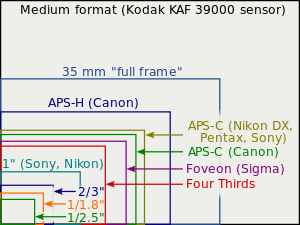
jeez I never had a problem shooting my dx 11-16 on my gh1 ... over a year ago !!!


300px-Sensor_sizes_overlaid_inside.svg.png


http://en.wikipedia.org/wiki/Micro_Four_Thirds_system


.
 
Last edited:
Panasonic uses a 4/3" sensor which is almost the same size as 35mm (24mm x 36mm) so the full frame Canon/Nikon glass will be fine. The smaller APS-C lenses may have the same issues as you would have putting them onto a full frame camera they only cover an area of 22mm x 15mm so that means you are only using a smaller portion of the sensor which may cause issues.

No, once again you are wrong.

To quote Barry:

35mm cinema film: 22mm x 11.9, for a diagonal of 25mm.
Canon 7D/T2i: 22.3mm x 12.05, for a diagonal of 25.3mm.
GH1: 18.9 x 10.22, for a diagonal of 21.5mm.

Which are NOTHING close to Full Frame 35mm, any of them.
 
Back
Top