

Zissou
Well-known member
Recently i shot a brief commercial at a commercial equipment (no pun intended) retailer, and we had a HELL of a time convincing the staff to shut off certain appliances so we could get a clean recording, and i figured this would be a great time to do a little write-up.
When i first started with video, i also purchased a pair of Rode NTG-2 mics, because i had one camera that supported XLR's and one that didnt, and the NTG-2's had great ratings and more importantly a low price relative to other models. I knew shotguns were very sensitive to handling noise, so i had bought a boom light stand, well insulated XLR cables, and a shock mount as well as a foam and windscreen. I figured i was set; just aim, adjust, and shoot. I knew there were a total of 4 different kelvin temperatures of fluorescent lights, all 60Hz, so i decided to shoot 1/60 and overwhelm the fluorescent lighting with halogens so i had a more even color temperature, i knew the angles (worked there for years), i knew the employees (most were my friends or former co-workers), and i knew all the locals that would be there during the shoot, so i figured i had it in the bag.
My first job was shooting an ad for my parents' restaurant for the local cable providers' advertisment channel, so it was obviously 90% interior work and all next to noisy appliances, fluorescent lighting, banging/clanging plates/dishes, and a million other little electrical nightmares i had never taken great notice of.
Naturally, i first realized the shotguns i had bought were creating a LOT of reverb, and that i should have gone with cardioid mics, so i ended up using a PETE based foam to cover most of the 'slits' on the shotgun barrels and dropped the mic (mounted on a boom light stand) away from the fluorescent transformers. next, i canned the stereo recording idea as it exacerbated the reverb effect, and recorded in mono. The building was mostly wooden interior in the dining room, with composite recycled paper ceiling panels, and pretty open, so i didnt have a problem with reverb in the main dining room, and i killed the compressors for the fridges and beverage machines, but the kitchen was another story.
Small, narrow, and FILLED with stainless steel, from the fridges to the walls and ceilings, EVERYTHING reverbed. Worse still, there was a hum. actually SEVERAL hums. at first i thought the preamp on the XH A1 was just very noisy or i had the audio gain up, and i spent half a day trying to figure out how to minimize the noise. In the end i re-recorded it with a single cardioid, shut down ALL the fridges, boomed away from the fluorescent transformers, and unplugged the microwaves, dishwasher, electric deepfryer, killed the stereo, and several other items.
Im a big believer in learning through experience, and this one taught me A LOT in a very short period of time, but i learned to do things with the right tools as well, and a lot about background noise and electrical noise.
Basically, watch out for the following when mic'ing. Its not just on-camera noise or someone coughing/moving etc behind the camera.
Fluorescent light ballasts
refrigerators
fans
refrigerator/freezer compressors
DC converters
dense or metal walls, especially near angles/corners
picture tube TV's
transformers (exterior or interior)
Any other ideas on what to watch out for in the field would be a great resource for all of us; i couldnt find a thread on what to watch out for, so i figure i start one. Maybe it could be added to and made into a sticky; i know i am missing a LOT to look out for; im a novice!
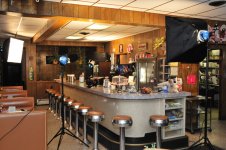
Heres a shot from the shoot...
When i first started with video, i also purchased a pair of Rode NTG-2 mics, because i had one camera that supported XLR's and one that didnt, and the NTG-2's had great ratings and more importantly a low price relative to other models. I knew shotguns were very sensitive to handling noise, so i had bought a boom light stand, well insulated XLR cables, and a shock mount as well as a foam and windscreen. I figured i was set; just aim, adjust, and shoot. I knew there were a total of 4 different kelvin temperatures of fluorescent lights, all 60Hz, so i decided to shoot 1/60 and overwhelm the fluorescent lighting with halogens so i had a more even color temperature, i knew the angles (worked there for years), i knew the employees (most were my friends or former co-workers), and i knew all the locals that would be there during the shoot, so i figured i had it in the bag.
My first job was shooting an ad for my parents' restaurant for the local cable providers' advertisment channel, so it was obviously 90% interior work and all next to noisy appliances, fluorescent lighting, banging/clanging plates/dishes, and a million other little electrical nightmares i had never taken great notice of.
Naturally, i first realized the shotguns i had bought were creating a LOT of reverb, and that i should have gone with cardioid mics, so i ended up using a PETE based foam to cover most of the 'slits' on the shotgun barrels and dropped the mic (mounted on a boom light stand) away from the fluorescent transformers. next, i canned the stereo recording idea as it exacerbated the reverb effect, and recorded in mono. The building was mostly wooden interior in the dining room, with composite recycled paper ceiling panels, and pretty open, so i didnt have a problem with reverb in the main dining room, and i killed the compressors for the fridges and beverage machines, but the kitchen was another story.
Small, narrow, and FILLED with stainless steel, from the fridges to the walls and ceilings, EVERYTHING reverbed. Worse still, there was a hum. actually SEVERAL hums. at first i thought the preamp on the XH A1 was just very noisy or i had the audio gain up, and i spent half a day trying to figure out how to minimize the noise. In the end i re-recorded it with a single cardioid, shut down ALL the fridges, boomed away from the fluorescent transformers, and unplugged the microwaves, dishwasher, electric deepfryer, killed the stereo, and several other items.
Im a big believer in learning through experience, and this one taught me A LOT in a very short period of time, but i learned to do things with the right tools as well, and a lot about background noise and electrical noise.
Basically, watch out for the following when mic'ing. Its not just on-camera noise or someone coughing/moving etc behind the camera.
Fluorescent light ballasts
refrigerators
fans
refrigerator/freezer compressors
DC converters
dense or metal walls, especially near angles/corners
picture tube TV's
transformers (exterior or interior)
Any other ideas on what to watch out for in the field would be a great resource for all of us; i couldnt find a thread on what to watch out for, so i figure i start one. Maybe it could be added to and made into a sticky; i know i am missing a LOT to look out for; im a novice!
Heres a shot from the shoot...


