Audio Technica AT897 with small consumer grade low end DVR

I want to record the speech in acoustically live environment:

1) Can we use a Condenser microphone (Audio Technica AT897) in small consumer grade low end DVR e.g. Sony ICD-UX200 or ICD-PX820 after patching cable from XLR jack to stereo mini jack without compromising on audio quality? (e.g. low speech intelligibility, hiss sound etc.)Or is there something missing in this chain e.g. preamp or impedance matching transformer etc...

2) If hiss is inevitable in my chain then is there any good software which can delete this unwanted hiss and ambient noise?

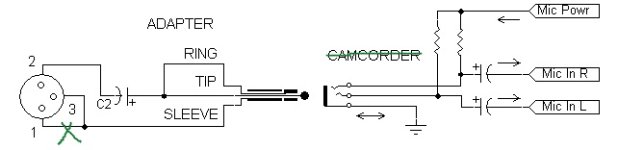
3) I will patch it like this:
attachment.php


ICD-UX200 Recorder Microphone jack input for plug in power has
minimum input:
level 0.9 mV, 3 kilohms or lower impedance microphone.

ICD-PX820 Recorder Microphone jack input for plug in power has
minimum input:
level 0.5 mV, 3 kilohms or lower impedance microphone.

AT897“The signal appears across Pins 2 and 3; Pin 1 is ground (shield). Output phase is “Pin 2 hot”— positive acoustic pressure produces positive voltage at Pin 2. To avoid phase cancellation and poor sound, all mic cables must be wired consistently: Pin 1-to-Pin 1, etc.
Nominal open circuit output voltage shall be 10.0 mV (phantom) or 8.9 mV (battery) at 1 V, 1 Pascal. Output shall be low impedance balanced (200 ohms – phantom, or 300 ohms – battery).”

Spec. Sheets:
http://www.docs.sony.com/release/ICDPX820.pdf
http://www.docs.sony.com/release/ICDUX200.pdf
http://www.audio-technica.com/cms/re...897_submit.pdf

 
It'll work but I wouldn't expect it to sound very good. If you're trying to record in sync to video, I would anticipate MAJOR problems maintaining sync over the length of any reasonable shot as that type of recorder doesn't usually have a sample clock sporting any accuracy at all. Those little recorders are toys designed for recording memos and class notes, not for serious audio work. An accurate sample rate is not needed for memos but it must be exactly on-spec in a recorder for video sync sound.

You can use a condensor mic but why do you want to use a shotgun? What exactlty are you hoping to accomplish with that choice of microphone? If by "acoustically live environment" you mean a place with a lot of hard surfaces and resulting reflected sound, a shotgun is the last mic you should choose.

If you want to try it, an important thing to watch for is the wiring of your patch cable. The mic output is mono with XLR pin 2 hot, pin 3 cold, pin 1 ground. The mic input is stereo TRS with tip left hot, ring right hot, and sleeve the common ground. Your patch cable needs to be wired XLR2->tip, jumper to ring, XLR3->sleeve, XLR1->cable shield, shield unconnected at TRS end. In addition you need capacitors in the connector to prevent the recorder's 'plug-in power' from getting to the mic. This is NOT the standard XLR->TRS "adapter" wiring you find on the music store shelf.

Software exists to reduce steady noise like a hiss or the drone of a fan but non-constant ambient noise like voices around you in an exhibit hall won't respond well to noise reduction software.
 
Last edited:
It'll work but I wouldn't expect it to sound very good.

I'm inspired by this, He is using ICD-PX720:

http://www.youtube.com/watch?v=sgAIqpC67jc

If you're trying to record in sync to video, I would anticipate MAJOR problems maintaining sync over the length of any reasonable shot as that type of recorder doesn't usually have a sample clock sporting any accuracy at all. Those little recorders are toys designed for recording memos and class notes, not for serious audio work. An accurate sample rate is not needed for memos but it must be exactly on-spec in a recorder for video sync sound..

No, I'll sync it with images, i.e. it won't bother me

You can use a condensor mic but why do you want to use a shotgun? What exactlty are you hoping to accomplish with that choice of microphone? If by "acoustically live environment" you mean a place with a lot of hard surfaces and resulting reflected sound, a shotgun is the last mic you should choose..

I will record it in a Hall, which isn't accustically engineered, it has many ceiling fans, serveral pillar, a net of Speaker for sound reinforement. Because cardioid mic have low axis rejection, therefore I will use the shotgun or line-cardioid to reject the all unwanted noise of fans etc. The Hall looks like:

1.jpg

Though my hall has ceiling fans. Do you think shotgun won't help me? I saw many videos no youtube in which cardioid or omni mic picking so much ambient noise.


If you want to try it, an important thing to watch for is the wiring of your patch cable. The mic output is mono with XLR pin 2 hot, pin 3 cold, pin 1 ground. The mic input is stereo TRS with tip left hot, ring right hot, and sleeve the common ground. Your patch cable needs to be wired XLR2->tip, jumper to ring, XLR3->sleeve, XLR1->cable shield, shield unconnected at TRS end. In addition you need capacitors in the connector to prevent the recorder's 'plug-in power' from getting to the mic. This is NOT the standard XLR->TRS "adapter" wiring you find on the music store shelf.

like this?:


Untitled picture.jpg

http://www.rcrowley.com/CamAdapt.htm
 
If it's a speech I assume that the speaker would be standing at a podium? Is there a mic on the podium? If so couldn't you just tap into the house amplification system? Or perhaps just place the recorder directly on the podium?
 
No, There is a complete PA system, But I want to recorder through my own chain, i.e. mic -> ??? -> DVR. And I have limited budget to buy gears and also in my country we don't have great choice to buy mics, DVR, etc.. Otherwise I would buy Zoom H4n, and any other shortgun mic.
 
It's a common misconception that shotguns are for sound like a telephoto lens is for picture, letting you stand back and capture sound as if you were up close. They aren't. If you can't get your mic within about 24 inches of the speaker's mouth a shotgun won't help.

Firstly, shotguns don't absolutely reject off-axis sounds. Rather, it's a matter of degree. They are less sensitive off-axis but much ambient will make it through. Also, the degree of rejection you'll get depends on the frequency of the sound in question - at low frequencys and the very high, a line-gradient mic becomes almost omni in response. Even more imprtant, where there's a high proportion of reflected sound to the direct sound from the subject, and all those hard surfaces in your hall look like that would be the case, shotguns tend to sound hollow and distorted, almost ike you were recording in a metal culvert. A hypercardioid would be much better behaved. If you are comitted to using the mini-recorder, why not simplify ... use its built-in mic with the interviewer standing close to the subject, hand-holding the recorder within a few inches of the subject's mouth. The inverse square law says his voice will be much louder than the background ambience, even with omni or cardioid mics. With the mic two inches from the speaker's mouth, his voice will be much louder than a fan 20 feet away. I would expect that to give better results.

The wiring diagram is correct although there is a slight variation that might be even better. The diagram you posted assumes a typical unbalanced shielded cable with one centre conductor. Tip and ring are fed from XLR2 via the centre conductor and XLR3 connects to the shield and then to the sleeve at the TRS end. A variation would be to use a cable such as commonly used for balanced wiring with 2 centre conductors in a twisted pair plus the shield. In that case one centre conductor is used for pin 2 to tip and ring, the second centre conductor for pin 3 to sleeve, while the shield is connected to pin 1 at the XLR end but left floating, not connected to anything, at the TRS end.

When you say you're going to sync it to images, do you mean still photos, like a slide show with a voice track?
 
Last edited:
Thanks for help.
If you can't get your mic within about 24 inches of the speaker's mouth a shotgun won't help.

Firstly, shotguns don't absolutely reject off-axis sounds. Rather, it's a matter of degree. They are less sensitive off-axis but much ambient will make it through. Also, the degree of rejection you'll get depends on the frequency of the sound in question - at low frequencys and the very high, a line-gradient mic becomes almost omni in response. Even more imprtant, where there's a high proportion of reflected sound to the direct sound from the subject, and all those hard surfaces in your hall look like that would be the case, shotguns tend to sound hollow and distorted, almost ike you were recording in a metal culvert. A hypercardioid would be much better behaved. If you are comitted to using the mini-recorder, why not simplify ... use its built-in mic with the interviewer standing close to the subject, hand-holding the recorder within a few inches of the subject's mouth. The inverse square law says his voice will be much louder than the background ambience, even with omni or cardioid mics. With the mic two inches from the speaker's mouth, his voice will be much louder than a fan 20 feet away. I would expect that to give better results.

I searched the internet, youtube, ty ford, jucied linked etc etc.; I found that normally built-in don't do great job. I will podcast these speeches and I'm afraid it they reduce the speech intelligibility, or create the stress full lisenting. I also considering Shure Beta 58a, it is supercardioid dynamic mic. but it's samples on youtube isn't so inspring their intelligibility is low.
http://www.youtube.com/watch?v=Lq7lE5Q7gg8

Youbube samples of AT897 shotgun inspried me but found that they are little bit bassy.

http://www.youtube.com/watch?v=dJ1-NRXFQHw

Also I have to two other choices 1) Beyerdynamic DMX 29, supercardioid dynamic but I have to buy it from germany, b/c on one have this in my country. 2) Sennheiser M 66 + K6, Supercardioid/Lobar condenser shotgun from my local dealer in 528 USD. But if I buy it I don't enough money to buy good pro DVR, therefore I'm sticking with consumer DVR. And I found that it may work great as:

http://www.youtube.com/watch?v=sgAIqpC67jc

I will place the mic about a feet away. Now what is your opinion?

When you say you're going to sync it to images, do you mean still photos, like a slide show with a voice track?
Yes.
 
Notice how close the speaker is to the mic in the clip you posted of the comparison of the Beta 58a to the PR20. That 4 inches or less distance is typical of the normal working distance of vocal mics such as those and the Beyerdynamic you also mentioned - they're designed for on-stage vocal music where the performer eats the mic, holding it so close to their mouth they're almost touching it with their lips. If your speaker is talking from a podium and you can mount the microphone on it they'd probably work okay from that standpoint. However, dynamic mics have low output levels and they probably won't provide a signal adequate to drive those recorder's mic inputs - a cardioid or hypercardioid condensor mic might be a better choice. Pro recorders have better sensitivity.

A shotgun or super-cardioid 1 foot away will sound 'bassy' due to the proximity effect that emphasises low frequencies. Directional mics in general have a range of suitable working distances - like Goldilocks you want them at just the right distance - not too far, not too close.

Not a fan of the ME66 - if you're looking at that model for your shotgun, the Rode NTG-2 is a better sounding (IMHO) mic at a lower price.

Why don't you get a decent portable audio recorder with decent internal mics and place it on the speaker's podium? You can order a Zoom H4n from B&H in New York for less than the total cost of any of the shotguns mics you have mentioned plus the Sony toy recorder.
 
Last edited:
Thanks Hosue et al, for your meticulous advices. I learned great from you guys.
In fact in my country there is NO trade, therefore we have no suppliers for audio equipment. We have some supplier but they have extremely limited number of running items for TV production etc. I get luckily Audio technica AT897, which costs me $280, otherwise they only have >$500 microphones, or some reporter microphones. For DVR we have lots of third class Chinese DVRs which only cost me <$35, otherwise we have one or two DVRs from Edirol, M-Audio etc. and they will cost me >$350. Summary is that we have some pro level thing and lots of third class Chinese consumer level equipment but don’t have semi-pro line available
I have limited budget available, therefore I'm sticking with AT897, after that I can't buy any pro DVR which are available in my country. Now we have to choose from cheap toy DVRs which are available in my country. We have decided to try our fate with Sony ICD-UX200F.
Now my question is that the Sony DVR doesn’t have Manual Recording gain control, it has only three sensitivity setting: S-High, High, and Low. If its low is too high w.r.t. AT897, and signal is clipped due high gain then is there any way to reduce the gain? As you guys told me lots patches and tricks.
 
I'm reading about the attenuators, but I think I definitly need an attenuator b/c ICD-UX200 has input level of 0.9 mV and AT897 has Nominal open circuit output voltage of 8.9 mV (battery) at 1 V, 1 Pascal. Am I right?
 
You are going to have to try out that little Sony. As long as you aren't trying to lipsync you probably will be fine. As to hiss, no idea. But it is correct that this little recorder is not meant to do syncing or high quality audio. you will be lucky if you get it. Just try it first!

I have used my AT 897 shotgun on my T2i and HMC 150 to shoot in a situation like you describe. Some thoughts. Steve is right, in that you likely won't be able to get great sound if you aren't right on the subject All my videos have been shot with the 897 in some kind of role picking up wild sound. Better is that I would get at least one lav mic, and put it on the person doing the talking. If you aren't going to be able to do that, can you get an audio person to boom the 897 in on the action? Barring all that, then yes, the 897 should pick up something. If the speakers will be on a podium with house sound, you might get lucky. here's some examples. All wild sound... I don't claim this is the greatest sound, but it works..you be the judge.

This is a live radio show shot with a t2i and an 897 picking up live sound.
http://www.youtube.com/watch?v=ye9-JtIWrXM

Live onstage show shot with the HMC150 with the 897 picking up live sound off the stage system. This was just shooting as it happened.
http://www.youtube.com/watch?v=wXa7et-VoL0

Another live shooting with the 897 on a T2i coming in raw into the minijack via a converter off the mic
http://www.vimeo.com/16850614

I have to say that I'm pleased with the results in general. When I can't get a mic up close this does the job just fine. But it you are expecting to get all the detail of a wedding, you better have it well mic'ed at the mouth of the speakers, then amplify for the room or you will be SOL.

I also have recently bought a RE50B dynamic mic from EV and must say that with my Zoom, it makes fabulous field setup. The EV is just bullet proof, with a built in wind screening. It's supposedly the standard for field reporting, and I can see why. No batteries to fool around with, just get the mic 4 fingers from your subjects mouth (like a reporter does). That is less than $150 and does the job. But both mics are nice. Another option is Okitava, which gives you a variety of mics in one, with changeble heads. I've not had enough experience using my Oki to tell you if it's worth it. What I can say is that the omni setting is absolutely 180! Be forewarned! And it requires phantom power..which the zoom can provide.
 
Last edited:
Thanks Hosue et al, for your meticulous advices. I learned great from you guys.
In fact in my country there is NO trade, therefore we have no suppliers for audio equipment. ... .

There may be no dealers local to your country but there are major vendors in North America, Europe, Oceana and SE Asia that ship internationally to just about anyplace on the planet. There's no reason you have to limit yourself to what's available in your own backyard.
 
Thank you for all, AT897 is working in ICD-UX200.I patched XLR Mono Balanced to TRS Stereo unbalanced 1/8” like this:
XLR Pin 1 to unconnected
XLR pin 2 to Mini Jack tip and ring
XLR pin 3 to mini-jack sleeve.
• I used 4.7 µf non-polar 50V capacitor between XLR pin 2 and mini jack tip/ring
• I didn’t match their impedances (AT896 = 300Ω and UX200 = <3000Ω). You told me that impedances were Ok.
• I didn’t use any attenuator or preamp.
• Recorder’s Low Cut filter is on
• I record it at “ST” High-quality stereo recording mode (44.1 kHz/192 kbps)
• Recorder was set to “High” sensitivity however “high” is undesirably High and low is too much low, as you have told me before
• Microphone 80Hz filter is on
• Mic is almost ½ feet away from me
• I record it in Room (12’x10’x10’) with Furniture
My problem is that why it is creating hiss. How I get rid of hiss from recoding?:
• Is it capacitor problem (i.e. 4.7 µf non-polar 50V)
• Is it impedance mismatch
Or if there is nothing wrong in above two things then which is best software to denoise this type of hiss:
• iZotope RX
• Wave lab 7 or something else
I’m complete novice. I mistakenly download Cubase 5 but it doesn’t have any denoiser.

Please check my hiss test:

http://www.youtube.com/watch?v=SGpvyZCxPzc
 
Last edited:
Neither the capcitance nor the impedances are likely the problem here. The recorder inputs wants to see a mic that has anything less that 3000 ohms and that's what you have, 300 ohms. As long as the impedance of the SOURCE (mic) is LESS than the impedance of the LOAD (recorder input) you're fine (with modern solid-state electronics anyway). I think the hiss is just in the nature of the recorder itself - that's what everyone has been cautioning you about when you said you were going to use a cheap consumer voice recorder. Cheap means low quality, marginally designed, minimal electronics which means noisy recordings. Also, hiss is not uncommon in MP3 recordings, again a drawback of the recorder since you're stuck with that file type and can't go switch to the higher quality uncompressed wave file used in more serious recorders. IZotope would be a good noise reducer to use on it. Wavelab is excellent editing and mastering software but I don't recall off the top of my head if it has a noise reduction plug-in bundled with it.

You might move the mic back a few inches - you said you had it at 6 inches and a foot or so might sound a little less bassy.
 
Last edited:
Neither the capcitance nor the impedances are likely the problem here. The recorder inputs wants to see a mic that has anything less that 3000 ohms and that's what you have, 300 ohms. As long as the impedance of the SOURCE (mic) is LESS than the impedance of the LOAD (recorder input) you're fine (with modern solid-state electronics anyway). I think the hiss is just in the nature of the recorder itself - that's what everyone has been cautioning you about when you said you were going to use a cheap consumer voice recorder. Cheap means low quality, marginally designed, minimal electronics which means noisy recordings.

But it's built-in Mic didn't hiss.

You might move the mic back a few inches - you said you had it at 6 inches and a foot or so might sound a little less bassy.

Please check my hiss test:
http://www.youtube.com/watch?v=SGpvyZCxPzc

I think it isn't bassy.
 
But it's built-in Mic didn't hiss.


Please check my hiss test:
http://www.youtube.com/watch?v=SGpvyZCxPzc

I think it isn't bassy.

Perhaps the internal mics don't have as much gain applied to them. I still think it is just the nature of the recorder. Adapting balanced to unbalanced reduces the mic's signal level by 6dB and splitting it between the left and right channels reduces it still more. The recording amp's AGC is going to increase the preamp gain accordingly and that will cause a corresponding increase in the level of any hiss present.

I did listen to it on studio monitors and IMHO the "hello...hello...hello..." that's directly on-axis near the start of the clip sounds a bit boomy, probably caused by being a little too close to the mic. Directional mics like shotguns (and hypercardioids and cardioids as well, all so-called "pressure-gradient" mics) exhibit something call the Proximity Effect where they start to emphasize bass frequencies when they're within a certain critical distance from the source. The more directional the mic, the farther out the proximity effect begins to be noticable and 6 inches is definitely within it for a shotgun. If you're familiar with the child's story of Goldilocks and the Three Bears, you're looking for what I call the Goldilocks Distance ... not too close, not too far, but just right - as close as possible without getting into the proximity effect zone (unless you want the bass emphsis of course, voice-over talent, radio announcers, and vocalists frequently exploit it).
 
Last edited:
Ok Thank you, :-)

If I apply attenuator b/w mic and recoder? I also try low sensitivity setting on recorder, but it reduced the overall signal volume including hiss.
 
Back
Top