artistic influences?

Fahad

Veteran
so... i wanted to ask this question in both the directing and writing sections, but figured i'd just ask it once here.

what are, if any, artistic movements, or techniques that influence your work?

you know how there is surrealism, expressionism, dada, psychedelic, stuckism, etc. what influences your work?

(the thing that transcends the genre you produce)
 
I think the answer is all of the above, at least at the subconscious level. Everything you take in via your senses hits your brain and is recorded. Colors, moods, tones, feelings, names, phrases, etc. These things are what makes up your creative base.

When you write a story, a song, or compose a picture, you can't help but draw influence and perspective from everything you take in, even if you don't realize it.

So yes, I believe you are indeed influenced by everything you are exposed to.
 
Life. I create based on what I see everyday. Bright colors, the way light wraps around a face, everything I see makes some sort of difference. Some things really stick with me and won't get out of my head and they get churned around and around. Finally something comes out. Sometimes its just gas though...

That said sometimes I feel lacking in inspiration so I'll go take a trip to the museum. Usually something strikes me with a mood/feeling pushing me in one direction or another. More often than not though I end up staring at this for a while and get an idea - lots of things going on here and it always seems to get my brain moving - http://www.philbrook.org/exhibitions/galleries/page.cfm?page=21& Fortunate that its part of a permanent collection...
 
I like what I like, but when you're an Art Director everything influences your work...

As it should. But, do you feel you lean to one style over the other?

For me, it's realism.

That does seem to be the prevalent flavor of films. Anywhere from Children of Men, Talladega Nights, to Iron Man. I would really include most (commercial) films in this set.

...I believe you are indeed influenced by everything you are exposed to.

Very true, SF. I think everything you're exposed to should influence your work. Otherwise, the work would be 'stale'.

Life. I create based on what I see everyday. Bright colors, the way light wraps around a face, everything I see makes some sort of difference. Some things really stick with me and won't get out of my head and they get churned around and around. Finally something comes out. Sometimes its just gas though...

That said sometimes I feel lacking in inspiration so I'll go take a trip to the museum. Usually something strikes me with a mood/feeling pushing me in one direction or another. More often than not though I end up staring at this for a while and get an idea - lots of things going on here and it always seems to get my brain moving - http://www.philbrook.org/exhibitions/galleries/page.cfm?page=21& Fortunate that its part of a permanent collection...

Thanks for the link, Jeff. Very inspiring stuff there.

Personally, I haven't produced anything worth mentioning, so I can't say what my work is influenced by. But, visually speaking, I have always been interested in surrealism, eclecticism, symbolism, expressionism, and chiaroscuro.

Also, as far as cinematographic considerations go, I really dig the work of photographer Gregory Colbert (see Ashes & Snow). I don't know what his style is called. Similar is the work of Nick Brant.

As for literary considerations (i.e. writing), I haven't pin-pointed where exactly I'm coming from.
 
Like Max said. Everything, and it doesn't matter the medium. The end goal is always to be able to freely express yourself in whatever medium you choose, which ultimatley never happens with anyone. The fun is in trying to get there.

I don't do video, but anything creative I do, or try to do, is based upon everything I know, right?
That's the 'ideal' goal anyways. Freedom of expression. That's it man. It's that simple.

//Unless your in it for the money. In which case, idk.
 
Last edited:
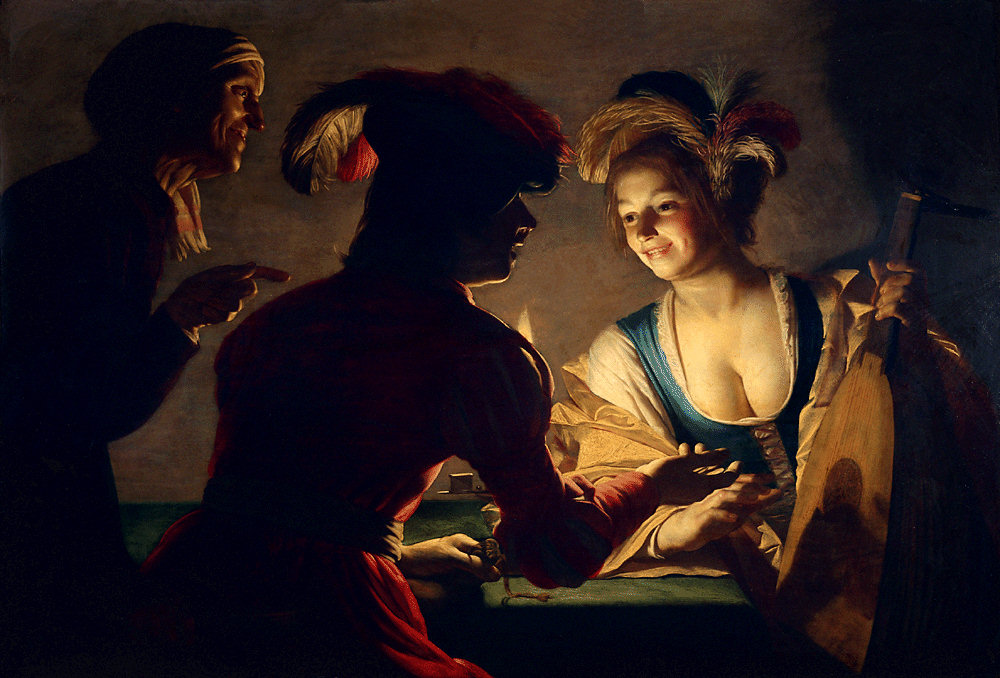
Dutch 17th century paintings for lighting, and Edward Hopper paintings for composition/framing/blocking.

And then there are (of course) a lot´s of films that had a big influence on my work.

Frank
 
Dutch 17th century paintings...

this is great:

Gerrit_van_Honthorst_-_De_koppelaarster.jpg


looks like a scene out of barry lyndon... dang, still have to watch that movie.
 
Yeah I like the great master painters, especially the Dutch Masters, and am also a big fan of Caravaggio. I am also very fond of modernist painting, from the impressionist, to the cubists, surrealists and abstract expressionists. I am starting to read the writings of Antonin Artaud and his Theatre of Cruelty and drama by Bertolt Brecht and his use of the alienating devices.
 
Peter Joel Witkin. MASTER of portraiture and context to its surroundings. This guy turns subjects into something dead and alive, the living become carcases, the deceased become angels.

Sally Mann. Noone captures light like sally. Her Large format pinhole daguerreotypes make me hurt they are so beautiful.

Terry Richardson. MASTER portaits. Noone knows when to press the shutter like him. he captures expressions so fleeting and impossible to replicate it really makes me wonder about the strength of his connection to his subjects. The beauty of his work is that he doesnt need the pagentry of other photographers to have a powerful picture (cough cough* Anne Leibovitz... cough*). He uses one light, sometimes an onboard flash, and a white wall. the magic is in the expresson of his subjects. His portraits of Robery Downy Jr are incredible.

Nick Cave. Severely underrated musician. His lyrics are films waiting to happen.

Iain M. Banks, i want to turn all his books into screen plays.....


Oh yeah, I love Joel Peter Witkin. What amazing photos. Marilyn Manson and Nine Inch Nails videos would not be the same without his influence, that's for sure.

I have to tip my hat to the FSA photographers from the '30's and early '40's, especially Walker Evans and Dorethea Lang. Their stuff is avaialable (along with a lot of very cool other photos) for download from the National Archive (but is tough to sort through).

The writing of Charles Bukowski has also had a big influence on me. I don't think he has been done well in the movie adaptations of his books. ("Barfly" was good, but "Factotum" sucked, IMHO).
 
if anyone's interested, i found this:

FILM GENRES AND MOVEMENTS

Absolute Film: A nonrepresentational film that uses film's formal characteristics, design elements and structural properties to produce a pure, visual effect. This type of structural film parallels developments in nonrepresentational painting.

Abstract Film: A film which represents recognizable images in such a way that the content and effect is more poetic than narrative.

Art Film: beginning in 1907 with the French producers' failed attempt to raise filmic quality to that of theatre and art by creating the Compagnie de Film d'Art, certain films gained art status through the significance of their experimental and aesthetic explorations. Thus a distinction developed in the 1950's between commercial films marketed for a mass audience, and those films whose aim was creative license and artistic independence to be viewed by a more discriminating audience. See films of Bruce Elder, Michael Snow, Stan Brakhage, Kenneth Anger, Stan VanderBeek, Ron Rice, etc.

Avant garde: A Modernist term which reflects the notion that progress is inevitable, and where the most effective work is being done by a small group of artists who are challenging historic conventions. This cutting edge of artists is viewed as intellectually and esthetically more advanced, hence, the term Avant garde: "front-line". Modernist Avant garde films became increasingly nonnarrative in structure. See Absolute and Abstract film.

Black Comedy: A type of comedy which deals in macabre subjects such as nuclear war, murder, mutilation, war, obesity, family breakdown, etc., ie. Kubrick's, Dr. Strangelove or Clockwork Orange. TVs "Mash" etc.

B picture: When double features became a popular marketing device in the late forties, fifties and sixties, quick, cheap pictures were make to fill the bottom of the double bill. See "Ed Wood" for a satirical look at one of Hollywood's most notoriously bad directors of B pictures. Today's parallel would be the "made-for-TV movie".

Cinema Novo: The Brazilian movement for a new cinema in the 1960's. Related to New Wave and Neue Kino. Cinema Novo directors include Glauber Rocha, Ruy Guerra, Nelson Pereira dos Santas, Carlos Diegues.

Cinema Verité: A term which is loosely applied to documentary form but more specifically means the use of light-weight equipment to film directly from the scene of action and normally using interview techniques. Unlike Direct Cinema, Cinema Verité admitted that the presence of the camera made a difference -- had an effect on the reactions, documentation and experience captured in the final recording. This could cover a range of techniques from "in the field" news interviews to Andy Warhol's single point of view documentaries, such as "Chelsea Girls" and "Sleep," and Rouch and Morin's classic, "Chronique d'un été."

Direct Cinema: Like Cinema Verité this movement was based on a documentary form. Gone were the well phrased and opinion-oriented narrations of early documentaries. Developed in America where hundreds of feet of film would be recorded and edited to represent an authentic record of events. Directors such as Robert Drew, Richard Leacock, Donn Pennebaker and Albert and David Maysies created examples such as "Primary" (1960); "Don't Look Back" (on Bob Dylan) (1966); "Salesman" (1969); and "Gimme Shelter" (1970).

Docudrama: Semifictional versions of actual events.

Documentary: A term with a wide latitude of meaning, basically used to refer to any film or program not wholly fictional in character. First popularized by NFB Director, John Grierson. See Cinema Verite, Direct Cinema and Docudrama.

Dramatization: A fictional representation of an actual event.

Epic Theatre: In Bertholdt Brecht's theory, theatre which appeals more to the spectators' reason than their feelings.

Exploitation Film: A filrn designed to profit by serving a particular need or desire of the audience. Examples: Sexploitation, Blaxploitation, Child exploitation, etc.

Expressionism: Generally, the kind of film style that allows liberal use of technical devices and artistic distortion and in which the personality of the director is always paramount. See German Expressionism

Film Noir: Originally a French term, now in common usage to indicate a film with a gritty, urban setting that deals with mainly dark or violent passions in a downbeat way. Use of exaggerated lighting contrasts with an emphasis on dark tonal qualities.

Formalism: 1) concern with form over content. 2) The theory that meaning exists primarily in the form or language of a discourse rather than in the content or subject. 3) the Russian movement of the twenties that developed these ideas.

Film Genre: The type of film: archetypal patterns like the Western, Gangster, Science Fiction, Horror, Action, Drama, Fantasy, Adventure, etc.

German Expressionism: Style of film common in Germany in the twenties, characterized by dramatic lighting, distorted sets, and symbolic action and characters. The movement also involved painting and the theatre.

Materialist Cinema: 1) a contemporary movement, mainly in avant garde cinema, which celebrates the physical fact of film, camera, light, projector, and in which the materials of the art are, in fact, its main subject matter. Michael Snow, Tony Conrad, Paul Sharits, and Hollis Frampton are important figures in this movement. 2) the cinema of filmmakers such as Jean-Luc Godard and Roberto Rossellini, which combines some of the qualities of the definition (1) with a strong conception of political change rooted in the basic conflicts of concrete economic realities.

Minimal Cinema: A kind of extreme, simplified Realism: Car, Dreyer, Robert Bresson, early Warhol. Minimal dependence on the technical power of the medium.

Naturalism: A theory of literature and film which supposes a scientific determinism such that the actions of a character are determined by biological, sociological, economic, or psychological laws. Often confused with Realism, it does not simply mean "natural" in style.

Neorealism: Characterized by political aims, the use of non-professional actors, location shooting, and some handheld work. "Neorealism has as its goal: to give all people courage, to give them consciousness as human beings. In the broadest sense, a rejection of the technical-professional work staff, the script writer, included. Handbooks, programs, grammars no longer have any meaning. Even designations such as close-ups, reverse shot etc. no longer have any meaning. Each person has his own personal film script… For there are endless possibilities of encountering reality in the cinema. There can be no a priori." - Cesare Zavattini, "Some Ideas on the Cinema," 1953. A style of filmmaking identified with Vitorio De Sica, Roberto Rossellini, and Luchino Visconti (among others) in Italy. See Realism.

Neue Kino: German Cinema since 1968.

New American Cinema: The personal cinema of independent filmmakers in the U.S. since World War II. Characterized by a lyric, poetic, experimental approach.

New Wave, or Nouvelle Vague: 1) Godard, Truffault, Chabrol, Rohmer, Rivette, et al. Strictly, filmmakers who began as critics on Cahiers du Cinema in the 1950's and who were influenced by Andre Bazin. 2) The term also used more loosely to describe all the young French filmmakers of the 1960's.

Realism: In film, the attitude which emphasizes the subject as opposed to the director's point of view. Hence, Realism is in opposition to Expressionism, where the director's viewpoint forms the central subject.

Screwball comedy: A type of comedy prevalent in the 1930's and typified by frenetic action, wisecracks, and sexual relationships as an important plot element. Usually about upper-class characters therefore often involved opulent sets and costumes as visual elements. "It Happened One Night" (1934); "Easy Living" (1937); and "Bringing up Baby" (1938); are prime examples. Highly verbal as opposed to the dynamic visuals of Slapstick comedy. See also Black comedy.

Slapstick comedy: A type of comedy, widely prevalent during the silent film era, which depends on broad physical action and pantomime for its effects rather than verbal wit or character development.

Spaghetti Western: A European Western, usually filmed in Spain or Italy and popularized in the 1960's by the films of Sergio Leone - "A Fistful of Dollars", "The Good, The Bad and The Ugly."

Structuralist Film: A film in which the codes and structures of social arrangements are evident. See Cine-structuralism, Materialist cinema.

Surrealism: An attempt to connect reality with the world of the subconscious mind to create an extreme reality where other levels of the consciousness and meaning are revealed. Seemingly paradoxical and bizarre, surrealist cinema approximated an incoherent dream experience. The film works of Dali and Bunuel offer some excellent examples of this movement.

Theatre of Cruelty: Antonin Artaud's thoery of theatre that emphasizes the stage as a concrete physical space requiring its own physical language. By "cruelty" Artaud meant a theatre that was "difficult", that insisted on the involvement of the spectator in the theatrical process, that was not subjugated to the text, and that returned to basic, mystical, cathartic qualities.

Third Cinema: Fernando Solana's and Octavio Getino's theory of cinema as neither consumer goods nor avant garde experiments, but rather as an instrument of revolutionary consciousness whose products "the system cannot assimilate."


Does anyone know of current film movements?

i found:
'Remodernist film'
'Postmodernist film'
'Dogme 95'
 
It's a pretty diverse list built up over the years. I've been careful not to select two films
that overlap in theme or genre.

If you feel like it, PM me your list (or post and PM me your list) as I'm always down for
checking out someone elses recommendations. Especially if they are carefully chosen.
 
Back
Top