Arri Statement on future

Great post and video! I think this outlines how the "little cameras" are a part of the game and have the potential to take over the game. The big cameras used to be needed to get the high end look but obviously that has changed.

Looks like Arri needs to come out with "The Eagle" :) to counter "The Turkey".
 
This is a fun watch, and we hear a lot about sony cameras, DJI cameras and panavision/preston custom services.

If you have 'set' experience it is interesting as there a small details like choosing lidar focus and gmaster lenses because changing the traditional fiz motor set up was too big/slow

I think the point Claudio was making is that the 4D's ecosystem is compact and efficient. When discussing a lens motor system "slow" can be misconstrued as the max speed the motors turn (what I thought you were saying, and I would have been quite surprised to learn that the DJI system was physically faster than Preston's in this regard--I don't believe it is).

Also fun to learn that the pan mechanism for the mounted cameras was controlled via a FIZ motor, presumably a DM1X, their fastest and most powerful. It reminds me of the '96 Olympics, where the underwater tracking camera had pan and tilt operated via a Seitz handset, a spiritual predecessor to the Preston FIZ.


I owned a Preston FIZ and various other of their devices for 25+ years, selling a few years ago as I trimmed down my package (thankfully, before the price sof used gear plummeted). It served me very well and service was top-notch. Popping by the offices when I needed service it was always great to have a chat with Howard Preston, a lovely gent and one of the true visionaries in the industry.
 
Yes, like my hero Marty Scorsese ;)... If I had the $ for NYU I'd spend it on a movie...
that's the right thinking these days. I did one year at NYU and dropped out, having talked my way onto a number of large scale productions in NYC and eager to start working instead of sitting in a classroom, or fighting with the guys in the "cage" about getting the gear I needed for my student film. I have never recommended film school at the undergraduate level (although I think there is something to be said about graduate studies, I've been overall impressed with AFI). The only thing I felt I missed out on at NYU was making those connections and alliances that sometimes result in career-long working relationships. But, I'll never know what difference that would or wouldn't have made. I do know that if I had four years of student loan debt to pay off, it would have delayed my buying a Steadicam considerably (still took me 5 years after dropping out to make enough to do that, and it was a tattered one).
 
that's the right thinking these days. I did one year at NYU and dropped out, having talked my way onto a number of large scale productions in NYC and eager to start working instead of sitting in a classroom, or fighting with the guys in the "cage" about getting the gear I needed for my student film. I have never recommended film school at the undergraduate level (although I think there is something to be said about graduate studies, I've been overall impressed with AFI). The only thing I felt I missed out on at NYU was making those connections and alliances that sometimes result in career-long working relationships. But, I'll never know what difference that would or wouldn't have made. I do know that if I had four years of student loan debt to pay off, it would have delayed my buying a Steadicam considerably (still took me 5 years after dropping out to make enough to do that, and it was a tattered one).
I didn't go to film school. This vocation came late to me. I was an English/journalism major. I do wish I had gone to film school for two reasons: 1). For the contacts 2). To learn the fundamentals. I have learned them from practical experience (and also from forums like dvxuser) but I'm kind of jealous of filmmakers who have a solid formal technical education.
 
2). To learn the fundamentals. I have learned them from practical experience (and also from forums like dvxuser) but I'm kind of jealous of filmmakers who have a solid formal technical education.
I think it's always been a little debatable how much "formal technical education" one gets at film school, much depends on the given professor's knowledge. I think I got about as much out of the books I read outside of class than what I learned within it. And then a few years later, getting an on-staff position at a small production company was my real boot camp. These days, Youtube University seems to be covering it well for most. To be honest, I've seen discussions within this very forum that delve so far into the technical that I have no clue what they are talking about, sometimes coming from folks who are essentially hobbyists. And yet I have colleagues out there who consider ME to be the technical one.
 
I When discussing a lens motor system "slow"

I think he was talking about lens changes and initial build time and trips to 'the cart'

Usually one has a first A/C twinking for 3 mins with fiz motors when 'swinging' a lens

That time (even with nice builds and consistent lens sets) is super slow versus chucking on a different AF lens that 'just calibrates with meta data.

Hey - one can probably just use a 24-70 af and probably leave it on the camera all day*

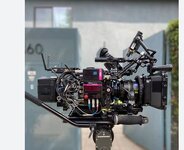
This (image below) is disgraceful for 2025 its not suprising arri are in the toilet!

cine.JPG

*maybe even have a trainee with a built 16-35 on standby.
 
Last edited:
..of course we all know the 'good enough' chats. I mean when is a 4d or steadicam not 'good enough' vs setting a track and having six guys deliver a Fisher for $1000/day

Im not saying a G 24-70 is as good as three Cooke primes, Im just saying I think the, the DOP director, thought that in this semi live environment the 24-70 was 'good enough' amd the time gains worth it.
 
I owned a Preston FIZ and various other of their devices for 25+ years, selling a few years ago as I trimmed down my package (thankfully, before the price sof used gear plummeted). It served me very well and service was top-notch. Popping by the offices when I needed service it was always great to have a chat with Howard Preston, a lovely gent and one of the true visionaries in the industry.

Im not knocking Preston.. hey they made the motors so powerful they could whip pan the camera.. still 100% relevant to today/this film

And all that stuff about getting signal through the whole track using fibre. Awesome

That is all 'cinema bespoke' and is clearly still being used.

I cant go on amazon and buy a remote system that will work around a 5km track with 100,000 folk on the 4g.

This re-enforces my argument that being small and bespoke and catering to major motion pictures is still a business. Arri selling overpriced C500s with a bit of brand cache less so.

S
 
I think it's always been a little debatable how much "formal technical education" one gets at film school, much depends on the given professor's knowledge. I think I got about as much out of the books I read outside of class than what I learned within it. And then a few years later, getting an on-staff position at a small production company was my real boot camp. These days, Youtube University seems to be covering it well for most. To be honest, I've seen discussions within this very forum that delve so far into the technical that I have no clue what they are talking about, sometimes coming from folks who are essentially hobbyists. And yet I have colleagues out there who consider ME to be the technical one.
Yeah, I think a lot of it has to do with the quality of the professor. My dad was a professor so it was established pretty early that a formal education was important. I was very green when I got into this craft, but I was lucky to have mentors who apparently saw some talent in me and took me under their wing.
 
It's certainly interesting seeing some of the news out of Arri lately. I know that companies need to adapt or die as time marches on, but despite their official announcement I still wonder where their focus is moving forward.

They just recently asked for feedback on a potential iPhone app that apparently they're looking to develop? Or to at least see what kind of feedback they could get around the subject. That's not really where I want to see Arri spending their time and resources, but I guess in the grand scheme of potential customers the iPhone market is certainly much larger than the high end cinema camera market.

I still think Arri makes some of the best cameras available, for those that need that kind of thing. We've yet to see a competitor best Arri in the dynamic range department for instance.

Of course, we don't all need what Arri is selling, but it seems to me that the bigger problem is that even Arri's specific market of high end cinema doesn't seem to need what they're selling. And I don't mean that they've been forced out by other players who have come on strong in the last several years, like Sony. There is just less production going on, and I have to think that the decline in that market is hitting them harder than competitors that also have consumer products, like a Sony.

From my beginning days of getting into this career I always aspired to shoot on Arri cameras. To me, getting to shoot on an Arri meant something. It stood for the highest quality, it meant you were serious about your craft, it was the same camera the "Hollywood guys" were shooting on.

When I finally got the opportunity to purchase a used Alexa Mini earlier this year it felt like I'd finally "arrived" in both my business and career.

Of course, I'm fully aware that shooting on a specific camera doesn't really mean a whole lot in the grand scheme of both running a successful production business and in the quality of work you produce. If you're good at what you do you can make a great image with almost anything nowadays.

I, for one, am wishing Arri well and I hope they can figure out a way to survive and even thrive. Time will tell...
 
Sony is so diversified as opposed to Arri that has pretty much all of its eggs in the high end cinema market.
Yes, Sony is an absolute behemoth compared to Arri when you look at the two companies.

It certainly gives Sony a leg up when it comes to their financial resources. It's almost astonishing that Arri competes so well against them in the high end cinema market when you really think about that fact as well.
 
Yes, Sony is an absolute behemoth compared to Arri when you look at the two companies.

It certainly gives Sony a leg up when it comes to their financial resources. It's almost astonishing that Arri competes so well against them in the high end cinema market when you really think about that fact as well.
I thin Arri and companies like Blackmagic have rightfully focused in on image quality and a digital film aesthetic that sets their cameras apart from Sony’s “immediate” look (at least on their lower end prosumer cameras). I think Canon has seen Sony’s success and is trending in that direction image-wise.
 
You should bear in mind that Arri digital cameras aren't just used on cinema films, they're also used on high end TV dramas. Within their budgets, the camera is only a small percentage compared to the cast and crew costs, also they usually rent the camera equipment, rather than purchase it.
 
I don't know their numbers but presumably their bubble was growing and I think it would eventually burst.

Can only do so much with limited products, new people who have embraced different competition and highly improved post-production that can likely make almost any lighting from anyone look excellent.

Still conjecture, but I imagine the same thing was happening to RED and they split.

Seriously...it is unimaginable to me that most movies will not be made by computers in 10-20 years.

Yeah, once in a while you'll bust out the digital camera and some humans for a throwback film, but it is a waste of time for investors, which care about the only thing that ever mattered, money.
 
I don't know their numbers but presumably their bubble was growing and I think it would eventually burst.

Can only do so much with limited products, new people who have embraced different competition and highly improved post-production that can likely make almost any lighting from anyone look excellent.

Still conjecture, but I imagine the same thing was happening to RED and they split.

Seriously...it is unimaginable to me that most movies will not be made by computers in 10-20 years.

Yeah, once in a while you'll bust out the digital camera and some humans for a throwback film, but it is a waste of time for investors, which care about the only thing that ever mattered, money.
The fx3 being used on The Creator is a double edged sword: great for indie filmmakers who can cheer at what their $4000 dollar camera can do but a bad omen for companies like Arri.
 
I used to think about the industry more and I think the most significant shift happened when everyone caught up with super-sampling.

Seriously, this was such a problem for many years and I remember Blackmagic in the early days speaking about their goals [I'm paraphrasing] and how they wanted to build a camera that was capable of what technology allowed at the time.

Everyone else limited their products based on how much or what you paid.

2012's BMCC literally felt like black magic witchcraft; you could not even pretend quality like that out of anything for $2000, it was mentally-turning.

Although the hardware produced 2K RAW, I'd suggest it was primarily a 1080p box with the best official* super-sampling [after ARRI and RED] seen up to that point.

*You also saw it around the same time in the GH2 hacks, the 5D Mark II hacks...what was possible, but not given to us.

You didn't need 4K, you needed output that wasn't pixel-binned and line-skipped and hindered in any other way.

Once that clarity and detail became normal from everyone, everything started to look the same - and all of the other features continued to improve the user, the customer experience.

I mean, look, the cameras still vary, of course they do, but the overall world of content creation started to look the same. Or more accurately, it looked different than it did the previous years.

What did it look like? High-quality. Simple as that.

For the first 30 years, it was all over the place.

Has anyone seen anything visually inferior from pretty much anyone in the last 5-6 years?

I don't think so, not me, not really. Because everything is high-quality.

And so then companies like RED and ARRI start to feel the pressure and could be eventually squeezed out...the returns have diminished and I don't know if director sentiment is enough for survival.

But I have to stop with the decline report and failure analysis, let's see what happens!

[Damn, that was a long one, it's 2015 all over again.]
 
There is usually more than one reason why the more expensive cameras are used. Build quality and high quality connections become increasingly important to the camera crew as the budget costs increase, the funders and producers also worry about reliably during a long shooting schedule. The result is that they are conservative regarding the main production cameras. Currently, Arri, Red and the Sony Venice seem to be the go-to cameras on the high-end productions. Other cameras tending to be used as B cameras or crash cameras.

On low budget, independent productions, camera costs tend to be a larger factor, so lower cost cameras enter the equation. The production politics are less of a factor in this matter.

Netflix and other funders/commissioners have lists of approved cameras.
 
ARRI supposedly provides great field support during major productions, which I'd assume is industry-expected, if true.

RED had tremendous momentum for a solid 7-8 years, while film and Venice 1/2 were sprinkled in here and there (Sony helped its cause quickly with some huge blockbusters), but ARRI's dominance was unmatched.

I always thought many productions didn’t think about it for too long and it was just the default choice and direction (there was SO much of everything else to think about).

We've seen some very rare cases of really successful work - the blair witch projects of the last 10-15 years - created with other random cameras, and we're seeing an additional variety of systems involved more than ever, but what we really need to see is where the industry is headed.
 
I cannot comment on the cameras, but I can on the lighting - we have controls, dimmers and a variety of their lighting kit still on the shelves - but it's sort of very underused. We also have a large lighting heritage collection. The Arri Fresnels tungsten Fresnels are nice, and we still have some 1K and 1.2Ks that are still making things bright. We also have lots of theatre and TV lighting from other brands - the collection includes Strand, ADB, Mole, Ianiro, Martin, Selecon, Hewett and more - plus of course LED that has now become heritage too! The trouble with Arri is that it doesn't stick out and shout 'use me' - it's nice solid kit, but they're just tools. Some other brands have a few awful designs and a few really nice ones. The Moles and Strands, with the larger Fresnel lenses blend easily with each others. The Arri ones just seem harder and the drop off at the edges more abrupt. When the first LED Arri Fresnels appeared the price shocked me. They had replaceable LED sections, marketed as an upgrade when better ones became available - again, at quite a high cost. I thought they over cooked this - expecting people to shell out with the warning that there would be better ones later. I bought cheaper ones.

Their controls were nice, not special too. Lots appeared to be rebranded products - I don't know if Arri were the original manufacturer or if they rebadged them into Arri livery.

Lighting wise it has always been good kit, but not special, and absolutely not cheap.

It's a great shame when large companies have this kind of problem, but often it's just they get stuck and cannot react to the market needs.
 
Back
Top