Are LEDs more diffused than incandescents?

Chiskon

Active member
I'm guessing this is because LEDs are multiple lights in a cluster which results in them being more diffused even used in a Fresnel fixture.

For example, I noticed that Mole's LED Tweenie has a light intensity of 30 F.C. in flood at 15' and 50 F.C. in spot. While the incandescent Tweenie II also has 30 F.C. in flood but 315 F.C. in spot.
The incandescent version also has a focus range from 2.3' to 17.3' while the LED is only 5.7' to 11.0' from spot to flood.
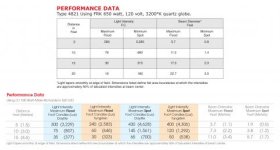
Mole Tweenie Comparison.jpg

I only own incandescent right now: 2 x Mole Midgets, 2 x Mole Tweenie II's, Arri 650W, 300W, and 150W. So I haven't used LEDs as much.

Working on a tech paper for a class and I decided to finally look into LEDs. This was a random thing I noticed. I already turned in the paper hee hee.

thanks for any help with my random question!
 
Last edited:
Im not engineer, but I would guess it's due to the way the two lights emmit the light? Aren't an incandesent better at using the build of the reflector surrounding it?

But LEDs notoriously have a weak throw compared to traditional fixtures. So it all boils down to what you need them for.....
 
Tungsten bulbs, as well as short arc types (HMI, Xenon, etc.) emit light from a very tiny area. So yes, your thought about L.E.D.s is spot on. They emit light from a much larger area, hundreds of emitting junctions scattered across the face of the chip, or hundreds of individual diodes across the surface of the unit.
 
You're correct in your assessment. Smaller area = more efficient use of optics or parabolic reflectors. On paper, the focus of a fresnel lens is really a singular point, so the closer you can get to that in terms of your light source, the better the lens will function as intended.
 
While what other people are saying is true, what you are seeing in those photometrics is maybe more about output and beam angle. First off, the fact that the "flood" beam with that 100w LED has the same photometric reading as a 650w tungsten fresnel at full flood but with a much narrower beam angle already indicates that they do not have the same output. If you set them at the same beam diameter of 11' at 15ft by spotting down the 650w fresnel a bit, the 650w tungsten fresnel would likely have at least twice the fc reading since a 17' beam diameter has more than twice the area of a 11' beam diameter. Basically a 100w LED is not a good replacement for a 650w tungsten fresnel, a 200w LED would be closer, which makes sense since LEDs are usually about 3-4 times more efficient than tungsten. And then the spot on the LED doesn't spot the beam nearly as much as it does on the 650w fresnel, so it's spot photometrics are spreading half as much light over an area that is 6x larger than the spot beam on the 650w fresnel, so I would expect the photometrics for it's spot to be at least 6x less, which is the case.

As for diffused or not, LEDs are not naturally more or less "diffused" than tungsten. Do you mean more soft? The two terms are often used interchangeably but may not mean the same thing since soft tends to refer to the effect of having soft shadows which comes from a larger light source, whereas diffused refers to diffusion of light which specifically refers to the spreading of a beam of light and often occurs in circumstances where light sources are made larger, but diffusing light on it's own does not make the light "softer" since a diffuser can be smaller than the originating light source. LED emitters are often a bit more soft because of their surface area and because of the common use of multiple emitters in one light. However in their most common forms, one could argue that LEDs are less diffused in that most LEDs are often surface mounted and have at most 180deg beam angles, whereas a tungsten bulb generally emits light 360deg. However, both of these properties are quickly obscured by a particular light fixture's design and use of reflectors, lenses, diffusers etc.
 
The feature is the size of the emitter vs the size of a filament. In practice, bright LEDs are in cluster modules, with a much greater surface area. In addition, a conventional lamp has a reflector, which is missing in the LED source. So the only common element is the Fresnel lens. In a conventional Fresnel, the reflector also maintains it's distance from the lamp. The upshot is that Fresnel lensed LED fixtures rarely have the ability to spot right down, or open so wide. The hotspot on a conventional Fresnel can be very intense when on spot, and that last few degrees ramps up the brightness considerably. In the middle range, the two designs are far more similar. They're best viewed as different light sources. They make look the same but performance is quite different.
 
Back
Top