Anamorphic vs Spherical

pan77

New member
I've never shot anamorphic because I have gotten into 3D, so my question about Anamorphic, because it is always associated with widescreen is... Is Anamorphic really wider than Spherical? Like if I shot with the widest capable Anamorphic lens, before the picture becomes unwatchable when viewing on a flat screen because of fisheye effects, there would still be an equivalent spherical lense that captures the same width from the same camera position, just with more vertical information with spherical? Anamorpic is about capturing more resolution for 2.35 aspect ratio on big screens and wider view with longer lenses?

Thanks for your help in answering this.
 
Last edited:
Yes. Anamorphic is generally 1.3 - 2 times wider. It achieves this by squashing the image horizontally. You then either project through an anamorphic lens to desqueeze it or stretch it out in the NLE.

You don't need an anamorphic to achieve this however. Just trim or black bar your standard frame to the desired ratio. Mask off your LCD while filming to frame correctly. To get the same width just use the same lens from twice as far back or use a wider lens. In either case trim or letterbox it in post.

Unless you want the other characteristics of an anamorphic lens there is no reason to use them, they're a PIA. But if you like the natural anamorphic look, the stretched bokeh, flares etc then only an anamorphic will do. But these things can be faked in post so you have to be a fan for the anamorphic lens to be worth it. Unless you can afford Hawks or Lomos. Anamorphics soften the image and stretch the pixels which I find takes away some video harshness.

The best way to achieve the anamorphic frame is to use a wide lens and crop. Flares can be achieved with plug-ins and give you more control over them. There are also streak filters and that can give you the flares on a regular lens. The stretched bokeh can be achieved by shaping the bokeh with a black disc with an oval cut out over the lens. The bokeh will take on any shape you cut into it. Cinemorph make an adapter that is essentially a streak filter with the black disc glued on. It has it's limitations but if you work within them you can get a good look with them.

Hope that helps.
 
I don't care to replicate the characteristics of anamorphic, they are flaws to me and they don't work in 3D unless it is post converted 3D. I just want to know if Anamorphic is wider inherently from the same camera position ie. not moving the camera back. I know if you have a 35mm spherical lens it isn't as wide a view as 35mm Anamorphic, but 24mm spherical is just as wide if not wider view as the 35mm Anamorphic. 20mm is generally the widest you can go before it stars going really fisheye in spherical, can anamorphic go wider without going fisheye from the same position?
 
Yes it is wider. If it is a 2x anamorphic it is 2x wider. If it is a 1.33x anamorphic it is 1.33x wider. Unless you are using a crop sensor there are very few anamorphics that will work on a taking lens of less than 50mm. To take a couple of old Nikon MF lenses for example: Nikon 50mm f2 for example has a picture angle of 46 degrees. A Nikon 20mm f2.8 has a picture angle of 94 degrees (approximately double) so the 50mm with a 2x anamorphic will result in roughly the same width as a 20mm without.

So this pretty much works out for you since the 20mm is the widest angle you want to use and also corresponds to the widest angle an anamorphic can generally achieve on a full frame 4:3 sensor (aspect ratio 8:3 or 2.66:1 widescreen). While yes the anamorphic can go wider without going fisheye (softness at the edges however....) it cannot be practically used on a taking lens less than 50mm, which equates to 20mm spherical, which is the widest angle you are happy to go.

The same calculations will work for a 16:9 sensor but the 2x anamorphic is generally considered too extreme to be practical so a 1.33x (~2.39 widescreen) or 1.5x (~2.66 cinemascope) are preferred. Using a 50mm taking lens on an anamorphic this means you would be looking for sphericals which have picture angles of 62 deg and 69 deg respectively (corresponding to 35mm and somewhere in between 35mm and 28mm).

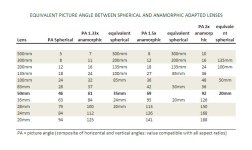
To make it simple I've made a chart that should make things easy for you. These values are approximate, different lenses will vary even from the same manufacturer and model and all anamorphics are bespoke, there was never enough of a market for proper industrialisation. However this rule of thumb should be enough to make it work in the real world.

equivalent picture angles - anamorphic vs spherical.JPG

NOTE: since these values are calculated off the picture angle (diagonal, like tv sizing conventions) err to the wider lens when the anamorphic PA falls between two values as only the horizontal is stretched.
 
Last edited:
Cool! So does anything with a PA over, say, 100 start distorting the edges? I was looking at some peoples test Anamorpic vids/pics and when they use lenses over around 100 the edges look awful, I've never seen a movie that seems to go that wide, does anyone seriously uses anamorphic over 100?
 
The PA (picture angle) refers to the diagonal angle, so the angle on the plane that bisects the top left and bottom right corner of the sensor. So in effect it is the horizontal angle and the vertical angle combined. Lens manufacturers use it because it is the same regardless of the aspect ratio of the camera's sensor. Which is why my figures are approximate because obviously the anamorphic only squeezes the horiztonal.

Now not all anamorphics are equal so it is hard to speak in generalities here without exceptions popping up but I'll try and outline some points that might be useful to your particular line of enquiry.

1.33x anamorphics such as those on offer during the transition in the industry from 4:3 to 16:9 were offered to allow owners of 4:3 DV cameras to get a couple of extra years out of their investment by producing footage that could be stretched to 16:9 from a 4:3 sensor. They actually prefer wider focal lengths and fall down at longer focal lengths. They attach to the existing lens. They have since been used with 16:9 sensor cameras because this creates native 2.37. I think it is about 85mm focal length that the image starts to deteriorate badly. They are in general softer than the following types with some edge distortion.

The next broad category are repurposed projection lenses. These are anamorphics that are intended for cinema projection but have been adapted by enthusiasts for taking. These work by attaching them to a spherical lens by means of a clamp. This is the most common kind. They are mostly 2x anamorphics, some 1.5x models and a few rarer other squeeze factors including variable. These usually require focussing both the anamorphic and spherical lenses which is time consuming and a pain. These generally require longer lenses. A wide lens will either vignette or the inside of the anamorphic barrel will be visible in the final image. 50mm seems to generally be the widest lens. I don't know of an upper limit on focal length but diminishing practicality is present in the longer lengths. I use mine with 50mm, 85mm, 105mm and 135mm, rarely have cause to pair it with my 200mm.

Finally there are purpose built designs that break into two categories, adapters (like above attach to another lens) such as bolex anamorphics, intended for taking and then attaching to the projector for playback, which are often focus through (just focus spherical lens); and integrated anamorphics which come with a calibrated spherical lens, single focussing. These are the most desirable and most expensive. These will pair with whatever spherical lens they are packaged with. I know there is a lomo 35mm, not 100% sure but I think there is a Hawk 28mm but I haven't researched what I can't afford.

Now with that out of the way back to your question. The edges will look bad on many of these anamorphic technologies for many reasons, first amongst that anamorphics will generally have soft edges. Just the nature of the beast. Some are worse than others. Some are actually pretty good but unless the two lenses are perfectly focussed these flaws will be amplified. To get good focus needs time, skill and good monitoring. On the crop sensor DSLRs the story is a little better because their sensor can't even capture the edges, the centre of the anamorphics provides the whole image.

I use mine on a 35mm lens adapter with a HVX. So by zooming out I get full sensor equivalent and by zooming all the way in I get crop sensor equivalent. Which leads to the next issue at the edges, vignetting. The closer you get to the wide 'limit' of the anamorphic lens the greater the vignetting, to the point you can actually see the inside of the lens barrel in your frame. With a full sensor equivalent I can use a 50mm lens with some vignetting, fairly okay by 85mm. Zooming in to crop sensor size I can use a 35mm lens with minimal vignetting by 50mm. These limitations can be worked around with careful framing but are there.

Then there is the fact that in the digital world you are going to unsqueeze it in post rather than at projection. This means that the pixels will be stretched horizontally. This will obviously result in a softening in the image. The upside is that the eye is more sensitive to vertical resolution and that the softening takes away some of the video harshness. Also specific to digital, it preserves the vertical resolution. Personally I like the look for the reasons others call flaws but it isn't for everyone.

So in summary, I don't think anamorphics will give you what you want due to the practical limitations I've described. I know of 35mm focal length integrated anamorphics but the cheap ones are in the thousands. Only professionals with a professional budget use those. The amateur stuff that you would have been looking at would be predominantly the projector lenses that I talked about. I've watched a lot of those videos and the quality is pretty low for the most part and I'd put at least part of that on the skills of the camera operator. People tend to hear about anamorphics, buy one, have a play, realise it's a PIA and get rid of them so it's mostly camera tests by people playing with their first one. There aren't many narrative amateur anamorphic videos.

You will be better off using the widest spherical you find acceptable and letterboxing it. Comfortable in the knowledge that an anamorphic won't deliver a wider angle without introducing vignetting, soft edges and other issues you find unacceptable. Whoa, lost track of time there. May be more information than you are after but hopefully addresses you questions in there somewhere. :)
 
Back
Top