Affordable Camera Jib Development - what features do YOU need?

Hi all,

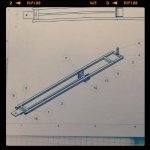
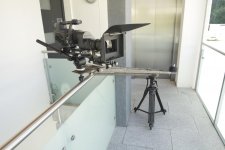
I am currently developing a camera jib, specs so far: (in european dimensions)


suitable cameras: from DSLR's to a full rigged EPIC
max. camera weight: 15-20kg
length from Tripod to Camera: 1,2m to 2m
nice movements through plain bearings
telescopic design - the current design only supports the counterweights to be moved back and forth to achieve a nice balanced setup.
smallest size (for transport) 1,5m x 0,2m x 0,15m, should fit in a normal snowboard bag for example.

weight:
the first prototype we are currently working on is going to be about 14kg - made of Steel and powder coated. I would consider building it from anodized aluminium, which would result in a third of the weight, but would also decrease stability a bit.

you will need two tripod heads and one tripod
minimum tripod recommendation as jib stand: weifeng FT-9901 (this is the one i will test it on) see here: http://www.weifengchina.com/pro/index_show.asp?id=16

with a tripod height of 0,8m you will achieve a height movement from 0,1m to 2,5m from floor (calculated for a 1,2m arm).


So my questions to all here in DVXuser are:

should i keep a fixed length for the arm?
if yes, how long would be a comfortable length for you?
if no, what range would you like to have on a slide out arm?
(always talking about the length from stand to camera)

would you need a bowl for your tripod head though you can level the jib on the stand tripod?
if yes, what bowl size will you need?

of course i will keep the price as low as possible, what are you willing to pay for a jib like this?
please keep the price range of other jibs in mind,
please add a comment for what configuration your price offer would be (tripod bowl, camera arm telescopic, length, material)

will you need a brake that rotates with the jib (for mounting the camera p.e), or would a simple safety pin be enough?

please keep in mind that every additional option will result in a more expensive jib.

please post any features you would like to see on a jib, that makes the work with it comfortable and easy to use.

i will keep this thread updated as good as i can, i will post some pictures of the production and construction process here soon.


thanks in advance, and please excuse my weird grammar in some sentences :)

regards

Stefan

EDIT: changed the transport length to 1,5 meters
 
Last edited:
Well I'm not in the running for a new jib as I already own two, and feel that there are already a number of jibs available. But if you feel the need to create one, my first suggestion would be... Don't manufacture one that needs to be mounted to a head, but rather make an integrated mount. People don't want to have to buy two heads to operate a jib, and often times will cheap out because of the cost of buying twice, meaning a limitation on payload and smoothness which they will blame on your jib.
 
The main features that I look for in a jib are...

1- Portable
2- Quick set-up ( less than 3 minutes would be ideal )
3- Stable with it's rated load ( smooth movement with no wobble )
4- Small enough to use indoors ( I shoot a lot indoors, so an 8ft jib arm is too big for a typical office environment )
 
Thanks for your reply David,
i know that there are several brands that provide good and professional jibs, but the pricetag for those are usually over 1200 $ without head and tripod, which is a lot of money in my opinion. I am looking to provide an affordable jib that can be used in the early stage of ones business, but can also be used if one gets advanced with a bigger camera setup.

I also thought of providing the suitable tripod + head for the stand for a additional fee so you could use your standard tripod head as jib head on the top, and quickly jump over to your sticks if needed...
 
The main features that I look for in a jib are...

1- Portable
2- Quick set-up ( less than 3 minutes would be ideal )
3- Stable with it's rated load ( smooth movement with no wobble )
4- Small enough to use indoors ( I shoot a lot indoors, so an 8ft jib arm is too big for a typical office environment )

would you say that a size of 1,8 meters is portable, how would you like to transport it? by car or even by plane? in my opinion a size of a snowboard bag is ok...?
i already considered the wobble issue, this was the worst issue of my first jib project two years ago...
4 to 5 feet would be the size i would be comfortable with.
 
From what I've seen of other jibs, something under 6 feet would be effective indoors and still provide a large range of motion.

Something like a slightly longer version of the EzFx Jr Jib, which has only 3 feet of movement. ( 3 feet of movement is kind of short )

EzFx Junior-Jib
 
From what I've seen of other jibs, something under 6 feet would be effective indoors and still provide a large range of motion.

Something like a slightly longer version of the EzFx Jr Jib, which has only 3 feet of movement. ( 3 feet of movement is kind of short )

EzFx Junior-Jib

the jib i designed will do the height of a normal room - about 2,5 meters (7,5 feet) with an arm length of 4 feet - so this would be a good solution for you i guess :)
 
hey folks, some updates here:

the prototype is ready - stable as hell, we will do more tests this week and see if we find some downsides to improve...

Things to do in the next weeks:

+ testing
+ modifying
+ testing
+ powder coating
+ testing
+ shooting more stills
+ obtaining offers for manufacturing the jib
+ calculating the price


_MG_5986.jpg


any opinions so far?

stay tuned, i will be back with more updates shortly...

greets Stefan
 
I dunno - I was just point out the to poster who thought the 3ft jib was too short that considering it is specced to a 50lb camera, it is already a significant counter mass load.

S
 
And this is something many people forget to factor into their max payload calculations. A jib designed to use a fluid head on a tripod will always be limited by the payload capacity of the head. For example... Your tripod may be able to hold a max weight of 50 pounds, and your head may have a max weight of 20 pounds. If you then add a jib weighing 10 pounds, a camera with monitor & battery weighing 20 pounds, and 40 pounds of counter weights, you have exceeded the max payload capacity of both your head and tripod. It's an accident waiting to happen.

For what it's worth, I travel with 100 pounds of counter weight.
 
Well usi9ng a fluid head it is worse than that

the head may be rated for 20lb

but the actual spec is probably "20Lb with the inertial centre* within 20cm of the head plate or suchlike"

The forces on the head under acceleration of of the jib are proportional to the inertial value, being the square of the distance of the mass from the head.

So I would suggest that a jib sitting on a fluid head with capacity of 20lb should have no more than maybe 5-10lb in total mass? about 2lb fro the camera and 8 for the entire mechanism including counter mass.

Jibs on fluid heads seem like a no go unless a naked DSLR is your game.

S

*probably not the correct technical term
 
Last edited:
thank you guys for your input, i really appreciate that!

morgan, its more the other way round - there are security factors calculated in the construction of every piece of device or machine. In mechanical engineering these security factor is by default from 1,7 to 2 but can also get up to 11 (on chairlifts for ski resorts for example), or more in very special cases.

So a 20lbs specced head will do around 30lbs to 40lbs without a problem.

But on the whole you guys are right, there is a significant load on a jib's head and tripod - since this issue was mentioned the first time I'm thinking of a capable "Just-Pan-Head" or however you wanna call it...

Do you think a "Fluid-Just-Pan-Head" is necessary or would a ball bearing unit do the job?

Should i provide a capable jib stand also?

What ball diameter would you prefer?
 
Of course there is a safety margin.

But the inertial sytem I outlined retained that, if not used it up by only halving the max load rather than dividing it by 4 or 8

A for making a pan tilt head I see no need for a fluid drag head as the system is inertial enough for smooth operation - this is where inertia is your saviour!


S
 
I think no friction is ideal myself - but im a steadicam nut.

I think no friction is acheivable, you may be able to to a three bearing head but unlikely can pull off even friction.. some thing that manfrotto struggle with!

S
 
I think no friction is ideal myself - but im a steadicam nut.

I think no friction is acheivable, you may be able to to a three bearing head but unlikely can pull off even friction.. some thing that manfrotto struggle with!

S

I also think that a normal bearing unit would give us really nice results... Three bearings would over-define the system, 2 bearings do the job easily...
 
hey folks, i'm back...
the necessary modifications are being done until tomorrow and i will give the jib another test ride on the weekend.

i also worked on the head - i'm currently planning a pan unit only, which provides a 3/8 inch thread to mount a half ball on the bottom.
So far, you will have to purchase this half ball separately - for example the Manfrotto 500BALL and the Manfrotto 520BALL are very affordable and would provide support for 75mm and 100mm bowls.

Do you see any disadvantages in purchasing that half ball separately from a camera store?
Will it be necessary to provide the half ball in a package along with the pan-head and the jib?

I will post some Pictures of the pan-head 3D-model tomorrow...

cheers and thanks for your attention

Steve
 
Back
Top