Aaton XTR Prod Color Tap Monitor

kassimnorris

Active member
Hey guys, Im about to shoot my first short on S16 and Im a proud owner of an Aaton XTR Prod cam now with a Color tap. Just curious if you guys have any suggestions of good but affordable onboard monitors to use with my setup? I will be shooting 50% on sticks and other half over the shoulder. When Im on sticks I would like to have a small on board monitor for framing and focusing purposes. Any suggestions from you guys would be nice. Thanks in advance.
 
Any small monitor that has composite video in (CVBS) will do. Consider that the groundglass image is quite a bit smaller than you may be used to from digital cameras since it is not full raster, so you may want to consider a larger monitor (7" vs 5") to compensate.

When Im on sticks I would like to have a small on board monitor for framing and focusing purposes.

This gives me pause. Bear in mind that the image you will be seeing from the tap is far, far inferior to what you may be used to from modern cameras. It is an approximation at best. Highlights will be blown out, shadows crushed, and the resolution of the picture area will be just a few hundred lines (standard def and as noted above, just a portion of the raster). It is very difficult to see critical focus in most situations on a film tap, especially in S16 where depth of field isn't as pronounced. And as far as framing--you should intend to do as much as possible through the eyepiece, resorting to operating off a monitor only when necessary, otherwise you will be more likely to miss issues in the frame. You have far more information in that eyepiece than you will from an outboard monitor.
 
Any small monitor that has composite video in (CVBS) will do. Consider that the groundglass image is quite a bit smaller than you may be used to from digital cameras since it is not full raster, so you may want to consider a larger monitor (7" vs 5") to compensate.


This gives me pause. Bear in mind that the image you will be seeing from the tap is far, far inferior to what you may be used to from modern cameras. It is an approximation at best. Highlights will be blown out, shadows crushed, and the resolution of the picture area will be just a few hundred lines (standard def and as noted above, just a portion of the raster). It is very difficult to see critical focus in most situations on a film tap, especially in S16 where depth of field isn't as pronounced. And as far as framing--you should intend to do as much as possible through the eyepiece, resorting to operating off a monitor only when necessary, otherwise you will be more likely to miss issues in the frame. You have far more information in that eyepiece than you will from an outboard monitor.

Hey thanks for responding, I'll start looking for those old Marshall monitors with composite video (in). I do actually own a Sony PVM on set monitor that I did some testing with so I can attest to your statement about not using it for exposure and nailing an accurate focus. I agree. Definitely not trusting a monitor for that. And I agree the eyepiece is by far superior. But, I for certain shots do need an external monitor since I only have a short VF eyepiece and not the long extension that would help in those situations for framing. The difficult shots I have will be very low near ground level and a monitor will be nice just for reference framing.
 
Yes, there are certainly situations where you can't use an eyepiece, of course. If I can continue to offer advice as I do with some of the younger operators I work with who didn't come up with film (you yourself may well have, so please don't be insulted--this may be useful for others who read this), it's very important in those situations to get your eyeball as close as possible to the camera to check for potential issues in the frame–flares, reflections etc–that may not be apparent on the tap. When I was doing a lot of Steadicam I would "walk the set" numerous times while it was being lit, looking carefully for such issues because I wasn't able to look through the eyepiece during the takes, of course. Remote heads on cranes were especially nerve wracking because generally you couldn't get to the perspective of the camera. Once we had a last minute change to a sweeping crane shot which resulted in a lot of crew reflections, and that take made it into the movie and was noted in the "goofs" section of IMDB--15 years later, still irritates me!

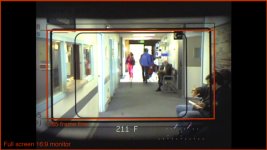
Another thing occurred to me about image size on the monitor, which is that the SD image will occupy an even smaller image size on a 16:9 display. Coincidentally I just digitized something off one of my old tap tapes from Scrubs the other day, which we shot on XTR Prods, so here's a representation of what that image would look like on a modern monitor. The red framelines are 1:85. On the show we were protecting 16:9 but framing 4:3, which is the innermost "pumpkin"--just a tiny amount of the video image! The better current onboard monitors will allow image zooming, which I think would probably be helpful to maximize your image for framing purposes (certainly won't help focus though).

scrubstap2.jpg

While I'm at it--I recently posted a fresh version of a clip I did around that time as part of a 30th anniversary of Steadicam tribute to Garrett Brown, which we shot on the set of Scrubs, with the Aatons in both studio and Steadicam mode.

 
Last edited:
Not insulted at all....I appreciate all the help I can get.....And YOU'RE FREAKING awesome for posting all of this. Very informative and it will surely help me out tons no doubt. Any other tips would be greatly appreciate.. I wouldn't be where I'am knowledge wise if it weren't for guys like you. I wish more industry professionals would be more open to sharing tips to us indie guys
 
Last edited:
Totally happy to help. I would think you'd be able to pick up an extended eyepiece for a song these days...I think we ended up using the one from the Aaton 35, but you need to always use a leveler with that because it's too heavy for the rotating lock on the camera body. The XTR is a glorious camera for handheld, a little quirky in studio mode, as I recall.
 
Boy this thread brings back memories! I can remember when I got my first color tap after shooting B&W for so long. Clients were thrilled that they could now watch a color VHS from the shoot.
 
I used to have an old Panasonic 7" SD monitor which was 16:9 (if you're familiar with the Star Trek series "Enterprise" with Scott Bacula, that monitor was embedded all over the bridge set). The monitor's zoom function would take a 4:3 image and zoom into the center which was just about perfect for me to frame the S-16 frame on my LTR54 tap (I had the Addy Boltersdorf B&W handle-mount tap). Most monitors offer this now so you should be able to get something close to the correct frame, but it will be pretty fuzzy. There are a lot of inexpensive LCD monitors out there these days, and a surprisingly large number of them will accept composite analog SD video. I found a few on Amazon for a project where everything was going to get destroyed in the process. Here's a cheap one -- $129!

http://www.amazon.com/Movo-LVM-7--C...32884&sr=1-1-spons&keywords=lcd+monitor&psc=1

Only thing I don't like is that it would require battery power, but you might be able to hack a cable to run it off the Aaton. That might cost you more than the monitor!
 
I was going to say, I may still have some Aaton accessory cables lying around from the old days...kassimnorris, if I can find them and you can use them, they are yours. Remind me, Mitch...on the older Aatons there was a 12v port that took a rectangular plastic connector, I want to say the brand was Amphenol? And then later there was a Lemo but I can't remember the configuration--four pin??
 
There was an Amphenol-9 on the older cameras and I think it may have stuck around into the XTRprod era. There were several Lemo plugs available, a Lemo-2 for the trigger, a Lemo-4 for timecode and a Lemo-6 for accessory power and other functions. Depending on the vintage camera (I used tosay that Atton model numbers were really by serial number!) the number of Lemo-6 ports grew and grew. Plus people often made breakout boxes with more ports on them because Acs always like to hang so much crap off every camera. Can't have enough power. Even the later model Li-Ion batteries had a Lemo-6 right on them, years before other companies thought to stick P-Taps and other sockets on video batteries (Aaton always ahead of its time).

Ah, a trip down memory lane. Surprised I recall that much. Always loved the Aatons, best damn designed cameras in the world -- inside and out. The wonderfully engineered film movement that was wholly unique to Aaton literally revolved around a single eccentric cam. Tuning it came down to the tightening of -- I kid you not -- a single nut. So just as the heart of Aaton the company came down to the enigmatic Jean-Pierre Beauviala, so too did the heart of his camera come down to the disposition of the Eccentric Nut. ;-)

Hi Mitch, a great post as usual and good to see you poking around on this side of the "digital wall" too……..
Couldn't agree more regarding the Aaton, ( and JP's quirky genius ), being the "best damn designed camera in the world".
Against all "good advice" I never could sell off my Aatons, still have the A-Minima kit and the truly wonderful Xtera that you helped me upgrade my Prod' to all those years back when you were at ACT. I think it was then the first US Prod' to Xtera upgrade, and I've never regretted that move.
The cameras are now back in their "homeland", France. where I now live most of the year……..and even still roll film through them as and when I can.
If only Kodak still made 800' loads, I love those Aaton 800' mags!

All the best Mitch for 2016 and onwards,
Peter
 
You guys rock! thanks for all the feedback. Mitch, thanks for sending that link I didn't know I could get a monitor so cheap...This will certainly help my pockets. CharlesPapert, HUGE THANKS...yea that would be awesome! That would definitely help. Oh and guys I forgot to mention that my XTR PROD also has a BNC output as well which I've used to get an external image on my Sony PVM 8020. If I use the BNC out wouldn't this route give me a somewhat better image
 
You guys rock! thanks for all the feedback. Mitch, thanks for sending that link I didn't know I could get a monitor so cheap...This will certainly help my pockets. CharlesPapert, HUGE THANKS...yea that would be awesome! That would definitely help. Oh and guys I forgot to mention that my XTR PROD also has a BNC output as well which I've used to get an external image on my Sony PVM 8020. If I use the BNC out wouldn't this route give me a somewhat better image

Which video assist do you have on the Prod', the VSA colour tap or the B+W?
They both have a BNC video out which is composite, so any composite monitor should work just fine, ( like Mitch's suggestion, perfect! ).
Simply connect the tap's BNC video out with the IN port on your Sony PVM 8020 and if everything's turned on you should have a picture.
With the Aaton VSA colour tap the you should also be able to access the tap's set-up menu on your PVM 8020 too.
If you decide to go with an on-board small LCD you really needn't bother too much with having an expensive custom power cable made, most small LCD's are good with power consumption and anyway most too can be run off of regular AA's or re-chargeables, that's what I'd do. I occasionally run a 7" Ikan as an "on-board" with my Xtera that way, no problems.
Good luck, the XTR is a great tool!
 
I'm guessing that your videotap has two outputs, one a BNC connector and the other an RCA socket. The signal out of each of them is identical. I always liked to use the RCA socket for cable feeds going off to remote monitors, so that if anyone tripped on the cord it would simply pull out rather than damage something. For an onboard monitor it doesn't really make a difference.
 
Hi Mitch, a great post as usual and good to see you poking around on this side of the "digital wall" too……..
Couldn't agree more regarding the Aaton, ( and JP's quirky genius ), being the "best damn designed camera in the world".
Against all "good advice" I never could sell off my Aatons, still have the A-Minima kit and the truly wonderful Xtera that you helped me upgrade my Prod' to all those years back when you were at ACT. I think it was then the first US Prod' to Xtera upgrade, and I've never regretted that move.
The cameras are now back in their "homeland", France. where I now live most of the year……..and even still roll film through them as and when I can.
If only Kodak still made 800' loads, I love those Aaton 800' mags!

All the best Mitch for 2016 and onwards,
Peter
Hi Peter,
Yes, yours was either #1 or #2 that was converted back in the day. Dual battery mounts really helped both the balance and the run time. I had planned to keep my old LTR until its only use was as a displayed piece of design art on my shelf, which it would have been terrific as! Alas, I couldn't justify it and my wife made me think more pragmatically.

All Aaton owners remember their camera's serial number, because it was their baby. I had 1215.
 
I'm curious about the manual iris 'lever' on the XTR prod . . .

In the user manual it says:
"Under normal operation, this mechanical iris should be wide open. When further light control is necessary, look at the video monitor"

I don't typically use the VCD, but under "normal operation" would "open" mean that the lever is facing FORWARD toward the lens/front of the camera?
 
I honestly cannot remember which way the thing faced but the function is pretty obvious when you use it. Move the lever and the iris opens or closes, allowing in more or less light. Adjust it to the appropriate brightness for the film stock you're shooting with. That's it, don't over think it.
 
Yes, there are certainly situations where you can't use an eyepiece, of course. If I can continue to offer advice as I do with some of the younger operators I work with who didn't come up with film (you yourself may well have, so please don't be insulted--this may be useful for others who read this), it's very important in those situations to get your eyeball as close as possible to the camera to check for potential issues in the frame–flares, reflections etc–that may not be apparent on the tap. When I was doing a lot of Steadicam I would "walk the set" numerous times while it was being lit, looking carefully for such issues because I wasn't able to look through the eyepiece during the takes, of course. Remote heads on cranes were especially nerve wracking because generally you couldn't get to the perspective of the camera. Once we had a last minute change to a sweeping crane shot which resulted in a lot of crew reflections, and that take made it into the movie and was noted in the "goofs" section of IMDB--15 years later, still irritates me!

Another thing occurred to me about image size on the monitor, which is that the SD image will occupy an even smaller image size on a 16:9 display. Coincidentally I just digitized something off one of my old tap tapes from Scrubs the other day, which we shot on XTR Prods, so here's a representation of what that image would look like on a modern monitor. The red framelines are 1:85. On the show we were protecting 16:9 but framing 4:3, which is the innermost "pumpkin"--just a tiny amount of the video image! The better current onboard monitors will allow image zooming, which I think would probably be helpful to maximize your image for framing purposes (certainly won't help focus though).

View attachment 109011

While I'm at it--I recently posted a fresh version of a clip I did around that time as part of a 30th anniversary of Steadicam tribute to Garrett Brown, which we shot on the set of Scrubs, with the Aatons in both studio and Steadicam mode.


I've never worked with film, so this info was useful for me, thanks!
 
https://www.mica.edu/Documents/VideoAndFilmPdfs/Aaton XTR prod User Guide.pdf

This answers my question -- the lever should be facing toward the front of the camera/right under normal function, when the CCD is not being used (page 46).

Once again, I am NOT using the CCD and I never do.
If the iris is not wide open, under normal function, does the positioning of the lever effect the actual EXPOSURE of the film when the camera is rolling? Also, would it effect the readings on the light meter?
 
Back
Top