A new audio challenge...

I've been tasked with covering a seminar and have enclosed a picture to give you the layout...what would be the best way to mic the participants so when they blurt out questions or comments I can get decent audio. Putting wireless on everyone is beyond the budget (over 16 people usually). Booming probably isn't practical due to randomness of folks speaking, by the time the boom op got there the comment would be over...also people like to talk on one side of the U then the other so boom op wouldn't work too well. Also, I cannot disrupt the flow of the seminar by interupting and having people repeat comments/questions, especially if its something funny. The room is very "live" and I've used a parabolic in the past with very echoey results. So any ideas on how to cover this wide area would be greatly appreciated.
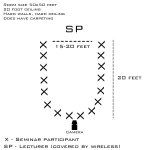
 

Attachments

  • seminar setup.jpg
    seminar setup.jpg
    32 KB · Views: 0
Are they sitting at a table? If so, then boundary mics spaced around the table. I'm using an Electro Voice RE90 and it has been good so far. You can space it in kind of a 1 for 3 type alignment, though the person in the middle will be picked up louder than the other two. Ideally, a 1 for 2 type of alignment would be better, splitting the difference between the two.

Phil
 
Oh sorry, there is no table between them. Its an open U shape where the lecturer often walks between the participants. How effective would the boundary mics be if they were on the floor in front of the people? Also with 16+ participants I'd need at least 5.
 
automatic mic mixer and lavs

automatic mic mixer and lavs

You can rent wired lav mics fairly inexpensively. I would then also rent two to three automatic mic mixers. Eight channels each. If you can't rent three then run the output of the auto mixers into a conventional mixer and mix any overflow participants manually. This will take care of the spontaneous nature of the event (except for wiring up people before it starts) and help with the poor acoustics. You won't have to have a bunch of mics to ride (and probably miss comments) adding to the room acoustic problem. I've done many shoots similiar to this and the solution I'm proposing isn't theoretical. It will work well for you.
Regards,
Bernie
 
I've had to do exactly the same thing earlier this year, and I ended up buying a bunch of fairly inexpensive boundary mics made by Samson.

Samson CM10B Unidirectional Boundary Mic
http://www.bhphotovideo.com/c/product/330987-REG/Samson_SACM10B_CM10B_Boundary_Microphone.html

Samson CM11B Omnidirectional Boundary Mic
http://www.bhphotovideo.com/c/product/330988-REG/Samson_SACM11B_CM11B_Boundary_Microphone.html

The sound quality is actually quite good, but the supplied cable is a piece of spaghetti, so you will probably want to replace it with a custom TA3F ( mini-XLR ) to XLR cable.
 
Boundary mics, where did you place them and how many did you need for how many folks? Did you have them on the floor? Would you happen to have any audio samples from the recording? What combination of the omni and unidirectional did you use?

Thank you for all of your replies!
 
Boundary mics, where did you place them and how many did you need for how many folks?

I was working on a fairly small budget, so I bought 6 of the Samson CM11B omnidirectional boundary mics ( I couldn't find any rental equivalents ) and connected them to a Mackie 1402-VLZ3 mixer that I rented. I went with omnidirectional mics because I wasn't sure how wide the pic-up pattern of cardioid version of of this mic was, and I couldn't afford to buy too many.

21 people around a large U shaped table, each mic sat on innermost edge of the table, which unfortunately picked up some table noise. The mics were evenly spaced around the table.

Would you happen to have any audio samples from the recording? What combination of the omni and unidirectional did you use?

I am under NDA with this corporate client, so I can't post any samples. The sound quality was OK, not great, but clear enough easily hear what people were saying.

...If I had to do it again, and I had more money to spend, I would probably use cardioid boundary mics ( more of them ), and find a way to make them less susceptible to table noise. ( thick foam pads ? )
 
Okay, thank you! The issue is though, that there is no table in my shoot. The chairs are arranged in the U and its just empty floor space in between, so I would probably have to put the mics on the floor in front of everyone and try to keep them out of the shot. What I had been using was a parabolic, but in a live room...well it gets pretty echoey!
 
I can see your challenge here. A lot of marks against traditional techniques. What about a stereo mic like a Rode NT4 or Audio Technica AT825 (both balanced and terminate to dual XLR connections--L/R) put up on a boom mic stand located at the camera perspective, but set up higher? Seems like the seating layout is pretty similar to how the mic would pick up, so if you boom it up high enough and then point it down towards the plane of speech, I would think you could yield better than acceptable results.

This is the first thing that came to mind, but certainly isn't the only workable option.
 
The issue is though, that there is no table in my shoot. The chairs are arranged in the U and its just empty floor space in between, so I would probably have to put the mics on the floor in front of everyone and try to keep them out of the shot.

Boundary mics work quite well from the floor, provided it's not a hardwood floor, which can be quite noisy from people walking and moving their feet. The audio quality would definitely be much better than what you would get from a parabolic mic.

Another option to consider is mounting the boundary mics on the ceiling. If the ceiling is low enough ( standard office ceiling ), they might sound a bit better than being placed on the floor. ( boundary mics can be placed on tables, the floor, the walls, or the ceiling )

I'm not sure a boom'd mic would be a great choice because of the distance between the mic and the people being recorded. Multiple mics closer to your subject are going to sound better.
 
Boundry mics (PZMs) can work well but if anyone is hitting, thumping, kicking the table or setting water bottles down and picking them up, forget it.

If it were me, I would mic them overhead using 4 Audio-Technica or Electro-Voice choir mics. These mics are designed to pickup large groups from 5-8' away so 3-4 would cover your group. They look like a large lavaliere and are mounted from the ceiling and hang down.

I own two and they can work well for these sorts of stupid audio situations where people present you with an impossible sound situation, no budget and strict limitations about what you can do, then expect perfectly legible audio. I don't miss corporate/event type of jobs at all.

Good luck,

Dan
 
Ah! You truly understand my pain, no budget and no interference! ha ha

It is carpeted but people definitely fidget because its 2 days at 8 hrs/day...so mics on the floor will pickup rustling of paper pens etc, where overheads would get the voice better I imagine. Though for this location with 20 ft ceilings it may have been tough to hang from the ceiling. Hopefully the next location will be standard office with hanging ceiling panels.

I guess what I should do is try to orchestrate some experiments to see what works better. Thanks again for all your input...I'll post back the results of this endeavor.
 
My Idea??

My Idea??

Is the idea I suggested beyond your budget and/or are you concerned about seeing cables and micing the participants? Or is it the thought of too many microphones to balance? Can't help with the budget but if you want decent sound this is a very good way to go. If the cables are the issue route them around the back side of the chairs and you won't see them in the middle of the floor. You probably won't see them much if at all. Route the cables , one to each chair, then when you wire up the people just plug them in as they are seated. The auto mic mixer is easy to use and will only leave the last mic on until the next person speaks. This greatly reduces the effect of the room in the mix. The lavs being closer to their mouths than you can possibly get anything else will also help that situation. The choir mic idea isn't bad but would require some rigging that might be more time consuming than micing everyone and will still get more room into the mix. As I said before I've done this numerous times and it will work very well for you.
Regards,
Bernie
 
I am going to try to experiment with the choir mics and the boundary mics. Meaning, I'll get some folks to act as guinea pigs and see if I can rent the various mics and see how they perform in a "typical" room this will be shot in.

To answer the question, why not put lapels on all, that would be ideal. The problem is that people get up, go to the bathroom, they have breaks every hour, they move all the chairs around to form discussion groups several times. They'll forget they have them on and start walking... So that means I would have to disconnect them, reconnect them, unwire them all many times during the day. The seminar is a total of 16 hours over two days, with anywhere from 12-26 people. I hope that explains why wired lapels would be a daunting undertaking.

Thank you again for all of your input, its been very valuable in figuring out workable options!

Now this is an interesting option too (for rental anyway) http://www.audio-technica.com/cms/wls_systems/e7dd603ca6147a97/index.html
 
I get it

I get it

I see now why the lavs won't do it for you. I would still urge you to consider the auto mix idea if the choir or pzm mics are giving you too much room. Hope the presenter walking into the area you have the pzms placed in (if you go that route) won't be a problem.
Bernie
 
I agree that floor pzms could be a problem, though the floor is carpeted. When I get a chance to do the research on overheads v. pzms I will post the results back here so everyone can benefit if they ever find themselves in my situation! ha ha

Tell me more about these "auto mixers" I've never heard of them?
 
automatic mic mixers

automatic mic mixers

They are mixers that turn mics on and off automatically when they "hear" the signal. Shure makes one, Audio Technica has a model, also Lectrosonic and some others. The most commonly used is the Shure. They are available in four and eight channel versions. Four or eight in and mono out. They are very simple to use. Just a single pot for each mic with a signal indicator light. The units can be ganged together and then the output will come out from a single xlr. They are microprocessor controled so its very rare to miss anything . One mic is always left on till the next channel is activated so the ambiance of the room doesn't pump up and down. It will activate as many channels that are receiving sufficient signal so a free form discussion with people talking over each other is possible . The alternative would be to have all of the mics potted up a certain amount and covering as many faders as you can with your eight fingers and two thumbs. Think of having say six mics up two thirds of the way (so you have a chance of getting the correct fader up enough to get a good signal) and you still have the off axis sound from the other open mics adding to the noise and roominess of the sound. Compare that to only one or two mics open at the same time, at the correct level setting. I don't know if this is post produced but I hope you are separating the presenter on the wireless to his own channel on the camera.
I've done a group as large as 25 at a table with lavs (didn't have as much concern about clunking glasses on the table) and the results were amazing. You won't get as direct a sound as lavs if you use pzms or overhead mics but it will be better than you can mix manually, and you won't be insane by the end of the seminar.
Bernie
 
Back
Top