60Hz hum and how to avoid

Ed Kishel

Veteran
I'm building a (very) basic backup system for my legal depo kit. My main kit will be an AC130a, a Shure MX367 mixer, and 6 balanced XLR lav mics with shielded cabling. It all meets NCRA guidelines- but I wanted an 2nd "emergency" kit should something catastrophic happen. I dont want to tell a client everyone has to go home 'cause I have technical issues.

The backup system is made up of hand me downs- a Panasonic miniDV AG-DVC60 (on AC power), 4 unbalanced Pyle electret condensor lav mics (1 AA powered), and a Radio Shack 4 channel mic mixer (9v batt power). It's all consumer stuff- but sounds suprisingly good. Not bad considering what I paid for it- $50 for the mics and mixer. It's bright and clear without much hiss or noise. For a backup I hope to never need- it works well....

...when I'm able to get rid of the hum I hear. It's faint and goes away when the cam is on battery power, but I have only 1 weak battery for this old camera, and want to use the AC adapter for power. This AC/DC adapter I'm sure is causing the hum. As I have already gone over my budget with my main kit- I want to avoid having to buy a bunch of new batteries for a kit I will probably never use. My goal for this backup system is that it never leaves my trunk.

I've gone through all the usual suspects- not crossing cables, checking the connections, isolating the power cords. It gets really loud when I touch one of the microphones. The only thing that helps is when I touch the chassis of the mixer or the camera's metal eyelet for the shoulder strap. The mixer does have a little screw on the back called GND. Is there something I can do- or is this standard for consumer gear like this. A link to a photo of the setup is below (if it helps).
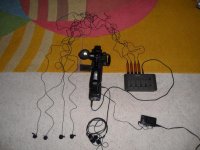
SAM_0322_zps56ba26e6.jpg

thanks!!
 
Last edited:
10yrs ago I remember the Panasonic GS400 camera had this hum problem when it ran on its AC adaptor. Try grounding the mixer with a wire from GND to the cam, or buy a new cam batteries.

But if you have to resort to using your backup, it'll probably only be because your AC130a goes down. For a backup kit, try the DVC60 with the Shure mixer
and 6 lavs. Use fresh batteries in it.

Cheers.
 
Last edited:
dave: yea I figured it was a ground loop- but some depos can be up to 8 hours long and I'm not going to spend close to $600 in batteries for something that will most likely never get used. As an emergency backup- I can live with a subtle hum.

mhood: I have the beachtek version of this box- and although it helps slightly, it doesn't rid it completely.

What is interesting is when I touch the camera chassis it stops. The human body is providing some sort of resitstance? I don't know about those sort of things- but I'm sure someone who is skilled in electronics could solder up some sort of resistor to an aligator clip that I could attach to the shoulder strap mount that would kill the hum much like my finger can.
 
Last edited:
mhood: I have the beachtek version of this box- and although it helps slightly, it doesn't rid it completely.

The XLR-PRO has a two position ground lift switch...that has meant a lot for me in the past. You might try a DI box with a ground lift.
 
It CANNOT be a ground loop if the DC supply is two wire and the AC adaptor has no ground connection - the cable in the picture looks to have a figure-8 connector. The touching of the chassis with your body is not grounding it - unless you are daft enough to grab hold of a water pipe or radiator, or some proper ground connected item. The problem will either be poor smoothing if the PSU is an old fashioned transformer/bridge rectifier design - and your touching it adds capacitance - but if the PSU is a small switch mode design, which many often are, then the noise comes from the psi. Touching it again changes the coupling and usually makes it quieter (but sometimes makes it worse!)

One thing to try is a choke - the lumps often found in the dc cables nowadays. You can buy these ferrite devices if you want, but you can make a better one yourself if you have the bits. An old loudspeaker that you can break apart and remove the circular magnet from. Wind a few turns of the dc lead through it - secure with tape and try it. The result is often really good - doing the same kind of thing as touching the chassis - but usually better!

In the UK, taking a ground cable from the chassis to the ground connector of our power outlets is a strict NO NO. We have very strict rules. Two conductor mains systems must be double insulated - with no path for the ground at all - and grounding these manually removes the protection. Ferrite rings work pretty well. Still not well enough to cope with Dell Laptop PSUS, which are evil.

Ground loops are formed when the system is grounded at multiple points that are at a different potential - which generates a small current in the loop which is what makes things hum. No ground means no ground loop. One ground also means there can't be a loop - two are required as a minimum!
 
Hi

Get some flexible multistrand wire with green cover and first test by running it to a AC plug adapter that converts the two prong camera AC plug to a three prong grounded plug. Attach the wire to the little green tab that sticks up from the three prong adapter (and goes to the third prong of the adapter internally). The other end try attaching to the mixer ground and or the camera ground (the strap) or both. A traditional ground loop loops through 2 or more paths in the buildings electrical system. In your case everything is floating. But something obviously needs to see a ground. So you are going to let it find its way to ground without your finger having to be there. Total cost should be around 3$. Yes it's another wire but also a solution. If this works you can make it all look pretty and stronger with a soldering iron. Good luck.
 
Hi
I was typing when Paul posted above. Great advice. I can't speak to the legality in Arizona of a consumer violating the double insulating properties of a device. His Ferrite Choke advice great. Often the offending signal runs along the outside of a conductor and can be interrupted by the ferrite choke. Sometimes on high quality patch cords of various kinds you will see a built in ferrite choke. It can take some playing around to get the right value.

Paul's explanation of the psu is really very valuable. Thanks Paul.
 
Yes Paul it's a figure 8 cable from the wall to the ac adapter. I will try your idea of the magnet- old speakers are cheap at the thrift store. Will check back in soon to update my progress.


thanks again guys :)
 
I carry IL-19 ISO transformers when interfacing with A/C powered gear. However ISOs are considerably more expensive than some of the other suggestions.. If they work. I would assume the IL-19 would remedy the problem.,
On unbalanced connections, a DI with a ground lift would be a first go-to. The Rolls DB25 is affordable a around $30USD.
 
That ferrite ring is worth trying, but quite small - so wrapping a few turns of cable (with the plug) might be tricky. There is a video on youtube at the moment that shows how risky lifting grounds can be. For years, hum removal was done by lifting the protective ground in the power cord connector - nowadays, doing this (in the UK) would be a great way of showing gross misconduct, and getting fired!


Watch the guy in the middle go rigid, and fall over, then the person touching him getting a shock.

Grounds save lives - lifting via DIs or transformers makes sense - but in this example, PSU noise is the likely cause, and lifting grounds might change the hum tone, but probably not remove it. Nothing will shift my rubbish Dell laptop PSU noise.
 
Back
Top