4k for moonlight in the desert?

colfaxrev

Member
I'm trying to complete my list for necessary lights for a night desert shoot.

I'm going to need 2 generators (Honda 7000 EU and Honda 6500). Honda 7000 is going to power 1 single 4k fresnel i think, and the other will handle 2-4 kinoflos and a couple small lights on some shots.

I'm wondering for the Canon T2i, if a 4k light raised up pretty high pointing downward will be a good base to start with as the moonlight before adding soft fills with the kinoflos.

do you think the 4k is too much? not enough? maybe I only need a 2k? I can't get a generator to handle any more than a 4k fresnel, so that is my limit.

This is a horror piece (10 min short) and i think in this case less is more. I just want a decent moonlight coverage on top.

Also 4 characters pull up to this location in a car, so I think I may need some smaller florescent lights inside the car somewhere (maybe gaffed to the top inside the car), but very minimal.

I'm using the fastest lenses I can get my hands on from a friend, so hopefully it works out

thanks a lot in advance! i appreciate all help from you guys
 
Let me start by saying I've never lit a scene quite like this... but hey, that won't stop me from giving advice.:)
My first thought is that a fresnel is not the most efficient light. A fresnel gives a very high quality, controlable light, but you'd probably get more light-per-watt with an open-face light. My second thought is that you haven't said how large an area you need to cover. Will the audience be able to see far into the distant landscape? And are you going to let that go dark? And just out of curiosity, how high up will the keylight be, and what are you going to use to elevate it?

Good luck!
-- Ken
 
Your 4k HMI is going to give you pretty decent bang, but it depends on how large an area you need to light, as well as how high you're willing to push your ISO, and how fast your lenses are.
Are you going to diffuse it at all? If so, with what?

I recently shot some outdoor night stuff using a 1.2k HMI PAR as the moonlight, though I was shooting on Alexa rated at 800 with Superspeeds. We also weren't trying to cover a massive area.
A Gaffer friend of mine recently lit a night scene on a stage, faking a car moving at night using a 1.2k HMI PAR gelled with 213 and 205, with a large softbox w/grid on the front of it as the moonlight, then lit the car interior with Mini-flos.

Mini-flos, sometimes called the Kino car kit are pretty useful for lighting up cars, and plug straight into your car's 12v power socket.

Are you planning on motivating all your lighting from the moon?
 
Just wanted to say if you're using this method, please have some item lit in the far background. It doesn't have to be clear or even be from a light source you provide. It just has to be steady and consistent, to give a sense of depth. Otherwise the effect will be that you've shot on a sound stage (good, of course, if you're going for that effect.).
 
thanks for all the feedback guys! especially lighting pieces in the far off in distance if possible! I think with my limited gear i will only be able to throw a kino pointing at the ground in the distance, as long as its vague it may work. I'll have to get some 50 footer stingers.

as far as how to spread the 4k, i think i was just going to throw a chimera on it, I'm not sure how high I can raise it, i need to make sure that stand is really secure. I don't want wind tipping the think over.

I MAY be better off using 2 2k lights not quite as high up and try to cover the same area.

I'm just trying to cover a parked car and let the vastness/darkness/endlessness of the desert instill some alone-ness and fear of unknown. but i would like to light up some land far off (as i can extend cord to) for depth.

and yes, moonlight is the main source. all fills are going to be very subtle just so we can see hints the characters. enought o get to know them and care about them, but allowing darkness to play its role

my biggest hurdle so far has been trying to work out the film permit. I've been scouring different areas surrounding Los Angeles. Palm Springs surrounding deserts, the film commission in that area is trying to charge $250 a day for filming. like their deserts are made of gold. I've been looking into Nevada instead, and it seems like they just want 40 bucks or so for a permit plus the insurance. Hopefully that works out since I think this will take 2 nights of filming. I've never had to deal with permits before, didn't realize it was such a pain calling film commissions all over. Defeinitely can not guerrilla it on this, because we're bringing dolly/track and 2 generators and lights. so it has to be legit unless i want to waste everyone's time and my money haha

luckily my mom works at state farm and she MAY be able to get the insurance stuff i need for a bit cheaper than calling up a film insurance company

thanks again for the tips and suggestions
 
i need to make sure that stand is really secure. I don't want wind tipping the think over.
Throw a few shot bags on it and you should be sweet. If the rental company gives you proper stands for the 4k, they're generally ones that are meant to go high.

I MAY be better off using 2 2k lights not quite as high up and try to cover the same area.
As in 2k tungsten? Well sure, if you're not gelling them... Keep in mind, if you want that blue moonlight effect: CTB gels cuts your light by 70%, so you wouldn't have the same light output anyway. A 4k HMI is already dayight balanced, so you've got a full 4k of blue/daylight light.
 
If you watch behind the scenes from the movie "flight of the phoenix" they talk to a great length to the lighting as well as cinematography techniques they used in the desert. They used a MASSIVE balloon light for the daylight shots, and I recall they did some night time shoots in that film as well that were faked. (day for night)

Your desert night scene sounds like it might be the perfect candidate for a "day for night" shoot. This would give you all the free light you want and since in a desert you will not get a vast array of shadows it will look real and can be pulled off, plus you can get very wide establishing shots to really sell the location. Just shoot 1 stop under exposed and apply bluish tint or other effect in post.

Check out a tutorial @ http://www.videocopilot.net/tutorials/day_to_night_conversion/

The disadvantage shooting in the day of course is sweating your pants off.
 
Last edited:
2k will probably work for close-ups, but that's about it. I recently attempted lighting a night-scene with a 1.2k HMI as moon light and it was pain (luckily a lot of close-ups saved it). Especially with a camera like the T2i, less rarely is more. It has terrible compression and renders details at about the same range as the latest iPhone in video. You could probably work the background with a pair of 4-6k HMI's, and a 2k on the actors - But honestly if you're bouncing the light you'll need to pack more punch or you'll be shooting so open your focus will be all over the place.

[EDIT]
I second the 'day for night' suggestion. It requires a bit more of a careful approach in order to look natural, but your result has a greater chance of looking.. not like crap.
 
thanks so much for the input guys! i've been thinking about the day to night conversion. I'm going to go out on tuesday and do some test shots. I guess since it's probably going to be harsh direct sunlight i'll go rent a butterfly set 20x20 type of deal, and a reflector. i'll see what kind of results i can muster up.

I'll post them up and i will definitely welcome any feedback you guys can offer me!

also, after researching all the costs of film permits and general liability insurance. the cheapest total i could find for permit and insurance was about 750 bucks for 2 days out in the desert SOO, I think this may turn guerilla, idk what kind of fines you have to pay if you get caught for that

I'll also have to ditch the dolly setup for a simpler stabilizer situation so it doesn't look as big incase CHP somehow spots us.

I guess doing it during the day is also not as obvious as blasting a 4k at 3am hahah.
 
@brynsank or anyone interested

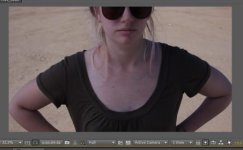
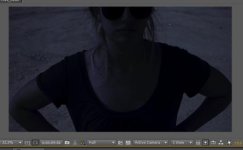
I rented a 6x silk butterfly set, and a big bounce board. This result is very flat, but when I do it for real i'm going to have kino flos to add soft fills in front, I make take a 2k for additional backlighting to make it more 3 demensional on the people. I'm going to throw ND on in the matte box and stop down to really darken things up. I want the kinos to make mainly the subject the only obviously visible thing in the frame. I want the background to be there but dark and vague. Here is the daylite to nighttime conversion from a pretty flat no highlight situation.

dayLight.jpgnightTime.jpg

the 6x silk softened the shadows to a good moonlight shadowing. when I do it for real I think i'll need a 20x.
 
one thing I did notice was with the 6x (i only had one combo stand + lollipop to hold it), was prone to swinging in the wind and possibly giving a concussion to someone! so i anchored it better with a c-stand on the other side.

I will have more stands for the 20x, but I'm afraid of creating a HUGE kite with metal frames that could damage people or things. Is there a tutorial or guide to locking down and safely securing a 20x silk butterfly set? Tent stakes? mallet? a **** load of sand bags? any advice on that would be greatly appreciated! I don't want to knock out/kill the talent or myself haha
 
You don't want to pull back on the exposure the way that you have now on your day-to-night conversion. Use flags - get a bit more contrast in there, and then simply pull back the highlights slightly and shift the mid/highs a bit to the blue side. Right now it's looking like you actually shot it at night with no lighting at all, and that's not a look to be going for.
 
You don't want to pull back on the exposure the way that you have now on your day-to-night conversion. Use flags - get a bit more contrast in there, and then simply pull back the highlights slightly and shift the mid/highs a bit to the blue side. Right now it's looking like you actually shot it at night with no lighting at all, and that's not a look to be going for.

yeah im definitely not going for that effect. i do want to pull back on the exposure though, because when i really do it i'm going to use lights to create the highlights. I only had a bounce board with me for that test.

You are looking just at my base before I actually add any lights.

I want to darken down the base lighting before I add the 3 dimentional lighting on the actors. The effect should be that the background is almsot pitch black but you can make out subtle details.

so imagine I pull back on the exposure or ND filter it with what you see here, and THEN add 2k backlight and kino flo fills
 
I could comment on a lot of information on this thread but I'll stick to the two things I think are the most relevant:

Please don't go about rigging a 20x from a tutorial. Bring at least one grip who is truly experienced at rigging these. There are certain conditions under which a good key grip will tell you that it is just plain dangerous to fly a 20x, period. You need to know what those are. As you said, "I don't want to knock out/kill the talent or myself haha". No you don't, and there is no place for the "haha" in this discussion. Sorry to be so stern, but it's a safety issue and it ain't cute.

Second: if your plan is to underexpose to the point where shade (via the silk) is two to three stops under, consider that your units now have to be brighter than that level. Remember that the original plan with your 2K's and kinos was to use them in pitch black--now they are intended to be used in broad daylight (the knocked down exposure under the silk will be negated in the equation by the stopped-down day-for-night look, so mathematically, the base level is roughly the same as direct sun). It should be apparent that these units won't be enough to overcome these levels, unless they are used very close to the subject.
 
Looking at your test, it looks good, nice and flat.

I might suggest you try skin +1 over that sand in the background when the time comes.
 
Looking at your test, it looks good, nice and flat.

I might suggest you try skin +1 over that sand in the background when the time comes.

sorry for my newb-ness but what is skin +1... my best guess is some way of darkening the sand behind the subject? is that a huge amount of some type of material?

thanks for the help!
 
Sorry I am newbie too, I meant your skin light levels +1 stop brighter than that sand. On waveform monitor you might get the skin 10ire brighter than sand. Your camera spot meter can also tell you ire level.
 
Back
Top