4K assignment help

Not sure if this is the right section.

I have a few questions about my university assignment.

here is the assignment:

"A post production house has made the decision to go 4K in its post production workflow, for both cinema and broadcast post production.
You need to prepare an analysis report on the complexities and challenges of adopting 4K 4:4:4:4 workflows.
Refer specifically to the outputs from the 3 lead digitial cinema cameras.
Compare the capabilities of 4:2:2 colour sub-sampling and why 4:4:4 is superior.
What hardware/software do you suggest the company invest in?
How can NLE's handle 4K?
What impact will this method of working have on the network infrastructure of the company.
Uncompressed recording, editing, grading and transfer is a priority for the company."


I don't understand why 4:4:4 subsampling would be better for 4K.

Would you need a different 4K camera for cinema than you would need for broadcast television?

I also don't understand the last 2 sentences of the brief, about network infrastructure, etc.

any links would be appreciated
 
Not sure if this is the right section.

I have a few questions about my university assignment.

here is the assignment:

"A post production house has made the decision to go 4K in its post production workflow, for both cinema and broadcast post production.
You need to prepare an analysis report on the complexities and challenges of adopting 4K 4:4:4:4 workflows.
Refer specifically to the outputs from the 3 lead digitial cinema cameras.
Compare the capabilities of 4:2:2 colour sub-sampling and why 4:4:4 is superior.
What hardware/software do you suggest the company invest in?
How can NLE's handle 4K?
What impact will this method of working have on the network infrastructure of the company.
Uncompressed recording, editing, grading and transfer is a priority for the company."


I don't understand why 4:4:4 subsampling would be better for 4K.

Would you need a different 4K camera for cinema than you would need for broadcast television?

I also don't understand the last 2 sentences of the brief, about network infrastructure, etc.

any links would be appreciated
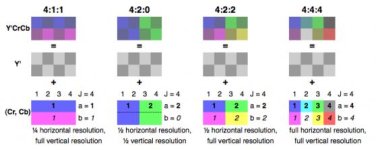
4:4:4 is better sampling for any resolution, not just 4k. 4k is a resolution. Think of 1080p... notice we have many cameras that claim to be HD, from BestBuy to HVX200 to Sony F35 and beyond. Clearly the Sony F35 is going to deliver a stellar picture versus the HD camera from BestBuy.... so resolution is just a very small part of what makes a camera good. So to answer your question, if 4k is the necessity, the cinematographer will pick the best 4k camera for the look he/she wants. Broadcast and Cinema often have different demands as well, so most likely the choice would change if going between the two... but not necessarily depending on the circumstances.

4:4:4 sampling means, in a nutshell, that every pixel in your image has been made by an accurate read of the chroma information that was actually there. Variations away from 4:4:4 mean more complicated and compressed algorithms are in play to create visual information. Meaning, instead of every pixel being 100% accurately portrayed, pixels are combined by mathematical averaging.

4:4:4 can allow for not only a more accurate image, but one with more fidelity in post and a better key if doing green/blue screen work.

My first full understanding of 4:4:4 vs 4:2:2 or 4:2:0 chroma subsampling/"color space" came from DVXuser's own Barry Green who does a great simplification of the explanation in his HVX200 book.Maybe he has something online he can link to? In the meantime, here is a wiki link that is less fluid in description but may help: http://en.wikipedia.org/wiki/Chroma_subsampling
 
Last edited:
4:4:4 is better sampling for any resolution.

From my understanding, it has to do with chroma (referred to as color commonly) space compression. My first full understanding came from DVXuser's own Barry Green who does a great simplification of the explanation in his HVX200 book. Here is a wiki link that is less fluid in description but may help: http://en.wikipedia.org/wiki/Chroma_subsampling

From what I've read around the internet 4:4:4 means having no subsampling at all and anything other than that will result in a loss of original colour information, it gets confusing though as i was taught that the eye is more sensitive to luminance than chrominance so i assumed a loss of colour information wouldn't matter.
 
Here is a good video that discusses chroma sampling. i didn't watch the whole thing to see if he got it right, but from scanning through, it looks good.

<a href="http://www.youtube.com/watch?v=7JYZDnenaGc" data-cke-saved-href="http://www.youtube.com/watch?v=7JYZDnenaGc">
 
What impact will this method of working have on the network infrastructure of the company.
Uncompressed recording, editing, grading and transfer is a priority for the company."

4K files are HUGE. Especially uncompressed. That means storing and moving huge amounts of data between departments. That means fiber 10 gig connections to each edit room, and some sort of huge, scalable storage solution like Avid ISIS or Isilon.

In my opinion, it's stupid to edit uncompressed. You should edit offline and do the online later in finishing and grading. But of the "client" wants it, then you should try to deliver it.
 
From what I've read around the internet 4:4:4 means having no subsampling at all and anything other than that will result in a loss of original colour information, it gets confusing though as i was taught that the eye is more sensitive to luminance than chrominance so i assumed a loss of colour information wouldn't matter.

I don't understand why you quoted me. Are you saying that 4:4:4 is not a sampling?

Notice I said "4:4:4 is better sampling"... not a better sub-sampling.

If discussing in basic terms, everything is "sampled" in order to get information in 4:4:4. To me, 4:4:4 is a sampling. It's just a '1:1' sampling (if I can get away with that.)

Regarding the luminance/color eye-sensitivity thing, that is true, and is why chroma subsampling was created. People don't nearly notice a compression of color as they do a compression of luminance, so the engineers sought to use that weakness as a way to save information. But when color grading, chroma keying, or just for the big-screen presentation, 4:4:4 will give you better results everytime.
 
Last edited:
I don't understand why you quoted me. Are you saying that 4:4:4 is not a sampling?

Notice I said "4:4:4 is better sampling"... not a better sub-sampling.

If discussing in basic terms, everything is "sampled" in order to get information in 4:4:4. To me, 4:4:4 is a sampling. It's just a '1:1' sampling (if I can get away with that.)

Regarding the luminance/color eye-sensitivity thing, that is true, and is why chroma subsampling was created. People don't nearly notice a compression of color as they do a compression of luminance, so the engineers sought to use that weakness as a way to save information. But when color grading, chroma keying, or just for the big-screen presentation, 4:4:4 will give you better results everytime.

Do you mean cinema screens when you say big screen presentation? the imaginary company in my assignment produce material for TV + cinema i think, both in 4K, will there need to be sub-sampling for the TV material? I'm new to subsampling so i may sound like a novice
 
No, no.

I can explain: When I say big screen, I do mean cinema screens. As someone mentioned and I repeated, the human eye is much more sensitive to luminance than color, hence why the subsampling of color and not luminance. Thus it's hard to see the difference from 4:2:2 and 4:4:4 on almost any device.

However, I argue that color grading and VFX work benefits from 4:4:4. My big screen comment is less of an argument and more of a desire. You could get away with a 4k 4:2:2 projection in a theater, but as a Cinematographer, I'd want and be willing to bet that on such a big screen, the extra information fidelity of 4:4:4 could be appreciated. I'd LOVE to be in a 4k theater and see a juxtaposition of 4:2:2 and 4:4:4 within a scene to see just how much the eye can miss or see. In theory the 'color resolution' would inherently double. Something none of us will miss on television or internet, but perhaps will on the big screen.

I believe the six big studios and the Digital Cinema Initiative chose the common form of digital cinema compression to be "Motion JPEG2000", which I think is 4:2:2 - 4:4:4. I believe the DCI calls for all cinema films to be 12-bit color with 4:4:4 color representation (for 2D cinema).

I read somewhere that 3D films are 4:2:2 if 'single' projection and can be 4:4:4 but only if dual projection. That stuff is a little beyond me as I've not done too much research in 3D projection and standards of said formats.
 
Last edited:
No, no.

I can explain: When I say big screen, I do mean cinema screens. As someone mentioned and I repeated, the human eye is much more sensitive to luminance than color, hence why the subsampling of color and not luminance. Thus it's hard to see the difference from 4:2:2 and 4:4:4 on almost any device.

However, I argue that color grading and VFX work benefits from 4:4:4. My big screen comment is less of an argument and more of a desire. You could get away with a 4k 4:2:2 projection in a theater, but as a Cinematographer, I'd want and be willing to bet that on such a big screen, the extra information fidelity of 4:4:4 could be appreciated. I'd LOVE to be in a 4k theater and see a juxtaposition of 4:2:2 and 4:4:4 within a scene to see just how much the eye can miss or see. In theory the 'color resolution' would inherently double. Something none of us will miss on television or internet, but perhaps will on the big screen.

I believe the six big studios and the Digital Cinema Initiative chose the common form of digital cinema compression to be "Motion JPEG2000", which I think is 4:2:2 - 4:4:4. I believe the DCI calls for all cinema films to be 12-bit color with 4:4:4 color representation (for 2D cinema).

I read somewhere that 3D films are 4:2:2 if 'single' projection and can be 4:4:4 but only if dual projection. That stuff is a little beyond me as I've not done too much research in 3D projection and standards of said formats.

so to sum things up you are saying that there should be sub-sampling for cinema material, e.g. 4:2:2? though the way my assignment brief is written i think we are supposed to use 4:4:4 as it says 'why 4:4:4 is superior?' I need to email my lecturer about that

I assume TV broadcast material could be 4:2:2 as well?

in terms of cameras, what do you think is best for 4K? there is no budget in this project, I was thinking of Red One
 
so to sum things up you are saying that there should be sub-sampling for cinema material, e.g. 4:2:2? though the way my assignment brief is written i think we are supposed to use 4:4:4 as it says 'why 4:4:4 is superior?' I need to email my lecturer about that

I assume TV broadcast material could be 4:2:2 as well?

in terms of cameras, what do you think is best for 4K? there is no budget in this project, I was thinking of Red One

No, I'm not saying that at all. In fact, that is the opposite of what I said.

In an ideal world, nobody would want anything less than 4:2:2. The ONLY reason we do subsampling is to alleviate the amount of data. With technology moving so fast, and seeing that we have the ability to shoot 4k, 5k, soon to be 6k and 8k resolutions, the pipelines are data friendly enough that I see no reason why in the near future any camera processor or post-workflow can't handle 4:4:4 in 4k. Technology is rapidly advancing and thus soon, we should theoretically no longer need (thus no longer desire) any form of color compression. 4:2:0 should have been dragged behind the shed and shot years ago.

4:4:4 is always better if the pipe can handle it, but many times, depending on how the video will be compressed and watched (like YouTube, streaming services, etc), 4:2:2 is very acceptable. Shooting 4:4:4 without the need for heavy color work of VFX for a production going to MPEG video on youtube is overkill considering the compressed death it will face upon upload. Same goes with many of our outlets of viewing. We compress color space because it's hard to tell that we did. The eye doesn't miss it that much. So my arguement is, if you need the compression, 4:2:2 is very acceptable in most cases. But in an ideal world, if we can afford the color information, we should use 4:4:4.

That is why I was vouching for 4:4:4 in 4k digital cinema projection. It's one of the few places where the difference of 4:4:4 vs 4:2:2 may be greater appreciated, if even, by the eye of the audience.
 
Last edited:
Also, I'm trying to help answer your questions, without doing the assignment for you.

That said, when discussing cameras, I'd tell the post house to be rightfully prepared for any popular camera format used in television and cinema production. Deciding on what the best 4k camera is, is not the post houses place or concern. The only concern is what formats the productions will bring to them.

They should learn what the most commonly used formats, codecs and cameras are. Be able to accept and deliver based on those formats, and then keep their ear to the industry to keep up with the new-new.

View attachment 69080
 
Last edited:
This is a damned odd assignment. My kind of assignment, but odd for any course. There are a lot of questions that I would say are normally aimed at different departments. Anyway, from a camera perspective, let me give you three options for a "4K" workflow.

Please note I'm simplifying these here quite a bit, but it's a good start.

1. ARRI ALEXA.
+ Quite a popular camera amongst many DoPs
+ Fast to use on set. Has a "2K/1080P" mode if your post workflow is rushed.
+ Has proven that it can do a successful 4K blow-up (Skyfall)
- It's not a genuine 4K (I'm not even going to start the argument about what is or isn't genuine 4K, but let's stay simple for now)
- ARRI RAW is very large, larger than REDCODE typically, but not as large as F65RAW
- Camera has been around a while, so workflow quite proven

2. RED ONE M-X (Not using epic as I don't have experience with it)
+Cheapest camera of this lot
+ Produces "4.5k/4K files" (for all that means)
+ RED RAW workflow is the oldest of these three, so is now pretty familiar to most
+ REDCODE RAW has variable levels of compression, so files are more manageable in size
- The camera isn't popular with a lot of people (but has an equal number of die hard fans)
- Limited frame-rate capabilities, if project is shooting slow-motion then there are resolution drops for those bits of footage (n/a with epic)

3. Sony F65
+ Highest measured resolution of these three (I think)
+ Easy to use, as with ALEXA
+ Has an HD mode if need be (not necessarily useful for 4K output, but good to know it's there)
- Massive files, absolutely massive
- Most expensive of these cameras
- Newest, so least tested workflow, but should still be stable


I should point out that the above are pretty rough generalisations, and opinions will vary on nearly everything, especially facts!
 
well, it is hard to say 4:4:4 is 1:1 sampling of a 4k picture, since the origin of the signal comes from a sensor that is a bayer array.

So a 4k sensor with a bayer array will not provide a 4:4:4 4k picture.
I am not aware of cameras with triple sensor in 4k. (at least not the big sensor camera like red or Alexa or F65)
So you should compare a tri-cmos (or ccd) 1080 picture with a 4k RGB bayer.

On the other hand, raw is not warranty to have better resolution or better subsampling, it is just a recording of what sensor sees "as is".
 
well, it is hard to say 4:4:4 is 1:1 sampling of a 4k picture, since the origin of the signal comes from a sensor that is a bayer array.

100% AGREE... That is why I put apostraphies around '1:1' and said "if I can get away with that" knowing it was a stretch of terms when used with bayer pattern sensors. I didn't want to dive into the de-bayer pool as it bring complications to the table, yet we might want to considering all real world application at this time uses a form of debayering. So in theory, nothing is a true representation of reality at that level. I suppose we are discussing 4:4:4 as if after the debayer process it's color information kept through the following post processes?

It's a whole new level of complication I was trying to avoid for the OP and thus was responding independent of any real world camera, trying to leave the de-bayering process out of the mix. But I guess we shouldn't in this day and age.
 
you should post it sometime

I have a studio design assignment as well, do you know any good websites for that sort of thing or books? I got information in Tozer-Broadcast Engineering. It's a full studio building i have to design and do a write up on, e.g. studios for soap operas, news, chat shows, green rooms, etc.
 
Man! What is your class about? Architecture? Post Production? hahaha. Seems they have you all over the place!

It sounds like a cool assignment. I'd love to do that! Where do you go?
 
Man! What is your class about? Architecture? Post Production? hahaha. Seems they have you all over the place!

It sounds like a cool assignment. I'd love to do that! Where do you go?

I do a degree called Media Technology, we are based in a new media complex called MediaCityUK, it's the biggest complex in Europe at the moment.
Some people would head towards systems design after graduation, like that studio design assignment but I don't have much interest in that, I would prefer to work towards becoming a Camera Operator.
 
Back
Top