
Navigation
Install the app
How to install the app on iOS
Follow along with the video below to see how to install our site as a web app on your home screen.
Note: This feature may not be available in some browsers.
More options
You are using an out of date browser. It may not display this or other websites correctly.
You should upgrade or use an alternative browser.
You should upgrade or use an alternative browser.
3200k or 5500k for indoor shooting?
- Thread starter Lucas 7D
- Start date


Lucas, all helpful info. There was a time not too long ago that there wasn't really a choice to use daylight or tungsten (3200 or 5500). It was always a battle to fight the sunlight entering the scene using tons of light fixtures and amps. Dichroic filters were expensive (to convert 3200 to 5000) when it came to outfitting each light. Today we have a lot of daylight choices from CFLs or tubes, LEDS, etc. I made a decision a while ago to only use daylight balanced lights and I haven't looked back. As long as you have white balance the camera doesn't care what you use. It does care when you try to mix them, but that's another issue. I can shoot indoors with a lot or little sunlight coming in or even outside using lights to help lighting. Oh by the way, the CFL's, Tubes or Leds use only a fraction of the power, so I can even use an inverter in my car for truly remote recordings.
Gary
Gary

Matt Gottshalk
Resident Preditor
And if it is mixed lighting, I'll often throw a 3200k bulb or two into my 5600k bank on my CoolLights 4 bank flo.
As long as you balance to it, it will look fine.
As long as you balance to it, it will look fine.

PerroneFord
Deals in Lead
Given the rather poor color response of most video cameras, I'd use light with as much "blue" in it as possible. I use 3200/3500 balance only when I absolutely, positively, cannot use anything else. 5500 is always preferable if you can get away with it.
CameronMcC
Well-known member
good stuff here.
prexdealer
Well-known member
Sorry to resurrect an old thread, but hey I searched! So if I am using 3200k bulbs (using some lowel totas, omni, and some china balls) and if I block out the window with a thick black plastic then the light in the room is pretty controllable, right? My question is then in post given then light was even, it shouldn't be a total headache to fix the coloration right?
Or is it better to add the blue gel to do some correcting while filming? From what I understand 3200K bulbs come off a bit orangish and that blue gels is te way to counter it.
Thanks!
Or is it better to add the blue gel to do some correcting while filming? From what I understand 3200K bulbs come off a bit orangish and that blue gels is te way to counter it.
Thanks!

Cool Lights
DVXuser Sponsor
If you're using normal 3200K bulbs and you white balance to 3200K then everything is white and there is no yellowish cast. Same for 5600K. That's the point of white balance on digital still and motion cameras. The only reason you would use gels would be to match some other lighting coming in like real daylight through a window. In your scenario, everything is already controlled so there is no need for gels at all if everything is already 3200K and that's what you intend to only use.
prexdealer
Well-known member
Thanks!
Prexdealer, so that makes sense, right? Historically, light sources were either tungsten, burning at about 3200K, or daylight, about 5600k. So film emulsions were developed that rendered white (and all other colors -- we really care about skin tones) pretty accurately at either color temperature. Modern digital cameras whether primarily for motion pictures or DSLRs have presets to match these two common sources and thus render colors appropriately under either color temperature illumination.
The point of color correcting gels on the light sources is to filter out the unwanted colors and pass through the desired ones to match the light to the white balance setting of the camera. Thus, a camera set for tungsten lights, 3200K, will require Color Temperature Orange gels on any daylight sources in order to remove a lot of the blue while passing through the warmer hues, and a camera set for daylight, 5600K, will require any tungsten sources to be gelled with Color Temperature Blue to pass the blues and diminish the reds and oranges in the tungsten sources. (Note that you absorb so much light going in either direction that you lose nearly two stops with these gels.)
This produces creative possibilities. For example, it is common to set the camera to tungsten white balance so that colors, say illuminated by a bedside lamp at night time, look relatively accurate, but a daylight colored light shining onto the scene will appear very blue, giving the illusion it is moonlight.
And here is something for you to ponder: If our eyes and brain adapt rapidly to different color temperatures so that we see white (and other colors) fairly accurately under either tungsten or daylight colored light, why is the camera so finicky and why do we see strong orange coloring in images from tungsten lights when the camera is set to daylight and strong blue coloring from daylight colored lights when the camera is set to tungsten? Hint: what do you think will happen if you stared at a picture with either problematic coloring for several minutes in a darkened room?
The point of color correcting gels on the light sources is to filter out the unwanted colors and pass through the desired ones to match the light to the white balance setting of the camera. Thus, a camera set for tungsten lights, 3200K, will require Color Temperature Orange gels on any daylight sources in order to remove a lot of the blue while passing through the warmer hues, and a camera set for daylight, 5600K, will require any tungsten sources to be gelled with Color Temperature Blue to pass the blues and diminish the reds and oranges in the tungsten sources. (Note that you absorb so much light going in either direction that you lose nearly two stops with these gels.)
This produces creative possibilities. For example, it is common to set the camera to tungsten white balance so that colors, say illuminated by a bedside lamp at night time, look relatively accurate, but a daylight colored light shining onto the scene will appear very blue, giving the illusion it is moonlight.
And here is something for you to ponder: If our eyes and brain adapt rapidly to different color temperatures so that we see white (and other colors) fairly accurately under either tungsten or daylight colored light, why is the camera so finicky and why do we see strong orange coloring in images from tungsten lights when the camera is set to daylight and strong blue coloring from daylight colored lights when the camera is set to tungsten? Hint: what do you think will happen if you stared at a picture with either problematic coloring for several minutes in a darkened room?
sonofaresiii
Well-known member
(Note that you absorb so much light going in either direction that you lose nearly two stops with these gels.)
nope. 2 stops for a full ctb, 2/3 stop for full cto. so you lose less light if you want to convert daylight to tungsten, which is why you'll more often see gels in front of windows than in front of lights.
nope. 2 stops for a full ctb, 2/3 stop for full cto. so you lose less light if you want to convert daylight to tungsten, which is why you'll more often see gels in front of windows than in front of lights.
CTB -1.5 stops, CTO ~1 stop. Rosco

David G. Smith
Steak Knife Member
Lucas, all helpful info. There was a time not too long ago that there wasn't really a choice to use daylight or tungsten (3200 or 5500). It was always a battle to fight the sunlight entering the scene using tons of light fixtures and amps. Dichroic filters were expensive (to convert 3200 to 5000) when it came to outfitting each light. Today we have a lot of daylight choices from CFLs or tubes, LEDS, etc. I made a decision a while ago to only use daylight balanced lights and I haven't looked back. As long as you have white balance the camera doesn't care what you use. It does care when you try to mix them, but that's another issue. I can shoot indoors with a lot or little sunlight coming in or even outside using lights to help lighting. Oh by the way, the CFL's, Tubes or Leds use only a fraction of the power, so I can even use an inverter in my car for truly remote recordings.
Gary
Lucas, all helpful info. There was a time not too long ago that there wasn't really a choice to use daylight or tungsten (3200 or 5500). It was always a battle to fight the sunlight entering the scene using tons of light fixtures and amps. Dichroic filters were expensive (to convert 3200 to 5000) when it came to outfitting each light. Today we have a lot of daylight choices from CFLs or tubes, LEDS, etc. I made a decision a while ago to only use daylight balanced lights and I haven't looked back. As long as you have white balance the camera doesn't care what you use. It does care when you try to mix them, but that's another issue. I can shoot indoors with a lot or little sunlight coming in or even outside using lights to help lighting. Oh by the way, the CFL's, Tubes or Leds use only a fraction of the power, so I can even use an inverter in my car for truly remote recordings.
Gary
I spent much of yesterday manhandling some daylight balanced CFLs into workable production lighting. I bought some 32watt 5500K "Full Spectrum" 93 CRI bulbs. http://www.bluemaxlighting.com/compact_fluorescent_39_ctg.htm
My first issue is with the green spike.
Light without gels. (All pictures shoot with a T2i daylight WB setting, Standard picture style):
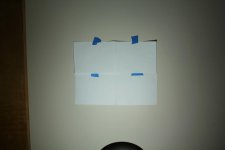
Here is the light with various strengths of minus green gel from Lee:
1/8 minus green:
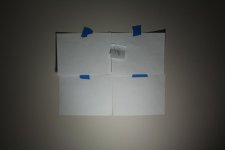
1/4 minus green:
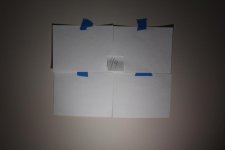
1/2 minus green:
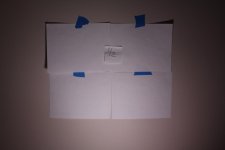
Full minus green:
I figured the 1/4 minus green takes care of the green spike, but I also found with footage I latter shot with my FS100 that the gel does warm up the light a little bit, the a little tweaking in post took care of that.
The other issue that I have with the CFLs, and tubes is the photometrics. They just don't have as much "Punch" or what is sometimes called "Throw" as small source tungsten lights do. CFLs and tubes are both soft sources (Through CFLs seem to be a little "Harder" than tubes).
I have very little experience with LED lights, but it seems to me that the ones are worth having are very expensive (From the guerrilla point of view where I am coming from).
I am going to put together a few instruments with the above CFLs just for situations where I have to match to day light and, with white balance set to tungsten, adding some blue light if needed, but I don't think I am going to go with an all daylight kit with just CFLs, tubes or LEDs anytime soon. If I am shooting interiors I like having the versatility that the available low cost tungsten lights give.
Last edited:

KINOKS
Well-known member
Given the rather poor color response of most video cameras, I'd use light with as much "blue" in it as possible. I use 3200/3500 balance only when I absolutely, positively, cannot use anything else. 5500 is always preferable if you can get away with it.
All video imagers that are silicon made are naturally balanced to 5600K as I understand it. So this means that when you light your scene at 3200K the camera needs to add gain to the blue channel which introduces noise off course. Looking at it from this point of view it's better to put together a daylight balanced kit. BUT the newer cameras that we use today have so little noise that this really is a mute point.