19 Things to Know

Terry_Lasater

All about the Caption
1. Never, under any circumstances, take a sleeping pill and a laxative on the same night.

2. If you had to identify, in one word, the reason why the human race has not achieved, and never will achieve, its full potential, that word would be "meetings."

3. There is a very fine line between "hobby" and "mental illness."

4. People who want to share their religious views with you almost never want you to share yours with them.

5. And when God, who created the entire universe with all of its glories, decides to deliver a message to humanity, He WILL NOT use, as His messenger, a person on cable TV with a bad hairstyle.

6. You should not confuse your career with your life.

7. No matter what happens, somebody will find a way to take it too seriously.

8. When trouble arises and things look bad, there is always one individual who perceives a solution and is willing to take command. Very often, that individual is crazy.

9. Nobody cares if you can't dance well. Just get up and dance.

10. Never lick a steak knife.

11. Take out the fortune before you eat the cookie.

12. The most destructive force in the universe is gossip.

13. You will never find anybody who can give you a clear and compelling reason why we observe daylight savings time.

14. You should never say anything to a woman that even remotely suggests that you think she's pregnant unless you can see an actual baby emerging from her at that moment.

15. There comes a time when you should stop expecting other people to make a big deal about your birthday. That time is age eleven.

16. The one thing that unites all human beings, regardless of age, gender, religion, economic status or ethnic background, is that, deep down inside, we ALL believe that we are above average drivers.

17. The main accomplishment of almost all organized protests is to annoy people who are not in them.

18. A person who is nice to you, but rude to the waiter, is not a nice person. (This is very important. Pay attention. It never fails.)

19. Your friends love you anyway.
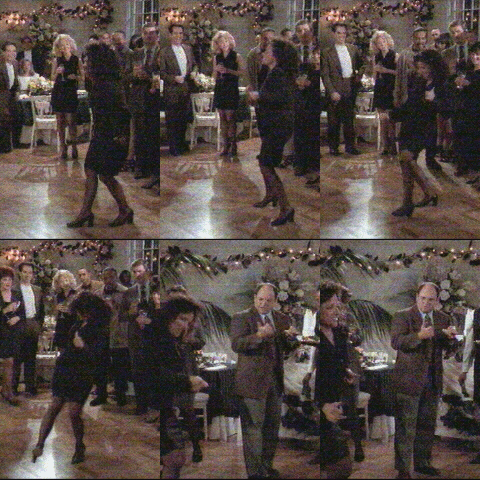
 
9. Nobody cares if you can't dance well. Just get up and dance.

What if I dance like Elaine?


ddb4fea63bb4fb1f735796e1179f8add.gif
 
Last edited:
I believe this is a Dave Barry column.

The reason I remember it is because I know a guy who looks just like him, and I've seen him get up and dance. I find that particular piece of advice dubious at best.
 
an article on... The Waiter Test of Characters

CEOs say how you treat a waiter can predict a lot about character

By Del Jones, USA TODAY
Office Depot CEO Steve Odland remembers like it was yesterday working in an upscale French restaurant in Denver.
The purple sorbet in cut glass he was serving tumbled onto the expensive white gown of an obviously rich and important woman. "I watched in slow motion ruining her dress for the evening," Odland says. "I thought I would be shot on sight."

Thirty years have passed, but Odland can't get the stain out of his mind, nor the woman's kind reaction. She was startled, regained composure and, in a reassuring voice, told the teenage Odland, "It's OK. It wasn't your fault." When she left the restaurant, she also left the future Fortune 500 CEO with a life lesson: You can tell a lot about a person by the way he or she treats the waiter.

Odland isn't the only CEO to have made this discovery. Rather, it seems to be one of those rare laws of the land that every CEO learns on the way up. It's hard to get a dozen CEOs to agree about anything, but all interviewed agree with the Waiter Rule.

They acknowledge that CEOs live in a Lake Wobegon world where every dinner or lunch partner is above average in their deference. How others treat the CEO says nothing, they say. But how others treat the waiter is like a magical window into the soul.

And beware of anyone who pulls out the power card to say something like, "I could buy this place and fire you," or "I know the owner and I could have you fired." Those who say such things have revealed more about their character than about their wealth and power.

Whoever came up with the waiter observation "is bang spot on," says BMW North America President Tom Purves, a native of Scotland, a citizen of the United Kingdom and Northern Ireland, who lives in New York City with his Norwegian wife, Hilde, and works for a German company. That makes him qualified to speak on different cultures, and he says the waiter theory is true everywhere.

The CEO who came up with it, or at least first wrote it down, is Raytheon CEO Bill Swanson. He wrote a booklet of 33 short leadership observations called Swanson's Unwritten Rules of Management. Raytheon has given away 250,000 of the books.

Among those 33 rules is only one that Swanson says never fails: "A person who is nice to you but rude to the waiter, or to others, is not a nice person."

Swanson says he first noticed this in the 1970s when he was eating with a man who became "absolutely obnoxious" to a waiter because the restaurant did not stock a particular wine.

"Watch out for people who have a situational value system, who can turn the charm on and off depending on the status of the person they are interacting with," Swanson writes. "Be especially wary of those who are rude to people perceived to be in subordinate roles."

The Waiter Rule also applies to the way people treat hotel maids, mailroom clerks, bellmen and security guards. Au Bon Pain co-founder Ron Shaich, now CEO of Panera Bread, says he was interviewing a candidate for general counsel in St. Louis. She was "sweet" to Shaich but turned "amazingly rude" to someone cleaning the tables, Shaich says. She didn't get the job.

Shaich says any time candidates are being considered for executive positions at Panera Bread, he asks his assistant, Laura Parisi, how they treated her, because some applicants are "pushy, self-absorbed and rude" to her before she transfers the call to him.

Just about every CEO has a waiter story to tell. Dave Gould, CEO of Witness Systems, experienced the rule firsthand when a waitress dumped a full glass of red wine on the expensive suit of another CEO during a contract negotiation. The victim CEO put her at ease with a joke about not having had time to shower that morning. A few days later, when there was an apparent impasse during negotiations, Gould trusted that CEO to have the character to work out any differences.

CEOs who blow up at waiters have an ego out of control, Gould says. "They're saying, 'I'm better. I'm smarter.' Those people tend not to be collaborative."

"To some people, speaking in a condescending manner makes them feel important, which to me is a total turnoff," says Seymour Holtzman, chairman of Casual Male Retail Group, which operates big-and-tall men's clothing stores including Casual Male XL.

How people were raised

Such behavior is an accurate predictor of character because it isn't easily learned or unlearned but rather speaks to how people were raised, says Siki Giunta, CEO of U.S. technology company Managed Objects, a native of Rome who once worked as a London bartender.

More recently, she had a boss who would not speak directly to the waiter but would tell his assistant what he wanted to eat, and the assistant would tell the waiter in a comical three-way display of pomposity. What did Giunta learn about his character? "That he was demanding and could not function well without a lot of hand-holding from his support system," she said.

It's somewhat telling, Giunta says, that the more elegant the restaurant, the more distant and invisible the wait staff is. As if the more important the customer, the less the wait staff matters. People view waiters as their temporary personal employees. Therefore, how executives treat waiters probably demonstrates how they treat their actual employees, says Sara Lee CEO Brenda Barnes, a former waitress and postal clerk, who says she is a demanding boss but never shouts at or demeans an employee.

"Sitting in the chair of CEO makes me no better of a person than the forklift operator in our plant," she says. "If you treat the waiter, or a subordinate, like garbage, guess what? Are they going to give it their all? I don't think so."

CEOs aren't the only ones who have discovered the Waiter Rule. A November survey of 2,500 by It's Just Lunch, a dating service for professionals, found that being rude to waiters ranks No. 1 as the worst in dining etiquette, at 52%, way ahead of blowing your nose at the table, at 35%.

Waiters say that early in a relationship, women will pull them aside to see how much their dates tipped, to get a read on their frugality and other tendencies. They are increasingly discussing boorish behavior by important customers at www.waiterrant.net and other blogs. They don't seem to mind the demanding customer, such as those who want meals prepared differently because of high blood pressure. But they have contempt for the arrogant customer.

Rule works with celebrities, too

The Waiter Rule also applies to celebrities, says Jimmy Rosemond, CEO of agency Czar Entertainment, who has brokered deals for Mike Tyson, Mario Winans and Guerilla Black. Rosemond declines to name names, but he remembers one dinner episode in Houston a few years back with a rude divisional president of a major music company.

When dinner was over, Rosemond felt compelled to apologize to the waiter on the way out. "I said, 'Please forgive my friend for acting like that.' It's embarrassing. They go into rages for simple mistakes like forgetting an order."

Rosemond says that particular music executive also treated his assistants and interns poorly — and was eventually fired.

Odland says he saw all types of people 30 years ago as a busboy. "People treated me wonderfully and others treated me like dirt. There were a lot of ugly people. I didn't have the money or the CEO title at the time, but I had the same intelligence and raw ability as I have today.

"Why would people treat me differently? Your value system and ethics need to be constant at all times regardless of who you are dealing with."

Holtzman grew up in the coal-mining town of Wilkes-Barre, Pa., and in the 1950s saw opportunity as a waiter 90 miles away in the Catskill Mountains, where customers did not tip until the end of the week. When they tipped poorly, he would say: "Sir, will you and your wife be tipping separately?"

"I saw a lot of character, or the lack thereof," says Holtzman, who says he can still carry three dishes in his right hand and two in his left.

"But for some twist of fate in life, they're the waiter and you're the one being waited on," Barnes says.
 
Back
Top