180 degree rule

In each of those cases, filming with a 360-degree shutter would be ideal / expected right?

No, under a 180-degree shutter regime, filming 50p for 50p playback expects a 180-degree 1/100 shutter. And that's what run of the mill shutter angle literature online recommends
 
Nope 180 is from the 25fps days. 360 degrees for 50p on a 50p timeline. eg both is 1/50th.
 
Nope 180 is from the 25fps days. 360 degrees for 50p on a 50p timeline. eg both is 1/50th.

I understand that you prefer that and I understand why. But for example, 1/100 shutter for 50p timeline is the first recommendation that pops up in a google search. (Article headline says he prefers 360-degree shutter for 50p but if you read the article it's because he frequently converts it to 25p.) Chatgpt also tells you to use 1/100. I'm not saying you should. But it's common practice.

Screenshot_20230217_215803_Chrome.jpg
 
No, under a 180-degree shutter regime, filming 50p for 50p playback expects a 180-degree 1/100 shutter. And that's what run of the mill shutter angle literature online recommends

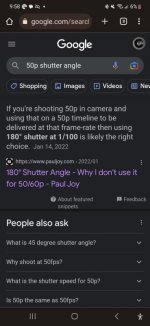
This is partly why I started this thread. I suspect the online consensus is wrong but I’m not 100% confident in that, and Occam’s razor was telling me that the misunderstanding was probably mine.

I’m more confident I’ve reached the right conclusions now (thanks everyone) but I’m still not sure if my reasoning was correct - that the amount of motion blur is controlled only by absolute shutter speed (no ratio of frame rate involved). So if a certain amount of motion blur is ‘natural’ at 25fps it should still look natural at 50p. Or at least that there is no reason to believe that look would be maintained by doubling the shutter speed and therefore halving the motion blur.

As an aside, someone in a comment thread suggested that 360 degree shutter always looks right with HFR (played back in real time). We are seeing all of the action with no unrecorded moments, after all. It’s just that 30fps and below is too slow, so the motion blur becomes excessive. Can’t vouch for the source.
 
Last edited:
On a related note, the word rule and 180 degrees is associated with camera placement, angles and subjects, not shutter speed, but they sometimes get mixed up.

https://en.wikipedia.org/wiki/180-degree_rule

Yes. When you used to hear “180 degree rule”, it was referring to the action axis or plane. Then when “digital filmmaking” became widespread to the masses, the term got inappropriately appropriated, bastardized or more bluntly just used flat out incorrectly, as millennials tended to do all too often with existing terms and phrases.
 
This is partly why I started this thread. I suspect the online consensus is wrong but I’m not 100% confident in that, and Occam’s razor was telling me that the misunderstanding was probably mine.

I’m more confident I’ve reached the right conclusions now (thanks everyone) but I’m still not sure if my reasoning was correct - that the amount of motion blur is controlled only by absolute shutter speed (no ratio of frame rate involved). So if a certain amount of motion blur is ‘natural’ at 24fps it should still look natural at higher frame rates. Or at least that there is no reason to believe it should be double the frame rate.

As an aside, someone in a comment thread suggested that 360 degree shutter always looks right with HFR (played back in real time). We are seeing all of the action with no unrecorded moments, after all. It’s just that 30fps and below is too slow, so the motion blur becomes excessive. Can’t vouch for the source.

The last part you wrote seems logical.

What is absolute is the motion blur of an action at a certain shutter speed. Running or doing a hair flick with 1/48 shutter will always have the same blur. I find it convenient to think about how still photos look at certain shutter speeds when choosing a faster shutter speed.

I will say that a 180-degree shutter for slow motion always seems perfect to me. I've settled on varying my shutter speed for real-time when I deem appropriate. But when overcranking at 60fps or 120fps, 180-degree shutter always seems just right to me.

Someone said something about 24fps judder on 60hz monitors before. This is not really something I notice. And nearly everything you watch on streaming services like Netflix was shot in 24 or 25 fps and nobody seems to complain. I've had ample opportunities to look at 24p and 60p on a monitor one after the other when switching between framerates while filming. I can get used to the smoothness of 60. But I definitely prefer the cadence of 24. It offers a bit of an abstraction or stylization that I find pleasing. More and more displays are moving to 120hz r3fresh rate anyway, I think.
 
the word rule and 180 degrees is associated with camera placement, angles and subjects, not shutter speed, but they sometimes get mixed up.https://en.wikipedia.org/wiki/180-degree_rule

Yes. When you used to hear “180 degree rule”, it was referring to the action axis or plane.

Yes, and that is more deserving of the name "rule", in the sense that things look awful if you break it, as I sometimes did by accident in my youth.

On the other hand, its confusion with shutter speed is something I did not witness until the last decade. I doubt any Hollywood cinematographer, shooting on a film camera, which is the only kind of camera where the unit of shutter speed sensibly is the degree, ever spoke about it as The 180-degree rule. As in, "Hey, Mac, do you think we should follow the 180-degree rule for this scene, or shoot at a different shutter speed?"
 
Yes, and that is more deserving of the name "rule", in the sense that things look awful if you break it, as I sometimes did by accident in my youth.

"

People break it all the time, although often for dramatic effect. I tend to think if it as a component of invisible editing. If you want to have a cut and prevent any confusion about orientation and who is talking and facing where, you better make sure you follow it. But all the viewer loses is a moment of getting their bearings when it's broken. I also find it easier to think of it as the left/right rule as in people facing screen left continue facing screen left.
 
People break it all the time, although often for dramatic effect.

Well, as the saying goes, "Rules are meant to be broken". I mean, that is the sure sign that it is, indeed, a rule: if you break it, it has a dramatic effect. Breaking rules is the cheapest dramatic effect, essentally free of charge, which is why less-talented or less-funded filmmakers break rules more often than more-talented and more-funded filmmakers.

On the other hand, I have never, ever, ever, ever, ever witnessed it being broken on purpose, at least not in a two-shot conversation, for which it would be the most bewitching. Care to share all of the people breaking it "all the time"? I am sure that someone, somewhere, has broken it, other than me, and even on purpose, rather than on accident, as in my case. But people breaking it all of the time is a reality other than the one I happen to live in.
 
Last edited:
I understand that you prefer that and I understand why. But for example, 1/100 shutter for 50p timeline is the first recommendation that pops up in a google search. (Article headline says he prefers 360-degree shutter for 50p but if you read the article it's because he frequently converts it to 25p.) Chatgpt also tells you to use 1/100. I'm not saying you should. But it's common practice.
]

Here is why 360 degrees @ 50(or 60)fps makes sense these days (and it's more than a preference):
- We are preconditioned over the decades to "like" the motion blur with 25fps & 180 degrees (1/50th shutter) ... and I'll not argue that case one way or another!
- These days our displays are progressive and run at 50 (or 60) hz
- When playing a 25fps video on the 50hz display, they repeat each 180degree (1/50th shutter) frame twice (they do a 2:2 pulldown) - but you are missing half the motion that happened and just repeating the prior frame potentially leading to judder with pans and movement.
- When playing a 50fps video on the 50hz display, each frame is still 1/50th of a second, but there are twice the # of frames, each is unique, captures all the time period and it matches the display.
- Infact Frame 1,3,5, etc is exactly the same between the 25 and 50fps video, but instead of repeating the 2,4,6, etc frames with a 25fps video you get a unique one that captures the missing time from the 25fps 180degree gets @25fps clip

We don't miss interlacing (it was missing half the lines but had 50fps). Likewise we should not miss half the frames which is what 25fps on a 50hz monitor is doing.

The only downside is increased bandwidth requirements as you are storing and transmitting twice the # of frames (but thanks to modern compression it's not twice the size).

Of course you can adapt this to NTSC rates as well.... not so much Film.
 

Attachments

  • 50vs25p playback.jpg
    50vs25p playback.jpg
    43.4 KB · Views: 0
Last edited:
What is a funny conversation with photography friends is I no longer say I shot 1/50th or 360 degrees. I say I don't use a shutter at all and just record everything at 50fps. :)
 
Well, as the saying goes, "Rules are meant to be broken". I mean, that is the sure sign that it is, indeed, a rule: if you break it, it has a dramatic effect. Breaking rules is the cheapest dramatic effect, essentally free of charge, which is why less-talented or less-funded filmmakers break rules more often than more-talented and more-funded filmmakers.

On the other hand, I have never, ever, ever, ever, ever witnessed it being broken on purpose, at least not in a two-shot conversation, for which it would be the most bewitching. Care to share all of the people breaking it "all the time"? I am sure that someone, somewhere, has broken it, other than me, and even on purpose, rather than on accident, as in my case. But people breaking it all of the time is a reality other than the one I happen to live in.

I will agree that it is fairly regularly "broken" in films and television, starting somewhere in the past 20 years or so.I think the last time I saw a two-hander with the same eyelines for both individuals was in "Fleishman Is In Trouble", recent Hulu series. It's in the playbook of "let's show the audience that things are a little off". Not uncommon to have reverse masters, i.e. from the other side of the line. I've shot plenty of those. The way it usually goes, if a director wants to shoot something that will cross the line, I'll let them know and we'll discuss it until everyone is clear on what the "correct" eyeline is. Sometimes we still go ahead and shoot it "incorrectly".

It's hard to come up with specific examples as I barely register them these days, but this one goes back 30+ years, well-known scene from Goodfellas (that involves a shooting, be warned if such things are triggering). The edit cuts twice to a closeup of the gun with Ray Liotta in the background that is shot from the other side of the line. Safe to assume that the piece of coverage was intended to cover Liotta's looks to Pesci and DeNiro, which would have been correct eyelines, but Scorcese and Schoonmaker opted to include the quick cuts from this angle even though they are a full reverse from the rest of the coverage. I always thought that was a pretty cool choice honestly.

https://www.youtube.com/watch?v=0WGVmKuDhIg
 
Well, as the saying goes, "Rules are meant to be broken". I mean, that is the sure sign that it is, indeed, a rule: if you break it, it has a dramatic effect. Breaking rules is the cheapest dramatic effect, essentally free of charge, which is why less-talented or less-funded filmmakers break rules more often than more-talented and more-funded filmmakers.

On the other hand, I have never, ever, ever, ever, ever witnessed it being broken on purpose, at least not in a two-shot conversation, for which it would be the most bewitching. Care to share all of the people breaking it "all the time"? I am sure that someone, somewhere, has broken it, other than me, and even on purpose, rather than on accident, as in my case. But people breaking it all of the time is a reality other than the one I happen to live in.

Here's a video that has a few examples: https://youtu.be/e-QbgIpK3zM

Honestly, i think that most of the time when it happens we dont remember it. Usually I will notice it in a film and then forget

But it's my default position to try to maintain the rule, of course
 
What's a two-hander?

A term we use to describe how many people are in a scene, so in that case two people. You can keep going with it: a dinner table scene could be a six-hander, but I rarely hear above 3 or 4 with the -hander suffix.

I never bothered to look it up before, but from what I see it comes from the theatre world, so it's not just a cool-kid film term!
 
Here's a video that has a few examples: https://youtu.be/e-QbgIpK3zM

Thanks. Yeah, I would agree that those were fine.

But I would also say that most of them are not actually violations of the 180-degree rule, even though the Youtuber presents them as such. Any time you cross the axis with a moving camera, especially with a wide shot, where both interloculators are in frame, is not really what the 180-degree rule was all about. The 180-degree rule was about boneheaded mistakes I made, where I am cutting back and forth between two people and it looks like they are not facing each other, but instead facing the same direction.

The rule is mainly about that staple of cinema: the back-and-forth cutting between two static, matched shots, of two people having a conversation. The other main situation that it applies to is depictions of travel. If you have a sequence of shots of someone going somewhere, be it on foot or in a car, then you generally want to shoot them going in the same screen direction each time, either left to right or right to left. I would say that you can probably change it up, so long as you do so carefully, like by inserting a shot of them going in a neutral direction (front to back, or back to front) or by moving the camera across the axis in the transition shot. But haphazardly going back and forth, with someone walking right to left and then left to right, makes it look like the person is literally going back and forth and not making any progress.

In that video, the closest thing to a violation was the first one, in Saving Private Ryan. That's interesting! On paper I would have thought it wouldn't work. I would have been like, "Um, Mr. Spielberg, I think you made a mistake here about camera placement" --- which is never a good idea. At some point in his career, Spielberg stopped storyboarding and just winged it. I know he worked that way on Schindler's List. For a lesser director, that is often when you mess up the 180-degree rule. But somehow it works in Saving Private Ryan. For what it's worth, he breaks it and then reestablishes it, with a new pair of matching shots. "Well done, Mr. Spielberg! Sorry I ever doubted you. I was just kidding. Can I get you some coffee?"
 
Last edited:
Sorry, it's my fault that these two subjects are now mixed together. It wasn't even entirely accidental, I was trying to be funny.

Back to motion blur - I was thinking that if you double the frame rate and halve the motion blur (to maintain a 180-degree shutter), wouldn't persistence of vision mean that the amount of motion blur is perceived to be the same? You are producing the same amount of blur in the same amount of time, after all - it's just spread over two frames which POV should make individually indistinguishable right?

It turns out there was another rabbity hole waiting for me. Persistence of vision as an explanation of motion perception in film doesn't seem to have much currency in academia. Here is a paper from 1978 where they critique some of the original 19th century studies that led to POV being used as an explanation of film motion:

"It cannot be, as Roget suggests, so simple a process as the fusing of slowly decaying tracings upon the retina, for the curved spokes persist even when the eye is moved about over the display. To put the matter another way, when Roget speaks of tracings remaining upon the retina from a sufficiently bright object, he is apparently referring to after-images. Yet it is well known that after-images, since they are in fact tracings of stimulation left upon the retina, yield stabilized images (an image that is on the retina itself and therefore moves as the eye is moved)."
https://faculty.uca.edu/wsmeador/ccs...work/Myth1.htm

And here is a follow up from the same people in 1993:

"A typical explanation of persistence of vision went something like this: when the human eye is presented with a rapid succession of slightly different images, there is a brief period during which each image, after its disappearance, persists upon the retina, allowing that image to blend smoothly with the next image. Such an explanation might begin to account for a sense of constancy of the light source (flicker fusion), but it is, of course, a totally inadequate explanation of the illusion of motion in the cinema. The proposed fusion or blending of images could produce only the superimposition of successive views, as in Marcel Duchamp's painting "Nude Descending a Staircase" or a frame from Norman McLaren's Pas de Deux. The result would be a piling up of images, or at best a static collage of superimposed still pictures, not an illusion of motion. It is the obvious inadequacy of the explanation, coupled with its recurrence in film literature for almost a century, that arouses one's curiosity about the origins of the notion and the means by which it has been perpetuated."
https://archives.evergreen.edu/webpa...1_Anderson.pdf

I'm not qualified to judge the source but it does seem that their proposed terminology "short-range apparent motion" is now widely used in academic studies about perception of motion.

So why do we perceive changes between still images presented in quick succession as motion? From that 1978 link:

"Everyone, it would seem, knows that moving pictures are made by projecting a series of stationary frames on a screen in rapid succession. Yet few people seem to be curious about the basis of this effect and those who are, seem to be satisfied with an incorrect explanation. . . . The fact of the matter is that we do not know why movement is perceived."

So there you go - mystery solved! You're welcome.
 
Last edited:
I finally got around to building a test rig to demonstrate the difference between:
  • 25p @ 180degree, and
  • 50p @ 360degree
The theory is sound in that we use monitors / TV etc running at 50fps, and they are backwardly compatible with both 50i and 25p. In the case of 25p, we need to repeat all frames twice to get to the TV’s native 50fps:
  • With 25/180 (1/50[SUP]th[/SUP] sec) we need to repeat every frame for every second 50hz VSYNC capturing only 50% of the temporal motion
  • Motion Blur is identical as each frame is 1/50[SUP]th[/SUP] sec
  • Exposure is the same as each frame is 1/50[SUP]th[/SUP] sec
  • Acquisition file sizes (for non GOP codecs) will double as we have twice the frames (eg it went from 244 to 487 Mb/s with these samples)
  • Deliverable file sizes will increase (but thanks to intraframe compression it only went from 10.1 to 10.4 Mb/s in these samples)
  • Temporal Resolution is doubled.
All great in theory But how does it look? This is a bit of a motion torture test showing the difference in two short sub 20sec clips. You are going to want to download them rather than play them in a browser or watch on a phone (and would be best on a 50hz monitor):
In this example I can see:
  • Red Segment: Demonstrates that the Motion Blur (red segment) is the same width between the two samples
  • 25/180 had the red segment juddering as there is a jump forward due the ½ rate temporal resolution of 180degree
  • 25/180 shows much worse perceived motion artifacts (backwards / forward spinning)
These differences (of course) become less and less as the speed slows down, with the final frames of both samples looking identical as temporal resolution is about capturing the changes over time (and these end up as still frames).

See what you think
 
Great discussion!

This is all actually better to be called screen geography or screen direction. The 180 degree rule is a subset of that visual vernacular. It is a rule born of logic in screen direction. Someone in profile looks at someone, if you cut to the person looking at them from the other side then they're looking in the wrong direction to the audience.

I think there's also a great example with the opening of The Road To Perdition to the realm of staging and of screen direction in general.

The very opening of the film is setting up a struggle. The isolation of a child, who's visually swimming against the tide in this opening montage. Everything is against him! He's going from right to left in every single shot except for the one where he's going away from camera while everything else goes towards him. Every shot here is someone struggling. Life is hard, more difficult.

https://www.youtube.com/watch?v=JxQsGZB0Sp8

Later, when he has grown in confidence and purpose, there's an interesting change. In one scene he arrives in a car from the left, faltering in....and then the sequence switches...now the camera moves left to right...

Skip to 1:15

https://www.youtube.com/watch?v=5ePA4IlIBRg

I am certain these are deliberate choices about screen direction. It's not that there's a rule, it's just better visual storytelling.

There's a logic with western cinema that left to right is more natural than right to left because it matches the direction way we read. Moving from the right seems harder more difficult less natural....

Which begs the question...does Japanese cinema have the same visual vernacular?
 
Back
Top
