Solo 401(k) vs IRA

Sounds like you dodged a bullet!

Holy freaking Moses Peter! Crypto as an investment???? Oh dear.

Speaking of solid investments, have I told all of you about Paulscoin? Paulscoin is not crypto coin. It is real coins just like US currency. It has never gone down in value and it continues to rise in value every day. It is very secure and stable. What makes it so secure? You have to invest for four years before you can take it back out. Tell your friends. In the meantime, I'll be reading up on extradition laws of various countries. Buy Now!
 
There is only one piece of advice I give. Do not put all your money in one brokerage nor one fund. Spread it around as much as you can. Big or small, investment companies go bust and so do funds. You might say "Well, Fidelity or Schwab is rock solid". So was Lehman Brothers. So was Bernie Madoff. So was the local financial guy at (fill in your favorite local, trusted investment guy from church). If you ever watched "American Greed" in the earlier episodes, if there is one thing it taught me..... ANYONE can be a fraud or go bust.

Paul, let's say that I want to follow Warren Buffett's advice and invest my retirement savings 90/10 in stocks/short-term bonds. (I won't be retiring for 30 or so years.) And let's say I'm putting all the stock investments in s&p 500 ETFs (primarily vanguard's VOO, which Buffett recommends).

What do you think is the minimum number of ETFs i should use to give myself security? 3? 5?

The other conclusions I've drawn on this topic are that I'm going to open a SEP IRA before April 15th to make deposits for last year. But I will probably want to open a solo 401(k) by the end of the year to give myself a higher maximum savings potential for next year.

Traditional IRAs seem to be the only way to receive the QBI deduction on your retirement savings. But you can't deduct your IRA investment if you invest in another type of retirement account as well and your income is above a certain threshold. So, I'm going to pass on an IRA and just use a SEP IRA.

And then I'm going to take most of my rainy day fund for short-term use and emergencies and put it in a savings account at My Savings Direct (a division of Emigrant Bank), which seems to have relatively high yields but also relatively decent customsr reviews, unlike the highest yield savings accounts which generally have awful reviews.
 
How much should you spread your money around? Well, how much do you want to lose in one go and how realistic is that a financial institution will go bust and how much hassle do you want to deal with? I can't answer that for you. Here's the thing. The more you spread it around, the better your chances are that one of them will go bust! Ahhhh! There are no easy answers.
 
Changing subjects. Have you noticed your signature doesn't show when you are logged in but it does show if you visit as a guest?
 
How much should you spread your money around? Well, how much do you want to lose in one go and how realistic is that a financial institution will go bust and how much hassle do you want to deal with? I can't answer that for you. Here's the thing. The more you spread it around, the better your chances are that one of them will go bust! Ahhhh! There are no easy answers.

Gotcha. I'm gonna say 15% loss is acceptable. Ergo I should open accounts at 7 different brokerages (6 for 6 different ETFs that receive 15% of the investment pie each and 1 to hold bonds). Then i increase my target savings rate by 15%. I love this plan. I feel more relaxed already.
 
Changing subjects. Have you noticed your signature doesn't show when you are logged in but it does show if you visit as a guest?

Yeah I noticed that. It's strange. I was also unable to find where I could change my signature the last time I tried.
 
How about that. I didn't want to give you a number, but I have 7 accounts. One more thing. I look for places that have a bank function so that when my money is in cash, it is automatically transferred to an FDIC account. I don't have that with all 7, but most of them.
 
Abe, it's time for you to visit another forum, https://www.bogleheads.org/

To summarize, it sounds like you're on the right track, as are the others who recommend investing in index funds. The only real question is, what proportion do you invest in stocks, and what proportion in bonds? This choice is somewhat personal, and so far no one I know knows of an objective, scientifically precise answer (just ballparks and rules of thumb).

I am unfamiliar with the solo 401(k), because I am no longer self-employed. But congratulations on being successful enough, and astute enough, to set aside money for retirement!

I've studied investing pretty intensely for the past couple of years, and your plan sounds good. The only questions I know to ask are:
  • Does it let you save enough? For example, an IRA has a lower limit than a 401(k). So, like you said, the 401(k) sounds best.
  • Does it let you save tax free? Both IRAs and 401(k) plans let you do this. Actually, this question is not cut-and-dried. Some recommend "Roth" versions of the IRA or 401(k), where you pay tax before contributing but don't pay tax upon withdrawal. There are pros and cons. For now I have settled on non-Roth, or Traditional, 401(k) conributiions. Do your own research to decide for yourself.
  • Does it let you choose funds that are called "index funds"? If not, pass. (See link, above.)
  • Do the funds have an expense ratio of 0.04% or less? If not, pass. Vanguard index funds have that rate, and I see no reason to pay more.
  • As Jack Bogle himself has said in his book, The Little Book of Common-Sense Investing, a financial advisor might be helpful in one-time things, like: making sure you're paying as little tax as possible, that you're saving enough, etc. But run for the hills if they start suggesting things like: investing in anything other than broad-market index funds or funds with higher fees.

Congratulations, again, on making sacrifices as your present self, for the sake of your future self. Relevant Jerry Seinfeld:
 
Last edited:
The only real question is, what proportion do you invest in stocks, and what proportion in bonds? This choice is somewhat personal, and so far no one I know knows of an objective, scientifically precise answer (just ballparks and rules of thumb).

Some recommend "Roth" versions of the IRA or 401(k), where you pay tax before contributing but don't pay tax upon withdrawal. There are pros and cons. For now I have settled on non-Roth, or Traditional, 401(k) contributions. Do your own research to decide for yourself.
[/LIST]

Regarding stocks and bonds ratios. As far as I can tell, this bit of advice to have some balance of stocks and bonds is baloney. Two things convinced me of this, but they could be horrible conclusions from flawed data. But I'll share anyway.

The first one is a stock/bond/cash performance calculator (I wish I still had the link). It used historical performance data to plot a prediction of how your money would do with various mixes of stocks and bonds. Comparing the best-case all bonds against the worst-case all stocks one ends up with the money lasting two years more with the bonds. But the upside on stocks of course is that it was off the charts compared to bonds. It said the most I would gain from bonds is two years and a really bad performance compared to all stock.

The second one was that I looked at the performance of bond and stock funds during and after the 2008 recession. I saw no advantage to own bonds during that stock crash.

I also ran my own spreadsheet going back to 1918? calculating what would happen if I had all my retirement money in the stock market for 30 years at starting at the age of 65 (so from 65 to age 95). I calculated this for each starting year from 1918 onwards. The only time it was a disaster is if I retired and started pulling money out when there was a stock down cycle such as 1929 or 2008.

Oh, and while we are at it. I took all of my Social Security payroll taxes year by year and calculated what I would have if I put it in the S&P 500. I would have twice as much Social Security income.
 
Abe, it's time for you to visit another forum, https://www.bogleheads.org/

To summarize, it sounds like you're on the right track, as are the others who recommend investing in index funds. The only real question is, what proportion do you invest in stocks, and what proportion in bonds? This choice is somewhat personal, and so far no one I know knows of an objective, scientifically precise answer (just ballparks and rules of thumb).

I am unfamiliar with the solo 401(k), because I am no longer self-employed. But congratulations on being successful enough, and astute enough, to set aside money for retirement!

I've studied investing pretty intensely for the past couple of years, and your plan sounds good. The only questions I know to ask are:
  • Does it let you save enough? For example, an IRA has a lower limit than a 401(k). So, like you said, the 401(k) sounds best.
  • Does it let you save tax free? Both IRAs and 401(k) plans let you do this. Actually, this question is not cut-and-dried. Some recommend "Roth" versions of the IRA or 401(k), where you pay tax before contributing but don't pay tax upon withdrawal. There are pros and cons. For now I have settled on non-Roth, or Traditional, 401(k) conributiions. Do your own research to decide for yourself.
  • Does it let you choose funds that are called "index funds"? If not, pass. (See link, above.)
  • Do the funds have an expense ratio of 0.04% or less? If not, pass. Vanguard index funds have that rate, and I see no reason to pay more.
  • As Jack Bogle himself has said in his book, The Little Book of Common-Sense Investing, a financial advisor might be helpful in one-time things, like: making sure you're paying as little tax as possible, that you're saving enough, etc. But run for the hills if they start suggesting things like: investing in anything other than broad-market index funds or funds with higher fees.

Congratulations, again, on making sacrifices as your present self, for the sake of your future self. Relevant Jerry Seinfeld:

Thanks for the encouragement, combat. Fear is a powerful motivator. I finally bound life insurance last year. I should have had it since I became a dad, but better late than too late. Now it's time to make sure that my family will be secure in the event that I survive to retirement.

Thanks for the recommendation for bogleheads, but is it a rabbit hole? One of my investing priorities is that I don't want to think about it too much. I'm mildly obsessive and I don't want to spend too much energy thinking about it or tracking stock tickers or such things. Obviously, you don't want to underthink it and screw yourself over. But my only goal is to maintain our standard of living in retirement.

Right now I'm looking at traditional sep ira and 401k contributions as i will probably pay less tax in retirement.

I'll probably put the lion's share on s&p 500 ETFs. The one thing I'd like to try and do is maybe pull the money out when it seems like there's a big structural downturn in the market. Like when the fed started raising rates last year to fight inflation. It sort of seems like it was predictable the market would come down. I might have sold and then bought back in early this year or right now. Even if you don't time such things perfectly, if you avoid a portion of the downturn it might save your portfolio a lot of value.
 
Regarding stocks and bonds ratios.[...]

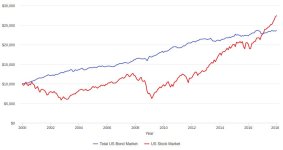
Well, bonds can outperform stocks for a long time.

stocks_v_bonds_2000-2017.jpg - Click image for larger version  Name:	stocks_v_bonds_2000-2017.jpg Views:	0 Size:	42.2 KB ID:	5700176

The unlucky fellow who retired in the year 2000 with a portfolio of 100% stocks would be outperformed by someone in 100% bonds for 17 years.

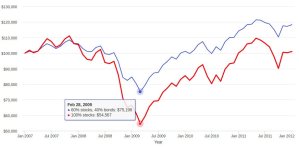
In general though, yes, stocks outperform bonds over multidecade timespans. But that's only if you grit your teeth and don't sell through myriad downturns. Bonds generally serve as a ballast to your portfolio, if for no other reason that you can sleep at night and don't panic-sell in the midst of a crash.


bal_pf_fin_crisis.jpg - Click image for larger version  Name:	bal_pf_fin_crisis.jpg Views:	0 Size:	53.9 KB ID:	5700177


However, during the accumulation phase, some people have gone with a 100% stock portfolio. It sure looked good over the last decade, when interest rates were unusually low. If you can maintain the mindset that, when stocks dive, you are just buying them now on sale, then you might do okay with a 100% stock portfolio. That mindset is rare.

I would not retire with 100% stocks, unless I had about twice as much saved as I needed. That is, most people recommend having 25 times your annual withdrawal rate. So, if you wanted to live on $100,000 in retirement, then you normally want to aim for having at least $2.5 million. (Well, that's not counting Social Security or any other retirement income.) But if instead you had $5 million saved, then yeah, it would be safer to be totally in stocks.

Fun with backtesting: https://www.portfoliovisualizer.com/backtest-asset-class-allocation (But remember, the start and end years that you choose make all of the difference in the world. Don't test only with the default timespan, from 1972 to present.)
 
Thanks for the recommendation for bogleheads, but is it a rabbit hole?

Just read the wiki pages. You don't need to partake in the discussions --- which are just the eternal September of newbies trying to outsmart the advice in the wiki pages.

One of my investing priorities is that I don't want to think about it too much. I'm mildly obsessive and I don't want to spend too much energy thinking about it or tracking stock tickers or such things.

Perfect. That's exactly what the Bogleheads would recommend. This is the Boglehead forum, not the Wall Street Bets forum on Reddit :) The Bogleheads are named after Jack Bogle, the father of index investing.

I'll probably put the lion's share on s&p 500 ETFs. The one thing I'd like to try and do is maybe pull the money out when it seems like there's a big structural downturn in the market. Like when the fed started raising rates last year to fight inflation. It sort of seems like it was predictable the market would come down. I might have sold and then bought back in early this year or right now. Even if you don't time such things perfectly, if you avoid a portion of the downturn it might save your portfolio a lot of value.

Well, that is called Market Timing, and no one seems able to do it consistently.

In retrospect, of course, January 2022 sure looked like a good time to get out of the market, or at least to reduce your investments, move into cash or commodities or something. But a major part of the downturn was the Russian-Ukraine War, which no one priced in. The war caused an oil crisis, which led to higher oil prices, which made our own inflation stickier, which made the Fed more aggressive with its rate hikes, which wasn't priced in.

That's the thing about stock prices. Their current price is not a reflection of current conditions. Their current price is a reflection of future expectations. The current price is how it all settles during a million trades a day, between buyers and sellers. Both buyers and sellers are trying to get the best price possible, which causes an equilibrium (or as close as we can get to one). These buyers and sellers are all doing their research, just like you. In fact, they are doing far more research than you. Did you know that almost all of the traders each day are "institutional investors"? An institutional investor is a full-time, professional investor. Finding the right price for a stock, buying and selling at the right time --- that's their only job. They went to college for this. They have been doing it for years. They have a lot of money to spend on research tools. They have dedicated computer departments to run calculations and simulations and automatic buying and selling at the precise microsecond. Etc. And 85% of the trades are by institutional investors (Investopedia).

You are not an institutional investor. You are a "retail investor" (a small fry, investing for yourself, as opposed to on behalf of others, like Yale's endowment fund or a state pension fund). Whatever insight you glean from The Wall Street Journal, the institutional investors already knew about it last week and it is theoretically priced into the market before you became aware of it.

More practically, "If you missed the market’s 10 best days over the past 30 years, your returns would have been cut in half. And missing the best 30 days would have reduced your returns by an astonishing 83%" --- Timing the Market Is Impossible (Hartford Funds). Suppose you sold a portion of your fund right before a downturn. Nice timing! Now when do you get back in? The current price of assets is supposedly the sum of all available knowledge about the asset's prospects. That is, if tomorrow it goes up, it should be because more good news came in tomorrow. If it goes down, it should be because more bad news suddenly came in. It often isn't like that. I've seen the market react slowly over a week to a piece of news. But predicting whether the market is going to do that, instead of getting it all over with in one day, is also hard to predict. It's impossible to look at a day's market action and say, ah, the market has bottomed, and now is a good time to get back in. Or vice versa.
 
Last edited:
Just to re-enforce my advice to spread your money around. You NEVER know what institution will go bust.

" Silicon Valley Bank was 'the gold standard within the wine industry.' "

California wine industry faces financial crisis majority of vineyards locked out of their accounts (msn.com)

Yes, I thought of your advice when I saw that. But my understanding is that folks over $250k stand to lose only 10% of less of their money once the bank is liquidated.

By the way, I'm not sure if I mentioned it earlier but the other bank failure we discussed (was it Lehman?) - I think that the "secured holdings" referred to securities, and so the people who held stock there were able to get all their stock back. And that unsecured holdings were cash and loans, which is the folks who took losses. I could be wrong, but I think I read that somewhere.
 
Abe, you always manage to find the positive side to any disaster. The bank is closed, people can't get their money, businesses can't make payroll, employees are without a paycheck, bills will go into arrears, businesses with have to take out emergency, high interest loans to keep running........ but, on the bright side, once things settle (who knows when), the big investors will ONLY lose 10%. Now that's a guy that always sees the glass half full.
 
This Monday the FED better get on top of this situation fast, because banks use a fractional reserve system where every dollar they take in from depositors they're allowed to borrow 10x from it. The question is how many banks are in similar situation to SVB? Another bank failure could trigger a cascading collapse. Banks play a confidence game, when that trust is lost they go out of business. There is no middle ground. Any bank currently in trouble is never going to say anything until they go under.
 
Abe, you always manage to find the positive side to any disaster. The bank is closed, people can't get their money, businesses can't make payroll, employees are without a paycheck, bills will go into arrears, businesses with have to take out emergency, high interest loans to keep running........ but, on the bright side, once things settle (who knows when), the big investors will ONLY lose 10%. Now that's a guy that always sees the glass half full.

I've been accused of optimism before. In this case, it doesn't hurt that I'm not an SVB customer.

My understanding of the outlook was mainly drawn from this tweet by Francois Chollet on Saturday afternoon. (Actually he's an AI researcher with great insights into AI. But everyone is talking about SVB, and his post was decisive and concise.

Reading up on the SVB situation and how FDIC operates -- the TL;DR is that the bank will reopen on Monday and folks will be able to withdraw up to $250k + some fraction of the remaining balance. Over the next few weeks they will recover 100% (or very close) of their full balance.

It is not at all likely that any company that banked with SVB will fail to make payroll as a result of the situation.
Baseline scenario is 100% balance recovery, worst case 90%.

Folks who will lose money are those who were exposed to the stock, or lenders to SVB. Not customers.

Weirdly enough most of the takes on my timeline are completely opposite from this more facts-grounded picture.
https://twitter.com/fchollet/status/1634608030204719104?t=uVuFgFKpoqLZI2hvlWVXjQ&s=19

Also, just as a general rule, I have tremendous faith in the US government to take care of money matters, especially when it comes to helping people who have money.

Over the weekend, public servants swooped in to do their FDIC thing and try to auction SVB to another bank.

It really seems like one of those situations where hairs will go gray and ulcers will form for nought. All the worrying about worst case scenarios would have been spared by hibernating for a week.

Losing 10% of their money is unlikely. But it beats losing 100%! That's the fear.

Of course, the real issue is a bank run throughout the country as "Sophisticated" "Responsible" people suddenly realize that their uninsured large deposits are not insured and they should pay closer attention to the institutions holding their money.

Theoretically, all those banks should be able to survive a run. But they've been hoisted by their own petard. SVB was among the banks who successfully lobbied for looser banking regulation in 2018 and paved the way for their own demise.

All the lefties in my Twitter timeline are having a good laugh at that, and at the cries of erstwhile libertarians begging for Uncle Sam to backstop their deposits. There are no atheists in the foxholes...
 
So, I opened a SEP IRA a week before tax day and deposited my maximum contribution for 2022. I went all in on the VOO for now. My plan is to open an account at a different brokerage each year until I have 7 accounts, and I can consider investing those in different ETFs or something. Probably no bonds for me until I get closer to retirement.

Thank you to everyone who offered me advice!

As I had feared, after I had taken available deductions, etc, on my taxes, my maximum allowable contribution to a SEP IRA was well below how much I wanted to put in this year. So, the plan is to get an EIN and open a solo 401(k) before the end of the calendar year. For 2023, I can contribute $22,500 more to a solo 401(k) than I could to a SEP IRA, and that should put me over the top of my target savings amount.
 
Back
Top