48v phantom to podium mic for G2 wireless?

AdamT

Active member
I have a Studio Projects C1 condenser studio mic and might try using it to record an important speech that will be given at a podium in a large room. I will be using a G2 wireless set to get the audio to my HVX200a. I know the mic needs 48v phantom, which the G2 transmitter does not provide. Is there a cheap, battery operated device (perhaps some kind of mixer) that will give the mic the phantom, and then send the feed into the G2 transmitter?

Thanks!!
 
The SKP 500 G2 transmitter with do this for you.

Use in place of your existing transmitter. It will turn any mic. into a radiomic. and also provide 48V phantom power (switchable) to power the mic.
 
Thanks but I was thinking something about 1/4 the price. Any other options?

OK..................

The EMO E720 is a small inexpensive battery phantom power unit to power a condenser mic.

BUT

You will need to get on to Sennheiser USA (or whoever distributes Sennheiser in your country) and get them to make up a special lead. You will need an XLR-3F to lockable mini-jack wired as follows:-

XLR pin-1 to mini-jack sleeve
XLR pin-2 to mini-jack tip
XLR pin-3 to XLR pin-1 or mini-jack sleeve

mini-jack ring is not connected.

NB: You will need blocking capacitors in the XLR to prevent the DC "plug-in power" for the tie mic. getting into the phantom power box.

John--it sounds like from your post you're talking about him plugging into the bodypack transmitter--mine was based on him plugging into the "plug-on" transmitter for hand-held mics. Would you need anything like you're talking about if he did have the "plug-on?" Just trying to expand my knowledge here as a very recent Sennheiser wireless user... :)
 
I'm confused why any kind of special mic cord has to be used. I'll have the C1 on the podium and run a short mic cord to the XLR input on the Rolls PB224 (which will send phantom power to the mic). Then I'll run another short mic cord from the output on the Rolls to the Sennheiser bodypak transmitter (cord will be an XLR to mini-plug type)

Or as Capt. Pierce suggested, to the handheld mic transmitter.

So what's the problem?
 
John--it sounds like from your post you're talking about him plugging into the bodypack transmitter--mine was based on him plugging into the "plug-on" transmitter for hand-held mics. Would you need anything like you're talking about if he did have the "plug-on?" Just trying to expand my knowledge here as a very recent Sennheiser wireless user... :)

The first post said he had the bodypack transmitter and my first answer was to advise using the plug-on.

He said that was too expensive (as he already had the pocket transmitter) so my answer was based on plugging the mic. into the bodypack with a special cable that has blocking capacitors to prevent the "plug-in power" damaging the mic. As it's a 48V powered condenser mic. you also need a battery phantom power supply, of course.

If you use the plug-on transmitter - that plugs directly onto any mic. with an XLR connector or you can also use a short XLR cable. The SKP 500 supplies 48V phantom power, the SKP 100 doesn't, so if you have the SKP 100 you will beed a battery phantom power supply the same as above.

I hope this answers you OK.
 
I'm confused why any kind of special mic cord has to be used. I'll have the C1 on the podium and run a short mic cord to the XLR input on the Rolls PB224 (which will send phantom power to the mic). Then I'll run another short mic cord from the output on the Rolls to the Sennheiser bodypak transmitter (cord will be an XLR to mini-plug type)

Or as Capt. Pierce suggested, to the handheld mic transmitter.

So what's the problem?

The problem is that the bodypack transmitter is putting out 5V of unbalanced "plug-in power" to power an electret tie mic.

If you use it with a balanced dynamic or proper condenser mic. you need to have a special cable with blocking capacitors in the XLR socket to prevent this 5V "plug-in power" getting any further (a dynamic does not need power and a condenser needs 48V). This 5V can cause problems and bad sound if it gets to the mic. (other than the mics it was designed for).

SOME microphones (normally electrets with a built-in battery) have the blocking capacitors in the mic., but it's always safer to use the special lead.

Ahhh I see. So somewhere along the way you need a cord that cuts out the 5V the transmitter is sending upstream (which is there to power a lav). Otherwise you send 53v into the condenser mic (48 + 5). Do you have a link where to get cords that do this? Thanks!!
 
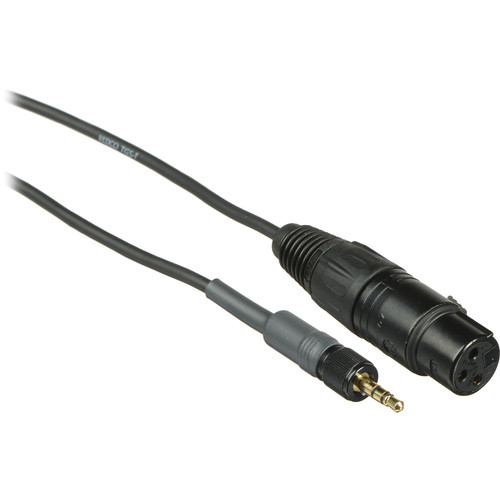
Sennheiser makes a cable to hook regular mics into their bodypacks, with the voltage blocking. Part number is CM1, list price $82.50 (but you can no doubt find it cheaper :) ).
 
The first post said he had the bodypack transmitter and my first answer was to advise using the plug-on.

He said that was too expensive (as he already had the pocket transmitter) so my answer was based on plugging the mic. into the bodypack with a special cable that has blocking capacitors to prevent the "plug-in power" damaging the mic. As it's a 48V powered condenser mic. you also need a battery phantom power supply, of course.

If you use the plug-on transmitter - that plugs directly onto any mic. with an XLR connector or you can also use a short XLR cable. The SKP 500 supplies 48V phantom power, the SKP 100 doesn't, so if you have the SKP 100 you will beed a battery phantom power supply the same as above.

I hope this answers you OK.

I missed that he mentioned the body pack. :)

Thanks for the clarification. I should probably look at one of those CM1 cables for our kit, since all I was able to talk my boss into was a 300 series combo system with a 100 series portable receiver; since the 300 combo came with a perfectly good hand-held mic, it was hard to convince her to spend the money on the plug-on as well...
 
here is the xlr to body pack cable, $50 from b&h but they are out of stock.
"The Sennheiser CM1 is a cable designed to connect to the EW series wireless transmitters. The cable features an XLR female connection for connecting line level or microphone level output devices."
310613.jpg


http://www.bhphotovideo.com/c/product/310613-REG/Sennheiser_CM1_XLR_Female_Microphone_Cable.html

There is something *very* wrong in that description.

The cable cannot do both mic. and line!

The line-in cable does *not* have the blocking capacitors and is wired to the mini-jack ring and sleeve only with tip not connected (ring is the line in).

The mic. cable *does* have the blocking capacitors and is wired to the mini-jack tip and sleeve only with ring not connected (tip is the line in).

Make sure you get the correct cable!
 
John is correct--the line cable is part number CL2 (at least here in the US), and the price is much less (presumably due to the lack of the capacitors).
 
There is something *very* wrong in that description.

The cable cannot do both mic. and line!

The line-in cable does *not* have the blocking capacitors and is wired to the mini-jack ring and sleeve only with tip not connected (ring is the line in).

The mic. cable *does* have the blocking capacitors and is wired to the mini-jack tip and sleeve only with ring not connected (tip is the line in).

Make sure you get the correct cable!

John, do you know where to buy the correct "mic" cable with blocking capacitors? A link to some place selling them here in the US would be helpful. Thanks!
 
Back
Top