Edge to Edge Sharpness on LE

Since we know the LEX has a much larger internal FOV than academy or other conventional standards (see my previous post in this thread for the relevant quote about this from Letus's site), I wonder if someone could try something out while I await the arrival of my own LEX (or point me to another place if someone's already done it).

According to Barry's book, a bare HVX shoots the 35mm still camera equivalent focal length of 50.8mm at a zoom setting of Z25 (or 6.6mm on the HVX's mm scale readout). He's got a wide range of lens lengths and equivalencies mapped out in the book, but since most users have at least a 50mm lens, and it's more or less a "neutral" focal length, it seemed like a good test subject.

The procedure would go like this:

1) Set up a focus chart or other similarly large, finely detailed image, and with the HVX's zoom set to 25 (or 6.6mm), position the camera so the screen is filled with the chart, focus for the center, and shoot.

2) Then, without moving the camera (except to accomodate whatever the difference is between the locations of the imaging planes with and without the adapter), add the LEX (or any adapter, for that matter) and a 50mm SLR lens. After setting it up normally, zoom the HVX to match the FOV as in case #1, and shoot again.

The question is, what HVX zoom setting is the result in case #2?

If it's significantly more zoomed in than what's necessary to eliminate vignetting, then we may have some useful information on minimizing edge focus problems. Presumably, more zoomed in should mean less edge-related issues of all kinds, right?

Furthermore, since we've established a bare HVX vs adapter-equipped focal length equivalency, then we know we're not over-zooming to get that advantage. We've eliminated the adapter's effect on FOV from the equation.

Of course, users could still zoom the HVX in less if they wanted to and didn't mind whatever the effect on the image quality was, but at least we'd know what setting could be regarded as focal length-neutral.

Thanks in advance to anyone willing to give this a shot.

Performed your test except with an 85mm Nikon. It's equivalent field of view in 1/3" chip is 11.7mm. BUt before I reveal the results, let me amend your test - you have to move the camera. If you start with the camera with no adaptor, your focal plane is approximately half way down the barrel part of the body (where the prism is). With any Adaptor, your focal plane is now where the ground glass is. In the case of the LE that's about 10 inches from the HVX's focal plane. So you got to move your camera back about ten inches.

I had to zoom into 69 (17.9mm) to duplicate the 11.7 mm results. At this wide, I am barely past the GG borders and it suffers from vignetting (especially the left side) similar to Kwan's post. To get past the vignetting on a wide lens (24mm) I have to zoom in to 81 (26.9mm). To get past vignetting on my 85m, I have to zoom into 74.

I can draw a few conclusions: either you have to zoom in much tighter than cine 35 FOV to get past vignetting or the HVX's zoom readout is highly inaccurate or both. The only way to really verify this, I guess, would be to compare the FOV on a 35mm film camera or find out FOV in degrees (from some chart out there) and duplicate that.

Eitherway, it would be nice to have a definitive answer for what zoom settings really replicate a cine 35 FOV.

Barry Says to tape an 8 x 11.5 sheet of paper on the wall Landscape wise, set the HVX with a 50mm lens on it 2 feet away from the paper leveled, then zoom the HVX in til you crop off the sides of the paper. 1/4 on each side. That is your 35mm FOV.

I think that's about 27.3 or 30, but I might be wrong.
 
Whoops! I'm a fool. That table I was using uses a photographic 35mm. Much more accurate calculator at this site:
http://www.panavision.co.nz/main/kbase/reference/tblelenseqvform.asp

An 85mm at cine 35mm (super 35 1:85, 23.5 mm x 10mm) is 15.7 degrees field of view. At standard 35mm 1:85 (21mm x 11.3) it's 14.1 degrees.

According to this calculator http://www.csgnetwork.com/righttricalc.html

At 7' away the width of the FOV should be 1.94 feet (1 foot and 11 1/4 inches).

So here are the results
SUPER 35 (1:85 emulation)
85mm Nikon
7 feet away
1.94 Width
Letus
HVX set at 81 (or 26.9mm)


STANDARD 35 (1:85)
85mm Nikon
7 feet away
1.84 Width (1foot, 11 inches.
HVX zoom set at 82 (or 27.3mm)


Phew! That makes sense. Well beyond the vignetting zone. Good numbers from barry.
 
Last edited:
That's what I thought. 27.3 is where I've been at this entire time and from there on out it gets even better.

Z70 and77 and any of those other numbers are incorrect for proper FOV anyway. However, that does not fix the wide angle issue. examples coming soon!
 
So you guys know, GG is in focus @ 5.38/.51 border @ 27.3mm. @ 40.04 the GG is in focus on the border of 5.25/.12.
 
Edge to Edge Tests

Edge to Edge Tests

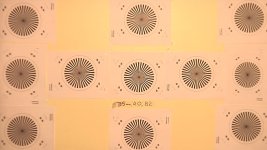
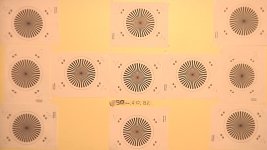
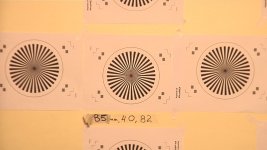
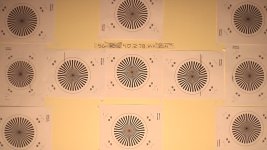
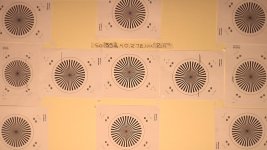
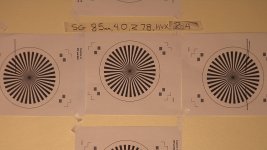
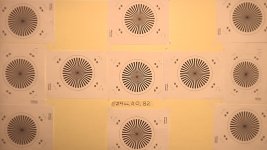
Shot 1080. HVX 200. Focus Charts are printed from Canon Inkjet but set up to give you an idea of the fall off. Do not use these test to judge vignetting as I didn't have the space or lights to illuminate my focus grid evenly.

The Focus Grid is about 40" wide. I shot everything at a 4.0 so you could see the nikons at their optimal focus performance.

The lens used:
Nikon 24mm 2.0
Nikon 35mm 1.4
Nikon 50mm 1.4
Nikon 85mm 1.4

All AI in great condition.

This first set of still are from the LETUS set at 82 (27.3) to emulate 35mm 1:85 cine FOV. The next set will be from the SG.

Also, keep in mind, focal planes are not curved. They're in fact, perpendicular to the camera axis. So even though the outer focus charts are further from the camera then the center chart, they're still on the same focal plane. Test it. When I focus on the center, the outer charts also reach their hyper focus. It explains how swing and tilt lenses work.
 

Attachments

  • LE-Nikon24mm(2.0)Setat4.jpg
    LE-Nikon24mm(2.0)Setat4.jpg
    117.9 KB · Views: 0
  • LE-Nikon35mm(1.4)Setat4.jpg
    LE-Nikon35mm(1.4)Setat4.jpg
    113.9 KB · Views: 0
  • LE-Nikon50mm(1.jpg
    LE-Nikon50mm(1.jpg
    109.7 KB · Views: 0
  • LE-Nikon85mm(1.4)Setat4.jpg
    LE-Nikon85mm(1.4)Setat4.jpg
    104.8 KB · Views: 0
Last edited:
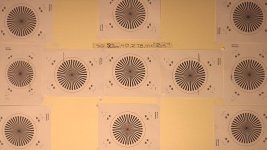
SG Edge to Edge Tests

SG Edge to Edge Tests

Here are the SG tests.

Same lenses and stop as above. The SG zoom was set to 78 to replicate 1:85 35mm cine FOV.

Please keep in mind when you view these stills - I do not get free anything from any manufacturer or advertising on my URL.

The results confirm my suspicions and also show what can and most likely will be improved (given the outstanding track record of the vendors making every effort to improve).

Also, aside from both adaptors showing edge focus degradation it's more prevalent on both on the left side due to the camera's lack of image centering. I believe Brevis x/y adjustment is the right thinking to fix this problem.

Whether you find the edge fall off too much or too little to be acceptable depends on the kind of work you do and where it gets exhibited. The larger the screen, the bigger the problem. The more you frame vital info to the edges the more it'll bug you. If you frame action mostly towards the center and won't be seen on a large TV or big screen than edge to edge deficiencies won't be a big deal. Otherwise, push the vendors to make a good product great. If it means having a second tier of "pro" pricing then I think it'll be worth it because I know it'll still be significantly cheaper than a PS. Take care of edge to edge, vignetting and image centering, and I believe you have a market for a 2 to 3 grand adaptor. Hell, that 's half the price of a camera and the same price of a good set of lenses. The adaptor being the heart and soul of the scheme should be able to command such a price.

I believe that the issues in both set of tests will eventually be addressed and should add to the price of the adaptors. But I also believe edge to edge sharpness is vital to dramatic film making in keeping your attention where it belongs - on the drama.

Look and judge. Going to get a drink, now. No more tests for at least a week - I hate doing this but you got to know what you need to know. And thanks for recommending a focus chart (now I know why my AC's always have them handy). And who's going to send me a Brevis Flip to test?
 

Attachments

  • SGNIKON24mm(2.0)Setat4.jpg
    SGNIKON24mm(2.0)Setat4.jpg
    134.8 KB · Views: 0
  • SGNikon35mm(1.4)Setat4.jpg
    SGNikon35mm(1.4)Setat4.jpg
    134.8 KB · Views: 0
  • SGNikon50mm(1.4)Setat4.jpg
    SGNikon50mm(1.4)Setat4.jpg
    134.6 KB · Views: 0
  • SG-Nikon85mm(1.4)at4.0.jpg
    SG-Nikon85mm(1.4)at4.0.jpg
    125 KB · Views: 0
Last edited:
Even though I couldn't light evenly, the 24mm vignettes far more than the others and hence the hotspot. This test is hard to judge for hotspots as I had a helluva time getting things even with one softbox. It's vignetting is more a function of the adaptors. You can see the difference between the two.

At some point when I have the time (never) I'll illuminate things evenly and cover my entire house with focus charts.
 
Last edited:
Tim,

Thanks for the grabs. i think they should help focus this discussion if you don't mind the pun. That is one helluva an interesting way to make a focus chart!

These are about what I would expect ands similar to my tests (I expect Brevis would be similar BTW), but for me the crucial issue is how and where did you set back- focus on your adapter ?( i mean video camera's focus on the adapter screen)

I see on all of these that the center is in sharp focus. I imagine that if you focused slightly past that point you would begin to see the corners come into sharper focus and you would eventually lose the center and have excellent focus on the corners.

When I setup, I have a large focus resolution card (3-4' wide) on a stand. I usually focus just past where you have and find the best compromise on center to corner focusing. That is I believe the proper point to focus the screen. The overall focus is never as good as your center, but the general appearance is more even.

I would like to see tests showing how these adapters compare when you have found that "sweet compromise spot" for each of them. That to me would show how sharp an adapter is.

BTW I am interested in full SLR FOV as well as 35mm cine equivilents. In fact I don't really care about 35mm cine framing in particular. After all these are designed to be SLR lenses - why only use the center of the picture? Theoretically there should be more resolution in using the full glass and a larger field of GG . So i am interested in how well these units perform when zoomed a bit further back. Letus off centering is a drag in this regard. That way I can get a decent wideangle also.

- Lenny Levy

You bring up some valid points. This first set of tests I needed to start at some standard that many of us identify with whic is cine 35mm FOV. Also, the only way to really see the amount of edge fall off is to start with the center at its highest focus. This is pretty much the standard when testing lenses be it film or stills.

That being done, I am definitely interested in seeing tests at the compromise position as I'm sure it would improve edge sharpness on both adaptors. It should be done first with the center optiimized and then the compromise so we've something to compare. To see what we lose and what we gain.

Concerning the amount zoom in, it just so happens 82 was the level of zoom in which vignetting disappeared on my wide lenses on the LE. It also happens to be the same angle as Cine 35 FOV. When I zoom out wider, I begin to see the vignetting. With the SG I could go out to 72 before vignetting began to creep in. This would give a slightly wider angle than cine 35.

Anything that approached photographic 35 FOV vignetted a bit too much on both (more so on the SG).

So who wants to do the compromise position tests. I've used all my time. Got to make a living now.

TIm
 
hey Tim, Great tests there, I too have done some on my HD television screen, after printing out a very thin grid on paper to see the gradual difference between the center and edges. And from what i have tested, your grabs seem to be a bit softer on the edges than mine, and im only zoomed in to Z78 on my canon XH A1.

What is the impact, for the SGpro, once the flip is involved? Because right now, without the flip, we're comparing apples and oranges.
 
I did my tests as large as I could (in my living room) so I could have some distance. The zoom level was whatever emulated 35cine FOV to have a standard. Also, any wider began to vignette on the LE.

Word on the street is that the SG flip actually is a hair sharper but also has to zoom in a bit more. We're waiting on a condenser to test ours. When it's in we'll run it through its paces. I hope the E to E is improved. The unit I'm really interested in now is the Brevis Flip. With x/y adjustment it apparently can eliminate the off center issue. That's a big deal for me. I'm close to putting my money down, but I just need to hear from users how it is in terms of build, optics, etc.

On the good news, word is that LE is working on glass that'll correct the E to E fall off. Apparently, the results are different with different cameras due to aspherical elements, hence, your Canon having better results.
 
On the good news, word is that LE is working on glass that'll correct the E to E fall off. Apparently, the results are different with different cameras due to aspherical elements, hence, your Canon having better results.

Did you hear that directly from Letus? Is there any indication of when this change is expected to be implemented? I haven't yet received the LEX I ordered on January 3rd, and would be happy to wait even longer if it means I'd get one with the fixed optics.

I've been looking with growing concern at grabs and footage that shows anywhere from mild to totally unacceptable edge softness, including many of the demo clips on Letus's own site. Your and Kwan's tests have also been quite scary. On the subject of the Canon, I did notice that some of the least edge-soft footage on the Letus site is from the XHA1. Perhaps the original LEX design was optimized on that camera?

I wonder if I'd need to tell them that I use an HVX, or if the 82mm thread spec is enough to tip them off (is the HVX the only cam that uses 82mm?).

I'm really, really hoping for a good outcome on this. Like you, I love the center sharpness and light-friendliness of the LEX. All that plus a cure for the edge softness would make it a total winner.
 
Last edited:
I found some more scientific tests by Ryan Walters.
www.timnaylor.com/edgetoedge

A curious thing about these chart shots is that the bare HVX shows the most edge softness in the upper left corner but the HVX+LEX shot is softest in the lower right. It suggests that the difference is even greater than it appears, since the HVX starts with a lower right "advantage" and ends up (+LEX) with a lower right "disadvantage".

IIRC, I also noticed worse right edge softness than left in most of the problematic LEX clips and grabs I 've seen.
 
Ted - the adjustment peripheral will be totally different than what we've seen before and will be able to correct more than just the HVX offset. You should see an announcement here on the boards in due time. Just keep your eyes peeled an your worries down. They are very aware of the HVX offset and every other camera (EX-1 included) and have been hard at work to help the community out.

Tim Naylor - Again, thanks for the tests. I know that I didn't notice such a drastic loss in edge sharpness until the PL lenses were strapped on, I want to try SuperSpeeds and I believe I'll have time to mess around and post up some results today myself (I don't have a focus chart and need to find one to DL and print). You're right about the Le brothers coming out with an adjustment unit. Just a matter of time.

Leni - 35mm FOV is VERY important. In fact, if you ever get a chance to use PL lenses you have to zoom in much further than the 35mm FOV to use them properly on all adapters. Which is why you need spacers for the Brevis to do so. I believe you have to zoom in to 24 x 16.

Question: Why is 35mm FOV so important when the frame is 16:9 Regardless?

Answer : For an accurate replication of 35mm DOF. There's work here on DVXuser that's WAY TOO SHALLOW. If you sit and watch movies, the depth of images is nowhere near as great as works posted here. Now if you don't care about hyper shallow imagery, go right ahead and use any FOV you think is cool.

Once again: THERE IS NO COMPROMISE. Anything you get wider than 35mm FOV is EXTRA. Adapters are created to mimic the FILM LOOK. If the look of film is a 35mm FOV, then anything beyond that is Extra, not a comrpomise. And every one of these adapters area created specifically for that.
 
Barry Says to tape an 8 x 11.5 sheet of paper on the wall Landscape wise, set the HVX with a 50mm lens on it 2 feet away from the paper leveled, then zoom the HVX in til you crop off the sides of the paper. 1/4 on each side. That is your 35mm FOV.


Just curious - 2 feet as measured from what?
I assume it's from the focal plane (the GG in this case) - right?

Just want to make sure.
 
Just curious - 2 feet as measured from what?
I assume it's from the focal plane (the GG in this case) - right?

Just want to make sure.

I think it's the actual lens since the lens is what gives you the FOV and not the GG. But that's a really good question. I wonder if it's the lens or the GG.
 
Back
Top