Arri or Lowel - or?

Hi Guys -

I'll attempt to be as clear as I can to help you guys help me out with your replies.

I'm looking for a light kit.

My budget around max of $2,300.

I'll be using a FX1 w/ SGproR3 setup most of the time.

What I'll be shooting is indoors/outdoors.

Interview type / Short film / documentaries

For the lighting - I'm sure it will be mostly indoor use, but never know at night small areas.

Probably wont ever be a huge area to illuminate but curious to know how much throw these kits can do.

So I'm looking at the:

Lowel DV Creator 55 Kit
DV903Z.jpg

Priced out around ~$1,900.
Contains...
1 Rifa-lite 55 (LC-55)
1 500w, 120v lamp (EHC)
1 Pro-light (P1-10)
1 Pro-light 4-way Barndoors (iP-20)
1 250w, 120v lamp (GCA)
1 Omni-light (O1-10)
1 Omni-light 4-way Barndoors (O1-20)
1 500w, 120v lamp (FTK)
1 Tota-light (T1-10)
1 750w, 120v lamp (EMD)
3 Uni TO Stands (UN-55)
1 KS Jr. Stand (DT-33)
1 Tota-frame (T1-20)
1 Assorted Gels (T1-78)
1 Pro & i Gel Frame (iP40)
1 iP Assorted Gels (iP-78)
1 Flexi-shaft pkg (2) (T1-50)
1 Tota-flag (T1-52)
1 Tota-brella (T1-25)
1 T/O Lampak (TO-61)
1 DP/Tota Lampak (DT-61)
1 TO-83 Case

or

Arri Softbank IV Tungsten 5 Light Kit -
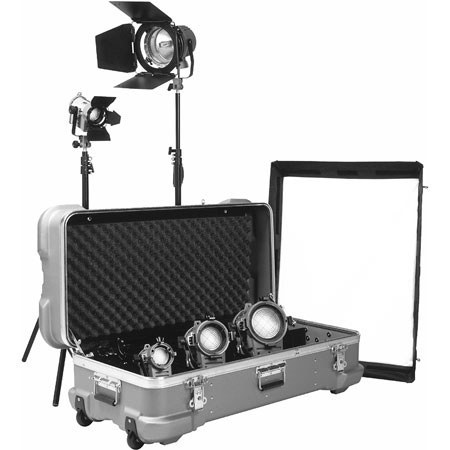
AR571891.JPG

I can find for around $2300
consists of:
2 Fresnel 150,
1 Fresnel 300,
1 Fresnel 650,
1 Arrilite 1000 Open Face Light,
Barndoors,
Scrims,
Filter Frames,
Bulbs,
24x32" Softbox,
Super Clamp,
Light Stands,
Accessory Pack,
Bulbs,
Heavy Duty Case


So there is the $400-500 difference.

I have read throughout many threads there that Arri are better quality - tends to be more expensive and heavier. Lowels are lighter, more affordable - however not as great of quality. I understand its a matter on how you use your equipment that determines a lot.

But for the differences as listed that each contain and the amount money - would you rather buy lowel and spend extra on somethings to add to it or just down right get the Arri? Or....?

Thanks guys - I really appreciate the help for a noob!

Jason
 
Last edited:
Hi:

I own Lowel and Arri kits and most of my clients have Arri kits. The Arris, IMHO, are superior in every way except weight and size. The Lowels work fine but open face lights are harder for beginners to use, in general and the Lowels are flimsy, they break much easier.

The Mole kit isn't bad either, but more $$ and not a lot better quality than the Arris. The only sore point on the Arris are plastic yokes that get loose with age, cables separate from power switch, but other than those, they rock.

Best,

Dan

Thank you for the reply, I'm guessing the Arris are the way to go. To clarify.

The yokes are plastic? The housing or?

Cables separate from the power switch. What does that mean? Does it come with all necessary cables and switches?

Thanks!

Jason
 
Hi Jason:

The yokes (tightening mechanisms) are the fastening mechanisms that allow the light to rotate on the mounting bracket, which is also sometimes refered to as a yoke. This really only matters on the light that you will use with a Chimera. As you might imagine, having a lightbox and a speedring hanging off of the front of a light puts some rotational strain on the light's yoke. I have noticed over the years that as you crank down on the yoke mechanism, it eventually gets looser and the Chimera can droop and point downwards more than you would like. Moles have metal yoke mechanism versus plastic on thee Arris.

However, there are some tricks you can do like gaffer taping the light's power cord to the light stand once you have the correct angle, so that the light/Chimera doesn't droop down to the floor.

On Lowels, it's worse. I have the speedrings for my 500 watt Lowel V Lights. They are so flimsy that I really have to tape the whole thing up so that the light/Chimera doesn't end up pointed at the floor, instead of the talent.

I do own a couple of Mole lights. On my Mighty (an open faced 2k), I can put my medium Chimera on it, which is pretty huge (36" x 48") and because of the metal yoke mechanism, that Mighty will hold the Medium Chimera exactly where I tightened it with no droop at all. Because it's metal on metal when you tighten it down.

Cable separating from power switch. Okay, all of my Lowels, Pro-Lights, V-Lights, etc. they have a power switch built into the light. They have a little plastic ring where the AC power enters the light fixture. Where that cable enters the light, all of the AC cables have frayed and I have to repair them by tearing the light apart and re-stripping the AC cord and buying new plastic retainer ring and putting the whole thing back together. It's a PITA.

On the Arris, I have never encountered this at the light fixture itself. All of the Arris have in-line power switches meaning that the power switch is in-line with the AC cords, not a switch on the light housing like the Lowels (not all of the Lowels are this way, just mainly the smaller models). On many of my Arris, where the AC cable enters or exits the in-line switch, the covering (like heat tubing) separates so that the two or three wire is exposed. Now the two or three wires are covered with insulation so it's not really dangerous, but I then have to take it all apart, re-strip the wires, re-align the heat tubing cover, then put it all back together again. This all stems usually from other crew members being lazy and yanking the AC cord out from the wall by the cable, rather than going up to the plug and unplugging it. It's abuse mostly, not normal wear and tear.

The lights do come with all of the necessary cables and switches, I am just talking about how they respond to abuse/wear and tear. Keep in mind I own 22 lights and have used all of them for years and years in professional situations. If you baby your gear, you won't have to to worry about most of this. I baby my gear, but I hire professional gaffers that are hard on gear and sometimes when I am not around on-set, they do stupid things like yanking cables or walking over/on power switches. Such is life.

Dan
 
Last edited:
Hi Jason:

The yokes (tightening mechanisms) are the fastening mechanisms that allow the light to rotate on the mounting bracket, which is also sometimes refered to as a yoke. This really only matters on the light that you will use with a Chimera. As you might imagine, having a lightbox and a speedring hanging off of the front of a light puts some rotational strain on the light's yoke. I have noticed over the years that as you crank down on the yoke mechanism, it eventually gets looser and the Chimera can droop and point downwards more than you would like. Moles have metal yoke mechanism versus plastic on thee Arris.

However, there are some tricks you can do like gaffer taping the light's power cord to the light stand once you have the correct angle, so that the light/Chimera doesn't droop down to the floor.

On Lowels, it's worse. I have the speedrings for my 500 watt Lowel V Lights. They are so flimsy that I really have to tape the whole thing up so that the light/Chimera doesn't end up pointed at the floor, instead of the talent.

I do own a couple of Mole lights. On my Mighty (an open faced 2k), I can put my medium Chimera on it, which is pretty huge (36" x 48") and because of the metal yoke mechanism, that Mighty will hold the Medium Chimera exactly where I tightened it with no droop at all. Because it's metal on metal when you tighten it down.

Cable separating from power switch. Okay, all of my Lowels, Pro-Lights, V-Lights, etc. they have a power switch built into the light. They have a little plastic ring where the AC power enters the light fixture. Where that cable enters the light, all of the AC cables have frayed and I have to repair them by tearing the light apart and re-stripping the AC cord and buying new plastic retainer ring and putting the whol thing back together. It's a PITA.

On the Arris, I have never encountered this at the light fixture itself. All of the Arris have in-line power switches meaning that the power switch is in-line with the AC cords, not a switch on the light housing like the Lowels (not all of the Lowels are this way, just mainly the smaller models). On many of my Arris, where the AC cable enters or exits the in-line switch, the covering (like heat tubing) separates so that the two or three wire is exposed. Now the two or three wires are covered with insulation so it's not really dangerous, but I then have to take it all apart, re-strip the wires, re-align the heat tubing cover, then put it all back together again. This all stems usually from other crew members being lazy and yanking the AC cord out from the wall by the cable, rather than going up to the plug and unplugging it. It's abuse mostly, not normal wear and tear.

The lights do come with all of the necessary cables and switches, I am just talking about how they respond to abuse/wear and tear. Keep in mind I own 22 lights and have used all of them for years and years in professional situations. If you baby your gear, you won't have to to worry about most of this. I baby my gear, but I hire professional gaffers that are hard on gear and sometimes when I am not around on-set, they do stupid things like yanking cables or walking over/on power switches. Such is life.

Dan


Perfect explanation Dan - Thank you for your time and experiences. It definitely helps with my decision making.

Jason
 
I prefer arris because it is easy to use scrims and they are sturdy for everyday use. Lowels are great for the hobbiest but for overall construction value, Arri's and Moles are the way to go.
 
I prefer arris because it is easy to use scrims and they are sturdy for everyday use. Lowels are great for the hobbiest but for overall construction value, Arri's and Moles are the way to go.


Thanks Smithy for the suggestion and reply!

btw nice SGPr3 - and ahh.. did you make the preorder for the FF - if so, YOU BUM! I left for vacation the day before he released the presale - grr missed it - I'll get on board for the next round - it's like a lottery! lol never know when it's going to be available! .. just "sometime in november" :-P :-)

Thanks again!

Jason
 
We have both Arri and Lowel kits. I prefer the Arri's because the light is much easier to control and the lamps don't burn out when you move and adjust the instruments.
 
I had to answer this same question a few months ago. I went with Lowel. I prefer the Arri in every way, but I am 90% of the time a one man crew. Arri are built better, but they are heavy. Heavy lights require heavier stands. You are almost going to need C-stands for the Arri stuff. And that adds weight and trips to the car. If you have a crew or a couple grips go Arri. If its just you I would consider lowel.


what ever you decide I would not recommend buying a KIT. Many times you will get a bunch of mounts and accessories you will never use.

You can also mix and match and save money.

www.imagewest.tv has a great Arri rip off fixture.

And Lowel tota lights are great for softboxes and China Balls.

Also the guys at coolights, that are on this forum, have some great fixtures for under 200. That can be Daylight or Tungsten.

My point is, the only perfect lighting kit is the one you build for your needs. Don't let Lowel or Arri tell you what you will need in the field.

My Kit includes:
1 750 watt Tota w/ Chimera
1 omni (500)
3 Pro Lights (250)
4 stands
1 gobo arm
1 1k inline dimmer
carrying case
gel pack

I did the whole kit for around $1200.00


Just my opinion, good luck on your purchases.
 
I second this "not buy a kit" idea. How can you really make one that's suited to everyone's uses? Put together something based on what you know you'll be doing and the type of work and the scale you'll be doing it in.
 
I would also put in a vote for the Arris. Although I'd rent if at all possible as opposed to buying. Or you can buy them used as well. That's a way to go.
 
Back
Top