A Properly working DOF Adapter... Less than 1 stop light loss

Homework anyone?

Homework anyone?

About DOF being too shallow? My best guess is that Anyone who's experienced this phenomenon with 645 (or other medium format lenses) is not properly reducing the image first and not taking advantage of the full usable projected frame. Without image reduction via lens condenser, approx only half the image is usable. Utilizing only half the image doubles the Depth of Field and would result in 'over depthy fieldness' :-Dum(DBG): or Too shallow a working depth of field with such a nice large lens. It's true that 35mm lenses are a tad less 'depthy' in the 50mm range, so zooming in past the true 35mm frame border to reduce vignetting also reveals a nice level of depth with small view lenses. When a Medium Format lens image is properly reduced for re-capture through an achromat by the video camera, the full original view intended for film is utilized... resulting in a very nice Depth of field resembling that of a 35mm film camera.

More homework in the next lesson.....
 
Lessons in light....... and more stuff

Lessons in light....... and more stuff

This post is lengthy, but by far the most usefull post you will find on this thread so far about light and light retention. by Cory Easom

also:

Nikon lenses-Mount
Rails, in the works...
and More answers.

Siniarch (nice Heinz commercial), Cinebuddy, PappasArts and all who took time to really comment and offer good advice, and critique. Even Wes... I'm taking everything into consideration so thank you much for your time, help and encouragement. I'm working hard to push this unit further.


Nikon Mount:

The unit will be backwards compatible with Nikon mount lenses... starting next week. I do see the importance as I have a full range of Nikon optics as well.


Camera Mounting/Rails:

At the moment, the camera mounts onto the Leica/Dicomar shade mount and rotates on smoothly and then screws into the accessory mount near the on camera mic to lock in the rotation and also displace the added weight from the shade mount to the body of the Camera. My brother came up with the idea of a quick release plate on the accessory mount so you only have to screw in the plate once. Then the unit slips on and off faster than the original shade and firmly clicks into place and unclicks for removal taking less than 2 seconds to attach and less to remove. I actually clocked this several times. I'll have to post a vid here. Works well for hand held quick mounting and shooting. This also keeps the collimation of the unit centered, all the glass involved aligned well without having to mess with shims or such. There is a 3 way external adjustment on the back of the unit for critical tilt and zoom of the ground glass but should not need any adjustment as it is aligned during assembly. One of the benefits of having a camera specific product is it will be tested and work properly with that specific camera. There are so many variables, mostly the optic differences between Panasonic, Canon, Jvc and so on. Mostly the Spherical aberration and Achromat mounting distance. I believe The 2 second mount and dismount is a benefit distinct from a generic adapter. The one time initial mounting of the quick release plate actually takes about 2 minutes. I'm sure I will make the unit adaptable to other cameras as a camera specific device in time.


Rail Assembly and Image flipping:

I will be testing a prism flip after completing this adapter. Soon after. That one will have a small standard 15mm dual rail for tripod mounting, matte box and accessories. What I'm working on now is a Rail/Partial protective cage that will enclose most of the unit and handle the flipping, of the whole camera and adapter. You must see it before discounting it. Makes the camera setup look really tough and will hold a large eyepiece and 7 to 9 inch monitor.


At this point, I would say the unit is still a DIY endeavor, but headed for production. Of course I would like to build the best unit with the most user friendly features, even if it were just for my own use. That's why I started research on this device. Not to save money and make a birdhouse style adapter in a Radio Shack plastic project box that is now a very tactical looking birdhouse, but to build an adapter that didn't have that muddy, squeezed through the matrix and re-digitized look to the footage. Also making a purposeful rigid machined housing to save space and weight instead of adapting a preexisting large box or something.


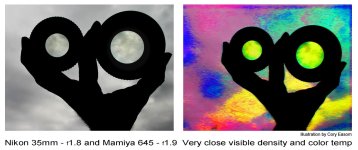
Visible Light: Through the eyes of an upright walking humanoid biped.


Having some experience with low light optics; Starting with an image 4x that of a 35mm seemed to be the answer because filming a postage stamp refracted through opaque spinning material didn't seem optimal. And there is a positive light issue that comes into play when working with a larger base image.


Some science and practical application. Very important.....

Reducer/Condenser I prefer the term condenser because although the image is reduced in size, the light after being passed through the condenser becomes more dense (more light in the same area, or brighter). Ever look at the sun through a magnifying glass? DON'T, I still have some burnt pixels on my left retina from when I was a small child. That was the moment my interest in optics was sparked. The sun looked much smaller and much brighter. Ok, I made that part up for an example but I do have the adapter birdhouse... Anyway, by starting with an image twice as tall and twice as wide as a 35mm, you have more room to condense the image. Again, condensing the image makes it smaller, but brighter.


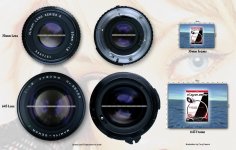
Here's a comparison. The F. factor or f stop rating. The image projected from an equal rated lens of different diameters is aprox the same brightness across the board, just larger through the larger lens. The nearest 'hands on' example I could find was a Mamiya 645 f 1.9 and a Nikon 50mm f 1.8 (The field of view on a 645 80mm is approx equiv to a 55mm view on a 35mm lens). So these lenses are roughly identical, just different sizes, 35mm and 645 (35mm and 6cm x 4.5cm -Hence their respective '35' and '645' names) Both lenses yield approx the same image brightness, but one is about 4x larger.


Light and the comparison between medium format and 35mm lenses.

The 'inverse square law' relates roughly to these 2 instances. I say 'roughly' and 'approximately' as disclaimers because I'm not a scientist or mathematician...or very good at spelling. Just trying to relate some of the knowledge I've gathered and do it in a manner that everyone can understand, including myself.

Concerning the distance of light and it's relative density. If the distance of a light source to an object is decreased by half. the light that reaches the object is quadrupled, not doubled. Similarly related... If an image is focused to 1/2 it's original size (through a high quality optic), the images light density factor is quadrupled, not doubled, because you have focused the image down to 1/4 it's original size, not half it's original size while retaining most of its relative brightness. Equaling approx 4 times the amount of light in the same area as the 35mm. My adapter doesn't condense the 645 image down quite that far or we would be back to a very bright postage stamp. About half way between seemed favorable.

Diameter of Objective Lenses: Also very important.

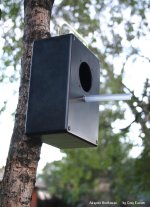
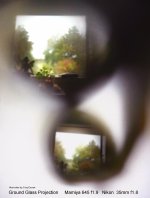
The diameter of the large (sometimes not so large) front optic of a lens determines the light gathering ability of the assembly. In the illustration I've included actual true to scale images of both lenses. and their images projected on a large ground glass. and a final diagram of the actual usable area of projection when used with a still camera for size reference. and the new birdhouse. :)


Whew.... Questions anyone?

Cory Easom
Ontario, Oregon
 

Attachments

  • easom-visible-thermal.jpg
    easom-visible-thermal.jpg
    96.7 KB · Views: 0
  • xeasom-adapter-birdhouse.jpg
    xeasom-adapter-birdhouse.jpg
    99.8 KB · Views: 0
  • ground_glass_projection_easom.jpg
    ground_glass_projection_easom.jpg
    85.1 KB · Views: 0
  • 0-35mm_size_comp-easom.jpg
    0-35mm_size_comp-easom.jpg
    144.6 KB · Views: 0
In my ignorance when I think to Oregon I was more used to remember the movie "The second american civil war".
I'm so stocked on your attachments...
Waiting for footage, preferably nikon footage.
Cheers
 
A larger Projected image means smaller grain too. I'm a medium format fan. Keep it up.
 
HVX footage.

HVX footage.

Thanks to user PENST. 'Steve' We were able to shot some footage with the HVX200. Turns out he lives right here in Ontario, about 3.5 miles away and was nice enough to meet up. Sometimes things just work out. Should have some stills and a little footage back from him very soon. We'll be shooting more after we machine a proper attachment. Thanks to all, Cory
 
The break in the optical chain is exactly why the conventional mode of thought on f stops and lights loss breaks down at the projected/recorded image. It's also why the Brevis with CF1/L can demonstrate .5 to .7 stops of light loss with a 50mm f1.4 lens attached. The 50mm lens represents 1 full stop, but projects an image onto a highly efficient emmissive/diffusive medium. The net effect is actually ~.5 stops of light gain. I'm very interested in your experiments with regard to linearity of light loss in the medium format world, an area we've never explored.

Your post (#42) is the first one that I've ever read here that works to the theory...so kudos :-) Wait until you start experimenting with the academy format world...more surprises there!
 
Your post #42 is the first one that I've ever read here that works to the theory...so kudos

Thanks Dennis. Nice to have a little validation from an adapter guru like yourself. This post from you is my favorite yet. Thank you for taking the time to read and comment so kindly on this thread. I tried to find my way solo and not ask too many questions. Sometimes we can learn more by finding our own answers. Glad to be on the right track. Everyone here has been awesome. You make a great product and I must say you are one of the reasons I set my sights so high. Great work and thanks for being an inspiration to us all.

Cory
 
Cory, it's a fascinating study. Based on what I've seen here, you're going to really enjoy your own voyage of discovery :-)
 
multiple lens types with one adapter?

multiple lens types with one adapter?

Sorry if this is a nooby question but can I use both medium format lenses and Nikon leses at the same time or just one or the other. Also if I have a Kiev or a pentax lens is there some way to make your adapter work with them to or is each kind of lens require a different adapter. Btw I think your adapter looks kick a$$ Thanks IG
 
Last edited:
My two cents:

Areas where you can edge the competition
- minimizing light loss
- better machining than the comp. Not hard to do.
- rock solid lens mount
- PL mount
- Absolute right angles. You wouldn't believe the misalignment on some adaptors.
- Excellent seals. Dust is problem with some of the comp.
- Make the target big enough so I don't have to zoom in so much to the point of losing light more light on the zoom lens. The top rated adaptors on this site require so much a zoom that you lose an additional 1/2 to 2/3 a stop.
- Make a relay for 2/3" cameras. This is where you'll crush the comp. None of the low cost adaptors make a 2/3" B mount relay. But loads of people are buying HPX 500's, Varicams, F 950's and the like. Short of mounting on a zoom lens and having a bazooka to shoot with, their only choice is the PS Technik ($$$$). This is where you'll make your money back and then some. I own an SG Pro and love it, but if I could mount it on a 2/3" camera, I'd buy an HPX 500 in a second. There's no true low cost 35 adaptor solution for 2/3" B mount cameras. And there's loads of 2/3" cameras out there begging for it. With what seems like a wealth of optical knowledge - make it so.


Things not to leave out
- Rail mounting. Must have it for heavier lenses and minimizing stress on the camera. And for all of us who need our 4 x 4 and 4 x 4.56 filters. All the bokeh in the world doesn't obviate the need for grads.
- Simple external AA battery system. Internal batts suck. AA system lets you use cheap rechargeables or relief from the local convenience store.

Things to consider
- Because of he lousy lcd's that come with the DVX and HVX, these users would most likely use an external monitor for focus/framing. I don't mind an extra 1/3 to 1/2 stop in lieu of a flip module. The flip should be an option.
- Beta test it on the field with "real" Dp's and operators not hobbyists and weekend warriors before offering it for sale as a pro device. I had a horrible experience with one of the most popular adaptors on this site. As one of the early owners, I felt like a guinea pig who ended up soldering motors on site; disassembling and cleaning dust and explaining the aesthetic beauty of vignetting. As I disassembled the product the third time in one shoot day because a speck of dust, I felt nothing but resent and bile towards the maker, thinking, this product never should have been for sale. It wasn't adequately tested or tested by people who don't rely on their gear to make a living.
Please, I beg, do not sell a single unit until protos have been put in the hands of pros who must rely on the gear day to day. I bought a cartoni earlier in the year that everyone was hype on. After going to the shop for the second time because of what I felt was a horrible design flaw, I ended up buying a much better and proven Miller head. Cartoni failed to test it adaquetely or don't care. I think it's the former since many of their other heads are great. But I bet the amount of repairs under warranty has really killed the profits on this particular head. Do it right. Do it once.
- With RED saturating the market, I see the adaptor market, staying with lower cost prosumer cameras and lower end 2/3" cameras. Because once you get to an HPX 3000 or Varicam with 35 adaptor/lenses, you're now in RED rental range (in about 6 months as RED gougers/vendors get the saturation reality slap).
- Get all the specs on the Sony XD CAm - EX. This will become the most wanted camera for adaptors in the months to come. With reviews touting it's picture eclipsing the HVX and JVC 200 series, a full raster 1080 chip and better light sensitivity, find out what it takes to get your adaptor on that camera.

As someone who shoots for a living and have owned and used just about every 35mm adaptor made, I'll gladly consult with you to get this adaptor to market and done right.

Tim Naylor - DP
www.timnaylor.com
 
Last edited:
More info please?

More info please?

I agree. But when necessity for a wide angle strikes, the gain could be pain for some:
http://www.bhphotovideo.com/c/product/264711-REG/Hasselblad_30_23050_Wide_Angle_50mm_f_3_5.html
This 50mm in medium format land shows about the same image as a 35mm in 24/36 land. Down the same page is a beautiful 30mm lens. Ehhhh......

I didn't fully understand the meaning of this post from Dan. Maybe Dan or someone else can elaborate on what he was really trying to say? Thanks
 
Looks like I will be in touch with Tim Naylor... I took an extensive look at his site. He is a true professional and has a great collection of work to view. Thanks Tim.

About using Nikon lenses. I will be threading the front barrel of the adapter with a standard nikon mount, then everything will up-convert from there. The PL mount may or may not have the Nikon mount. More testing.... :) Thanks everyone. It's been a busy week.
 
I didn't fully understand the meaning of this post from Dan. Maybe Dan or someone else can elaborate on what he was really trying to say? Thanks

Cory, I had to read that twice as well. No offense to Dan because he is very helpful and an excellent source of info and experience, but he is hard to follow some times by someone who maybe lost too many brain cells somewhere along the line. I took it as something akin to better glass equals a thinner wallet? If "The Super Easom Aerospace 645 I Can See The Image" can also be "The Super Easom Aerospace 35 I Can See The Image" then you can hit all the folks who already have the 35mm lenses.
Steve
 
Thanks Steve,

That was almost as cryptic, but thanks for deciphering for me. The good news is that Mamiya lenses are in the $100 to $200 range. The other good news as that the adapter will have a Nikon standard base mount. Thanks again Steve, Ur Awesome! Did I mention that Steve is the cool guy who's allowing tests with his HVX200. Very Cool.

Cory
 
Cory,

Have you taken the DVX stock lenses lateral chromatic aberration into account when designing this adapter?

I'm in the midst of preparing a for a very detailed adapter "shoot out", and one thing I've noticed is that the stock DVX lens has a lateral CA that changes depending on what your focal length is. This of course, if left uncorrected, really screws up basically every adapter test out there, as most adapters require various focal length settings. So in other words, the best adapter out there might show "bad" results on the DVX simply because it requires the camera to use the worst possible focal length of the lens, yet show "great" results on another camera, all of which just leads to further confusion about adapter performance..... and we haven't even touched on longitudinal chromatic aberration yet......

Thanks,
 
I'm loving this thread, learning every day, wish i could add to the knowledge pool :)
Keep it up guys!!!
 
Cory,

Have you taken the DVX stock lenses lateral chromatic aberration into account when designing this adapter?

I'm in the midst of preparing a for a very detailed adapter "shoot out", and one thing I've noticed is that the stock DVX lens has a lateral CA that changes depending on what your focal length is. This of course, if left uncorrected, really screws up basically every adapter test out there, as most adapters require various focal length settings. So in other words, the best adapter out there might show "bad" results on the DVX simply because it requires the camera to use the worst possible focal length of the lens, yet show "great" results on another camera, all of which just leads to further confusion about adapter performance..... and we haven't even touched on longitudinal chromatic aberration yet......

Thanks,

Yes, Cory my poor attempt to one up Dan on the obtuse scale. Chris, Do you have any objective evidence of what you are talking about? (like some pics with a description of various setups of lenses adapters etc..., so we can see what you are seeing) I've read your mention of this elsewhere? What about Juan and Co. at Reel-Stream or disussions among you other Andromeda owners/users? Did this become apparent through the RAW image and or true of the HVX as well?
thanks,
Steve
 
Steve,

Good questions.

I've been preparing for my adapter tests, and this became apparent during my preparations. I can't be sure if all DVX lenses exhibit the same CA characteristics or not, but, my most recent test does show that the lateral CA changes depending on what focal length you use. Check out my other thread for an example of what I'm talking about.
 
Back
Top