
Navigation
Install the app
How to install the app on iOS
Follow along with the video below to see how to install our site as a web app on your home screen.
Note: This feature may not be available in some browsers.
More options
You are using an out of date browser. It may not display this or other websites correctly.
You should upgrade or use an alternative browser.
You should upgrade or use an alternative browser.
Chimera 24x32 DAYLIGHT
- Thread starter taubkin
- Start date


Oynk
Well-known member
I got myself 3 bulbs, and some adapters and managed to put the 3 60W fluoros inside. Result: almost one stop more daylight from my chimera. No heat, no circuit breakers tripping.
I was just putting a kit together for a 'one man band' documentary.
I am trying to stay away from tungsten because of heat issues.
I am planning on using CFLs in China Balls along with Daylight LED lighting from VidLed (I bought the sticks, I am going to pick up a couple of lights next).
I figure my whole rig will be ultra-portable but I do have a few concerns...
Am I going to regret having only daylight temperature lights?
Is everyone I interview going to look green and sickly?
Am I going to regret not having any 'hard' lighting?
Expense isn't as much of an issue as portability and heat are. In the past I have used the old Lowell 3-light kit but it burns up a small room, subjects get sweaty, and the whole thing seems so antiquated.
I am really hoping to go for this look. Is that possible with CFLs in China Balls and some LED lights?
Have you used your CFL rig enough to have a strong opinion? Anyone else?
Thanks!
Last edited:

Spartacus
Veteran
I am really hoping to go for this look. Is that possible with CFLs in China Balls and some LED lights?
Have you used your CFL rig enough to have a strong opinion? Anyone else?
Thanks!
This look is even possible with only a window and white paper as a fill :happy:
If money ain´t a problem as you say, I´d suggest to get 2-3 Vidleds Coollights (you can gel them to DL and tungsten...)and instead of the china, which is harder to setup and control light with, get one of the larger 1x1 Litepanels as your soft key (should still be portable...)
BTW the VidLeds are pretty hard without diffusion so they make perfect hair/back/rim lights...
Or buy another three Vidleds, bolt them together and use sth like a Totaframe as for the difusion...
Good luck!

Cool Lights
DVXuser Sponsor
Green and sickly? Only if you don't pay attention to the quality of the CFLs you buy and the color temperature. But even Home Depot N:Visions 5500K models have shown to be great. Staying around the 5500K range should be fine for mixing with daylight. You won't miss tungsten unless you needed to blend with some practical lighting in the location you're shooting in. Much of the time though, you'll find yourself turning off the room lights and even perhaps blocking the windows.
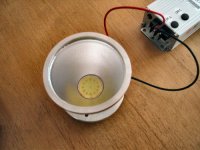
But I don't see anything all that special in the look you specified. As spartacus said, if you're looking for portable and easy. Look to reflectors and a CFL setup like taubkin mentioned at the start of the thread. I've done a fair amount of experimentation with LEDs and I just don't think they're there yet in terms of lumens per watt (LPW) and "bang for the buck." No question that they have lots of promise for the future but the best LEDs are in laboratories and not low enough in price to be used in a major way yet. Lots of issues around throw, color temperature, etc. At 30 LPW from an average LED, they are only marginally better than tungsten at 20 LPW. Heck, I've got a 60w LED that I've been experimenting with but in terms of cost, its really nothing more than an expensive novelty item right now.
But I don't see anything all that special in the look you specified. As spartacus said, if you're looking for portable and easy. Look to reflectors and a CFL setup like taubkin mentioned at the start of the thread. I've done a fair amount of experimentation with LEDs and I just don't think they're there yet in terms of lumens per watt (LPW) and "bang for the buck." No question that they have lots of promise for the future but the best LEDs are in laboratories and not low enough in price to be used in a major way yet. Lots of issues around throw, color temperature, etc. At 30 LPW from an average LED, they are only marginally better than tungsten at 20 LPW. Heck, I've got a 60w LED that I've been experimenting with but in terms of cost, its really nothing more than an expensive novelty item right now.
Cool Lights
DVXuser Sponsor
By the way, I was just discussing a similar topic on another board:
http://www.dvinfo.net/conf/showthread.php?t=98271
And it reminded me of the portable HID flashlight discovered by this guy named Christopher there. It really is like a portable daylight sungun and something like this could be entirely useful in a portable situation. Battery life is pretty good, its rechargeable and the price is right too. I explained a bit about sunguns in that thread and how they're really just battery powered pars and a par is really just like a flashlight in a lot of ways. Can be daylight metal halide / hmi or tungsten technology. The main thing is, for a sungun, you want something low enough wattage for sake of not drawing too much power but bright enough to be useful.
A serious amount of light out of such a little battery powered instrument and far less expensive than an LED equivalent which won't give you this kind of throw.
Cool Lights
DVXuser Sponsor
Yes sir--60w! I've enclosed a picture of it. It's about a 3/4" circle of greenish white, phosphor type material on a circuit board and surrounded by a small heat sink and reflector.
Asia really is where all the serious LED research is happening now. I also saw a 150w LED this year too. Can you believe it? Very expensive though. It's just not time for LEDs yet. I was going to make a small pepper fresnel but the project itself was going to be rather expensive as I needed to make a new cast aluminum fixture with a built-in heat sink to keep the LED from cooking itself. The finished product would have been offered for around $1000 so it's in Dedo class at that point. An expensive novelty. I thought my time was better spent on HMI, portable Flos, etc. The predictions of fluorescent and HMI demise at the hands of LEDs are a bit premature ;-)
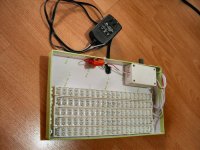
For fun, I also included a photo of the makeshift LED panel I setup last year on a shoebox top. It's got a dimmer that uses a 555 timer. I wasn't very happy with the LEDs in these strips though as there was some color shift during the dimming toward green and I also thought the color temp was a bit too high too--probably around 6500K to 7500K. Too blue for me. I occasionally use it as a fill light in product shots when I need just a bit more light on the side and don't have time to go get something else. I have my wife hold it up usually ;-) but next to a 5600K fluorescent lamp, the light is decidedly blue so its not what I really want.
When we do an LED panel, it'll be great, incorporate a couple of new ideas I have and it will have some ground breaking feature-to-price performance too.
Attachments
Oynk
Well-known member
Green and sickly? Only if you don't pay attention to the quality of the CFLs you buy and the color temperature. ....
But I don't see anything all that special in the look you specified. .
Thanks for your help. You are always so very thorough. You provide a great resource.
I do only have one follow up question: Is there a fixture that allows me to mount more than one (maybe up to four) fixtures in a soft box? Something with a speed ring and a few sockets?
The shot I picked is from an Errol Morris documentary. I just really like the 'clean, crisp, white' look he uses -also used in his famous Apple ads too.
I am doing some testing at home. I ordered some 'full spectrum' CFLs from Amazon, but when they showed up, there was no marking on the box to indicate color temperature. I am mixing them with my VidLed tube lights. I was really considering the other LEDs for accent lighting and fill without having to plug in a ton of gear.
I am going to just experiment.
Thanks for your help.
Cool Lights
DVXuser Sponsor
I haven't seen specifically (on the market) what you're asking for although in my travels I did see one edison socket to several proprietary CFL sockets.
An edison socket to 4 edison sockets would be a super adapter to have as long as the edison socket you're plugging it into could handle the extra wattage of the 4 bulbs. Say, a capacity of 250w or so. Then you could handle about 4 60w CFLs (or lower) with no problem. The closest existing thing I know about to what you want are some of those Y edison adapters you can get at home depot. People are using those to make CFL trees. You could get 3 of those and you could handle 4 bulbs and continue you're experimentation then. Just need an edison socket fixture with mount into a softbox at that point and you've got what you're asking for.
An edison socket to 4 edison sockets would be a super adapter to have as long as the edison socket you're plugging it into could handle the extra wattage of the 4 bulbs. Say, a capacity of 250w or so. Then you could handle about 4 60w CFLs (or lower) with no problem. The closest existing thing I know about to what you want are some of those Y edison adapters you can get at home depot. People are using those to make CFL trees. You could get 3 of those and you could handle 4 bulbs and continue you're experimentation then. Just need an edison socket fixture with mount into a softbox at that point and you've got what you're asking for.
Cool Lights
DVXuser Sponsor
I was just looking through catalogs for a solution to the 4 to 1 adapter and I found what I would do if I was going to DIY something up. A commercial version of this would be molded in bakelite or some other kind of heat resistant plastic but for a quick low cost solution here's a fun project.
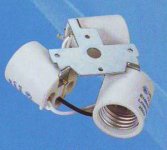
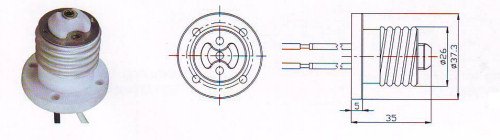
Step 1: First you need a 3 socket assembly like the one below. I would probably bend the 3 sockets down to 45 degree angle in there interest of having more surface area of the bulb exposed to the reflector.
Step 2: Then, a single socket assembly to go in the middle like the middle picture below. You would need a piece of 3/8" threaded pipe to lower it a bit so it clears the other three bulbs. That gives you 4 e26 sockets.
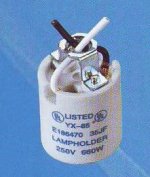
Step 3: Then finally, on the top of the assembly I would put an E26 base like the one pictured below in the last picture. Wire them all together paying attention to the color codes whites to whites, blacks to blacks. Keep wires as short as possible so they're not all over the place and use wire ties to keep them down. Solder the connections for the best effect and use electrician's tape to make sure each one is well-covered.
Voila. You have a great one to four tree.
Concerned about safety and all the wires? When you're sure the whole thing is working and well-tested, coat the middle parts of the assembly with 5 minute epoxy. Maybe an opaque white colored one so you can't see the wires at all. May need several layers to get it good and "potted" so to speak. I suppose you could even make a cardboard form around the thing and then just pour the epoxy in to really make it look professional. Just clean the cardboard off when the epoxy is cured.
Then your fixture is much more solid state and not prone to safety issues as much either. But you'll never be able to work on it again so make sure the connections are good.
Attachments
Spartacus
Veteran
One thing that stopped me from using CFL "on the road" that 4 have been trashed on location so far (all not by me and all used in china balls...)
Also they are pretty big for a bulb (at least the 45Ws I use), so when relying on four in your china, you should carry 7 or 8 for the worst case and for ruff travelling you´ll need sth like a Pelicase for them.
Consider the time you need to set up this solution, maybe you have all the time in the world to prepare a location, maybe someone gives you half an hour to set up AND do an interview...
I´m not trying to bad mouth CFL china balls, I use them myself, but only for generall fill, bringing up the ambient in large sceenes and about 20 of them to light our greenscreen...
Good luck!
Spartacus
Veteran
Richard,
this portability issue above, also always concernes me and so I wanne propose another thing for you to build :evil: :
What about HMI Tota Lights?
Totas remain the lightest high output fixture out there (correct me if I´m wrong...)
Of course you´ll need the ballast for the HMI, increasing weight and carrying size, but still a Tota style 300W HMI fixture will be smaller than a blue-line fresnel, won´t it?
I can´t find the link, but there is a fixture out there (green colored) that is like a disk with 4 or six floodlight (like Totas) in it, when attached to a chimera the lighting of the surface is perfectly even, no hotspot like with a fresnel.
It also cuts down the depth of the fixture, because besides the softbox the lamp is only 4 or 5 inches deep...
Anyone with the need for lighting up large areas or flooding windows from outside could use this!
There is also an adapter to put three Totas in one softbox, if I recall...
So a small box sized ballast, along with a HMI Tota style "brick-lite" would offer a small form factor with high output...
What do you think?
Cool Lights
DVXuser Sponsor
So he wants HID floodlights eh? Hey I hear you. I was thinking about my poor man's spacelight ideas just last week and this weekend and looking at existing ones. I've considered the 200w 8U bulb in my mogul fixture hanging upside down with no diffusion and also the HID solutions too with a silk skirt or purpose-built cylindrical silk china ball around them.
The real spacelights use as many as six open face flood lights at the top of the skirt. Something very similar to what you're asking for.
http://www.mole.com/rentals/catalog_sheets/7291.pdf
I assume since you're running the 220v model that you're at 800w with your totas? Well a 250w HID bulb would get you anywhere around the equivalent of a 1000 to 1200w light. A 150w would be even easier though and would be equivalent to a 650w--ballast is lighter too. After 150w, the ballasts start getting more heavy and bigger. Would a 150w be enough? I would avoid the 300w model as that puts you into a special category of ballast that gets more expensive as they're more rare. Stick with the 70, 150, 250, 400, 575 and 1200 for the best solutions. At around 400 we start getting into the need for fans too. Best to keep it 400 or below for now so you can have the ballast near the fixture and alleviate the need for a long cable.
Also, next question: should the ballast be in the fixture or on the floor. With my fresnels, the ballast will be attached to the yoke and won't add too much weight at all to the fixture. We're talking about a pound for a 150w ballast; and the dimensions of the thing are 5" x 7" x 1.5"--very small. An HID floodlight could have the ballast hidden in the back and would not be as small as a tota for sure. Or you could go for a super small and light fixture and have the ballasts together in a pack on the floor. Next step would be a holder to hold 3 to six of them and then a custom heat resistant softbox reflector to go around them with a silk and grid on the front. Sound like what you're thinking?
Spartacus
Veteran
Sound like what you're thinking?
Two minds, one thought :thumbsup:
Hm, thinking about it, maybe your HMI Dedos will do both jobs?
Anyways,
650W equivalent output would be enough I guess, so small ballasts too to help with a carry-on size...
I think I´d prefer the ballasts seperated from the lamp itself, first for portability I want light lightstands so the fixtures should be light too (maybe I want to rig them on a boom too...), second I´ll have to lay cables out anyways, sticking the ballast inbetween is no problem...
What about attaching the balast to the BOTTOM of the lightstand with a special mounting system, just like a sandbag for extra stability? Thus moving the lights would be easier too...
A ballast pack like the Dedos is nice for controlling the lights from one spot, but you also need very long cables if you want to move one light further away...
I guess such a HMI/HID floodlight should incorporate being light, small, tuff, stackable and CHEAP (still a main argument for the Totas).
If such a fixture would be priced around the 150W fresnel it´ll be too expensive to compete I guess, but maybe their versatility would be their USP...?
Stick´em in spacelights, laterns, softboxes, stack them together to form on large fixture to put outside windows...
And what about a softbox that folds similar to a Rifa?
Way to go mate :beer:
Cool Lights
DVXuser Sponsor
Yes, I get the idea. I think they can be a bit cheaper than the $399 150w fresnel but not sure how much yet; and we still need at least a safety glass and barndoors too so that adds a bit and makes it more than just a piece of metal with a couple of bends. The tota doesn't have a safety glass because exploding tungsten isn't much of a concern and we still have UV to think about too. Also, the tota can't come in a daylight flavor either so that's another point in our favor of getting 650w worth of daylight light without losing any because of gelling up with blue. We can also use a tungsten colored bulb too though for blending with other lighting which is another point in favor of the 150w size. I haven't seen that many larger bulbs with other color options in high CRI. The really cool part is that we may eventually figure out how to do a battery operated version for those that are on the move in power-challenged areas. It's done with some of the K5600 products so I know its possible.
Also, do I hear you saying then, that you would prefer we don't have the ballast permanently attached to the yoke of the 150w fresnel? If that's the case we'd have to figure out how to get a quicker disconnect from there so you could move it to the bottom of the light stand if you like. Some kind of clamping system but I'm not sure what that is yet. Something that could clamp to a yoke (which is a relatively small piece of metal) or the bottom of the light stand which usually has a bigger diameter.
Also, do I hear you saying then, that you would prefer we don't have the ballast permanently attached to the yoke of the 150w fresnel? If that's the case we'd have to figure out how to get a quicker disconnect from there so you could move it to the bottom of the light stand if you like. Some kind of clamping system but I'm not sure what that is yet. Something that could clamp to a yoke (which is a relatively small piece of metal) or the bottom of the light stand which usually has a bigger diameter.
Last edited:
Spartacus
Veteran
BALLAST: Again I see one of the advantages of the fixture in its lightness, so seperating ballast and lamp could first lower the center of gravity, making the lightstand more stable and taking away weight from the top of the lightstand, good for its section joints...
On boom setups, the ballast could also be used as the counterweight (I suppose it will be about twice as heavy as the lamp...?)
For the clamp, I guess it will be hard to find sth durable I guess that won´t destroy the formfactor (imagening a ballast with an attached Manfrotto superclamp...)
When using my VidLeds on a tripod, I put the HVX batteries in little sacks (like the ones climbers use for their talkum powder...) and hang them from the knobs of the section joints, so maybe the ballast just needs some strapping system or sth like an empty sandbag to put it in, to attach it to the bottom of the lightstand pole...
What do you think about the idea of making them stakable? Can this be done? Maybe if they somehow "snap" to a piece of metal, which then goes on the lightstand...
PRICE: The Totas are at 189$ if I recall, so this unit should cost less than the double price of a Tota, I´d say 350$ (including barndoors) maximum, better 300-320$.
Even so the Totas as tungsten only fixtures can´t really compete, they already have their name and place in the industry, so along with the improvement on daylight and powerconsumption the "new kid" should still be in the low-cost segment IMHO...
This would also seperate it from your fresnel.
But if we could really predict sales of a product we would be video conferencing from our Lear jets now :cheesy:
PS: this thing should fit into a chimera, otherwise this would be a threadjack...
Cool Lights
DVXuser Sponsor
Ballast would be about twice as heavy as fixture at 1 lb. I'm guessing the fixture would be about 1/2 pound. The yoke on those is so simple too. I was trying to figure out some kind of strap arrangement on the back of the ballast that would look professional and be durable and would allow it to hug a yoke or a light stand. We'll also need a connector too on the ballast where I wasn't planning that before (for the lamp cable). Since it was going to be fixed on the yoke of the fresnel I was economizing by not having a connector. We'll have to add a standard 2 pin connector of some kind that is secure and can handle the voltage but doesn't have to be as hefty as the 575w or 1200w cables.
I haven't come up with the connector or the strap part yet but I'm still thinking about it. My ballast company is waiting for me to give them the final specs on the case so the pressure is on now as this is one thing holding us up. I'm not sure how the stackable thing would work either although I agree that would be very nice.
$320 or less should be doable because we don't have a relatively expensive fresnel lens, lots of cast aluminum, a focusing mechanism, a bigger yoke, etc.; but I get your points and agree on that too. This thing is just an outer piece of metal, a reflector, socket, one sided yoke (or lolipop ;-) and lamp cable.
I do like more ideas for this 150w ballast as it'll be our standard for that size and the more quantity we get in buying them the lower our cost will be of course so more 150w fixtures is a good thing for the long run. And I think people will agree this is a nice size, cost and performance ratio and also darn reliable and the bulb is longer life than some of the higher wattage models. Since it's the coolest of our cool light's hot lights ;-) it's also the most absolutely silent metal halide solution we have right now where the ballast can be right there near the light because there's no fan.
Let's definitely help Taubkin out and get him a Chimera mounting for this too. I've never seen one in person, does someone have a picture of a chimera speedring and is there a special one for the tota or does the standard one work...
But immediately, help me figure out a strap and ballast pack arrangement and we're ready.
Spartacus
Veteran
Richard,
Just saw your website...great stuff.
I personally would prefer the ballast attached to the yoke or lamphead, although the quick disconnect idea sounds good also. A detachable extension (8-10') would be the best of both worlds, but I'd probably be using the attached ballast setup 90% of the time. A light stand with a wide enough base shouldn't have any problem with the extra pound or so.
Just my .02.
Ken
the Screen Skins guy
Cool Lights
DVXuser Sponsor
Sparta,
Thanks. I think I see how it attaches--looks like the yoke for the tota attaches to the bottom of the chimera speedring. Then I guess you open the barndoors full to allow the softbox reflector to work with the tota bulb.
KPlo,
Thanks for the compliments! I'm with you on the ballast but I also see the other side too and I'd rather get this down now then have to kluge something in later. I like it when everything in the system looks planned. It's just hell to find some of the parts you need sometimes to make these things work right though and be professional at the same time. The 150w fresnel is really tiny with a 4.25" lens and is only about 4 pounds and 5 with the ballast so we're not talking a huge mass here. A relatively simple stand could handle both. But, adetachable ballast with a 10 foot cord is definitely doable; its just the clamp thing and the cable connector I'm fussing over right now.