

fevercity
Well-known member
Maybe if it had a sexier name than "B.PRESS", I would've experimented more with this gamma setting sooner. Not that "CINELIKE V" is all that sexy but that's what I had settled on for a lot of my material. It is, after all, one of the 'suggested' film-out settings from DVFilm.com.
Maybe it's too many years finsihing shows for broadcast where maximum contrast is essential 'on the scopes'. Whatever the case, I do find myself pushing blacks to black, whites to white and bringing down mids to taste. I may have found some common ground with "B.PRESS".
Also, Barry Green writes in his bible that, with CINELIKE V, "more of the potential dynamic range is used so the image appears to have sharper contrast, but it's done so ELECTRONICALLY by stretching the gamma curve"*. I'm not sure if that's the culprit but I'm seeing mosquito noise in less-than-ideal recent shoots (sunrise, sunset and low-light). Pushing the range with color-correction {in 10-bit uncompressed} really brought out this noise even further. Regardless, I still push the range and 'almost always' bring down the mids, so maybe B.PRESS could fit the bill.
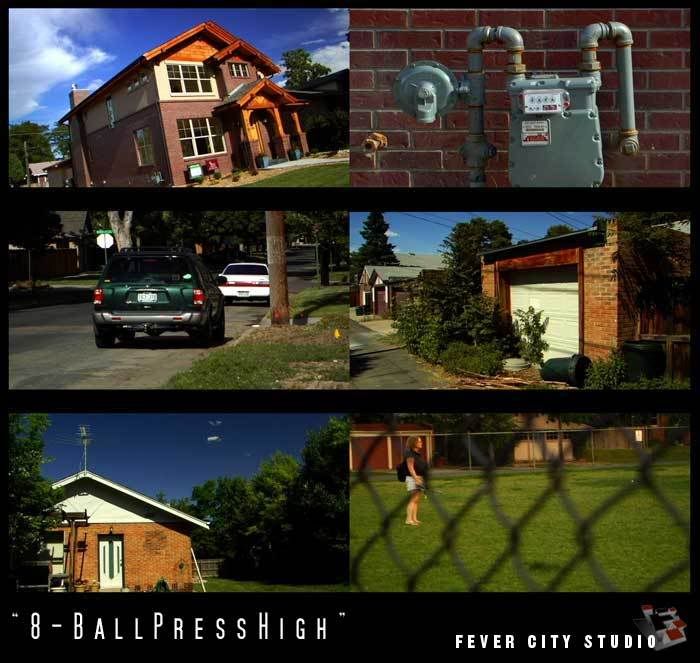
With this latest batch, chroma's a bit hot. This jpeg doesn't do justice to how saturated the new woodwork on that house is. The sky remains thanks to a polarizer filter. Otherwise, there's no other filtration and white balance is clean. The blacks are definitely solid. Maybe too solid - this gamma curve probably allows for some more room on the lower end (a -6 or -7 should be ideal). -8 is what's provided here for PEDESTAL and HIGH on the KNEE, hence the name:
"8-Ball Press High"
DETAIL LEVEL -3
V DETAIL LEVEL -1
DETAIL CORING +2
CHROMA LEVEL +3
CHROMA PHASE 0
COLOR TEMP 0
MASTER PED -8
A. IRIS LEVEL -1
GAMMA B.PRESS
KNEE HIGH
MATRIX CINELIKE
SKIN TONE DTL OFF
V DETAIL FREQ THIN
PROGRESSIVE 24p
* Barry Green, The DVX Book (Las Vegas, NV: Fiercely Independent Film Inc., 2004, 2005) p. 63.
Maybe it's too many years finsihing shows for broadcast where maximum contrast is essential 'on the scopes'. Whatever the case, I do find myself pushing blacks to black, whites to white and bringing down mids to taste. I may have found some common ground with "B.PRESS".
Also, Barry Green writes in his bible that, with CINELIKE V, "more of the potential dynamic range is used so the image appears to have sharper contrast, but it's done so ELECTRONICALLY by stretching the gamma curve"*. I'm not sure if that's the culprit but I'm seeing mosquito noise in less-than-ideal recent shoots (sunrise, sunset and low-light). Pushing the range with color-correction {in 10-bit uncompressed} really brought out this noise even further. Regardless, I still push the range and 'almost always' bring down the mids, so maybe B.PRESS could fit the bill.
With this latest batch, chroma's a bit hot. This jpeg doesn't do justice to how saturated the new woodwork on that house is. The sky remains thanks to a polarizer filter. Otherwise, there's no other filtration and white balance is clean. The blacks are definitely solid. Maybe too solid - this gamma curve probably allows for some more room on the lower end (a -6 or -7 should be ideal). -8 is what's provided here for PEDESTAL and HIGH on the KNEE, hence the name:
"8-Ball Press High"
DETAIL LEVEL -3
V DETAIL LEVEL -1
DETAIL CORING +2
CHROMA LEVEL +3
CHROMA PHASE 0
COLOR TEMP 0
MASTER PED -8
A. IRIS LEVEL -1
GAMMA B.PRESS
KNEE HIGH
MATRIX CINELIKE
SKIN TONE DTL OFF
V DETAIL FREQ THIN
PROGRESSIVE 24p
* Barry Green, The DVX Book (Las Vegas, NV: Fiercely Independent Film Inc., 2004, 2005) p. 63.

