The ugly streak caused by bright light.. again

Richard Sutcliffe

Well-known member
I've posted regarding this in the recent past as a minor gripe but it is really starting to bug me now.

Most of you will have noticed that when shooting towards the sun, or for that matter any bright light source we get a particularly ugly streak right down the chip.

When I posted previously Jan and Barry both commented that this was a feature of 1/3 chip cams which I accepted at the time but I have started to consider this a major flaw of the HVX. The more I am seeing it the more it is bugging me. Shots with this defect are often unusable.

I'd like to get an understanding of what is going on with this and at the same time can anyone explain why it is so pronounced on the HVX compared to any other small chip camera I own or have used.

On the Z1, PD150 and VX2k the problem is limited to a blueish streak which cant always be differentiated from the lens flare yet on the HVX we get an incredibly strong streak from top to bottom.

Can anyone comment?
 
It is indeed an issue with smaller chip cameras. I haven't noticed it with the HVX yet, however. Maybe you could post some sample grabs, so some of the users here can guage whether they think the streaking is acceptable to the situation.

Jason
 
The HVX is more resistant to it than other 1/3" cameras, but sure it still happens. The PDX10 and HD1 and HD100 really show a lot of vertical streaking.

But that's in general. Do you have a still that shows the effect you're talking about? Is it like this example (from a Sony FX1)?
FX1%20vertical%20flare%20from%20headlight.jpg
 
I can tell you right now, if it's one thing that the HVX renders well is light. In just about every clip I've seen from 1/3" cameras, the light-smear is like "ughghghggh". The A1 is heavy on it, IMO. The HVX handles light smear very well.
 
Also, if vertical smear is really a problem for you, you can consider a CMOS camera like the Sony V1; it should be immune to any vertical smear because it uses CMOS instead of CCD. There's no free lunch, of course, and the V1 is reportedly about two stops slower than the HVX or XHA1, so know what the tradeoffs are.
 
Thanks for the replies all. What is actually happening? Barry is it possible to give a simple summation so that I can get a better understanding or can anyone point me to a technical explanation?

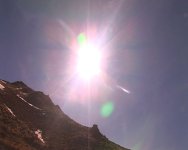
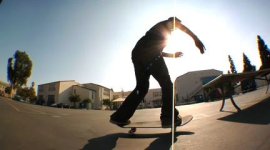
Two examples to hand, the skate fisheye isn't mine but is a good example of streaking and the way it chops the picture in half. This is exaxctly the same as the effect I've had on my own shots.

The other image is from a Z1. You can see the difference is quite marked. Closing the iris on the HVX doesn't make a huge ammount of difference and the streak is present in all shooting formats getting finer in HD and wider in SD.
 

Attachments

  • heli footage.jpg
    heli footage.jpg
    29.4 KB · Views: 0
  • skatefisheye.jpg
    skatefisheye.jpg
    15.5 KB · Views: 0
I had a shoot recently with a 2/3 Betacam camera and it had the same "videoproblem". The best way to counteract is light or using a reflector (in case of the skater) if you want to see into the subject. Off course skating with a cam AND a reflector is hard, but it never comes easy....
 
All CCDs suffer from it, and the smaller the pixels, the more prevalent the streaking will be. It's endemic to how CCDs are designed, and the only way to get completely past it is to go with a CMOS design. And, yes, the HVX is much more resistant to it than its competitors; the FX1 and HD100 streak like a 70's hippie at the Oscars compared to the HVX. The XHA1 does seem quite streak-resistant too.

For more, check out this thread on DVInfo:
http://dvinfo.net/conf/showthread.php?t=60850
 
Back
Top