Home Made Remote Follow Focus

samuel smith

New member
Hey All,

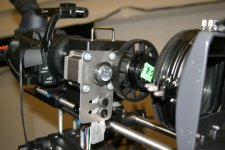
We originally picked up a RRFF and didn't like the play it had. So we sold it off and embarked on building our own remote follow focus. The motor is connected with 10 meters of cable to a handheld remote. It connects to Red Rocks' follow focus lens gears with a 32pitch gear.

In its initial tests it has proven to pull smooth focus. We are still fine-tuning. These are not the most up-to-date images, but I'll post those later.

Let me know what you think.

Cheers!
 

Attachments

  • IMG_1261.jpg
    IMG_1261.jpg
    51.5 KB · Views: 0
  • IMG_1264.jpg
    IMG_1264.jpg
    30.8 KB · Views: 0
What I think is that you rock ! I am planning to do something similar but instead of the ReRock lens gear I was thinking about a belt with pulley michanism wich is easyer to make. Good job !
 
What ever setup you choose, I'd say that the motor is the key. We originally planned on using servos but they couldn't give us the precision. They also couldn't give us the speed. Another issue was speed. As a result we used a stepper motor. A stepper allows us to to make precise marker (i.e., when we turn the wheel a particular amount the stepper motor moves the same).

On our new box (which I'll post photos of later), we can mark specific points on the wheel to rack to various points with high precision.
 
This posting was perfect timing. I was just starting to do research on building one. I was originally thinking about using servos.

Allow me to make the requests that all the DIYers are hoping for-

Pics along the way.

Precise parts list with links to where you found them.

Plus anything you figure out along the way, plus any limitations.


Good luck and godspeed.
 
VERY cool!

Couple of questions:
How thick is the cable/s? Can we see a picture?
How heavy is the motor and how much power does it need?
If the units share power, can you eliminate a wire from the cable by using seperate power sources for the remote and motor.
And how small can you get the remote?


... And about how much does it cost to make ... or how much would you sell it for?

- Mikko
 
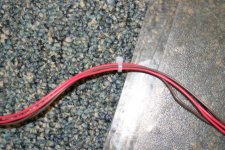
The cables aren't that thick. These motors take 5 wires. We believe that either an phone (ideally) or an ethernet cable could be used instead of just 5 wires set up like how they are now.

The Motor is 2lbs. Smaller motors proved to have the torque, but not the speed. I am convinced, however, that a smaller, stronger, faster motor exists.

The motor is turned by an item called an encoder, which is smaller than your thumb. So technically, the controller could be that size. But to make the stepper work you need an encoder and a motherboard. Both these items, with the motor need power.

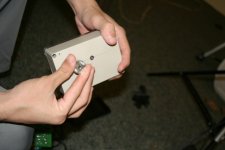
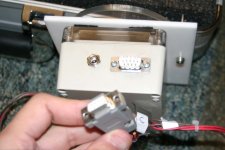
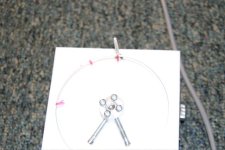
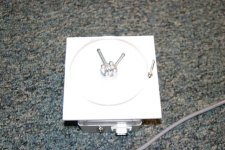
Right now, we have the brains all housed within the controller box, which includes a large wheel conected to the encoder for precision. The wheel can marked with dry erase marker for racking. It also has two rods underneath it that are used to calibrate the lens - that is, to set the min and max points. This box has one power in that splits the power (12 volts) necessary for the endcoder, board, and motor. The motor recieves power from one of the wires connected to it, from the box.

As far as costs go, parts (including mistakes) are under $900. I think this item, it done cleanly, could be put together for under $600 in parts.

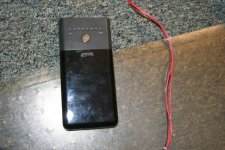
Here are some images.
 

Attachments

  • IMG_1319.jpg
    IMG_1319.jpg
    67.2 KB · Views: 0
  • IMG_1320.jpg
    IMG_1320.jpg
    93.2 KB · Views: 0
  • IMG_1321.jpg
    IMG_1321.jpg
    44.8 KB · Views: 0
  • IMG_1325.jpg
    IMG_1325.jpg
    41.1 KB · Views: 0
  • IMG_1322.jpg
    IMG_1322.jpg
    61.1 KB · Views: 0
Hi Samuel,

Any updates ?

What is that mattebox in pic1 ? I am near finishing building a mattebox and I am curently in the proccess either to built the filter holders myself or finding something ready, yours are quite atractive ! (I guess the price is not)

Andreas
 
Home Made Remote Follow Focus

've seen controller kits ($35-40) for DC servo motors down at my local electronics store which work off of variable resistance- That means that you can easily rig some type of joystick control. The controller sends short pulses of the full voltage to the DC servo motor. The less resistance, the closer together the pulses are. The inertia of the motor smooths out the pulse interval. This allows the motor to exert nearly it's full torque at even slow speeds while still being smooth. The trick comes in using the hand wheels as a controller. Finding inexpensive rotary encoders online is relatively easy, as is finding DC servo motors and controllers. The thing I've had the most trouble finding is the interface to decode the pulse phase from the rotary encoder and translating it to a voltage or resistance which will drive the servo control.
 
Is there any update on this,

I have question where is most of that $600 going, it's seems rather high for basically just a stepper motor...please enlighten me!
 
Hi

I am interested in building such a rig for FF and would just like to know the 'resolution' of the whole system. I can see that the images show that the Stepper Motor is connected Directly to the lens, without gearing. Is this enough to give very smooth control?

Warmest Regards
Alex
 
There are some problems with stepper motors: They can make a dreadful noise in full speed (usually, if if used with planetary gears).
Another problem is vibration (in some cases it is not easy to "calm" it down).
In attempt to build super low cost remote FF system, we tested number of RCC servos for our system: analogue servos are not that precise, some are too week, some - to noisy; even the price of single motor alone can go over 100$.
Finally we made decision and took nosy, but very precise and powerful motor for our system: up to 15 kg/cm. It can run all types of lenses.
Interior life sound recording is impossible. Good for voice over scenes, good for commercials, good for music TV and football translations.
Hope we'll manage to find satisfying engine for our low-cost prototype: quiet, high torque and cheap...
 
Back
Top