AR Glasses - has anyone used them to monitor camera?

Obviously, you never know until you try, but Garrett Brown experimented with a head mounted/heads-up type display for the Steadicam and abandoned it, because it made him motion sick.

any idea when that was? I wonder if it was impeded by the technology of the time, in terms of viewing comfort

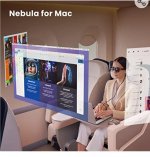
it seems like there is some customizability in this interface, that you can shrink a window and put it in the corner of your field of view. one reviewer said he watches movies with it while riding his motorcycle (yikes!!!). I doubt it would work for camera operating because of the latency and probably other issues, but it could be cool

it could be fun for watching movies as well (which is its main design purpose) but I worry about harming your eyes with prolonged use
 
It was back in the 70’s when he was still prototyping it. It was some type of fiber-optic system, relaying the actual optical image, I believe.
 
It was back in the 70’s when he was still prototyping it. It was some type of fiber-optic system, relaying the actual optical image, I believe.

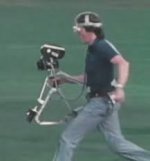
Maybe that's this

images?q=tbn:ANd9GcQFGQKnxAW5962MzN_rYk3BZg7uQ81v1wlgiw&usqp=CAU.jpg

I think you'd probably get a lot less nauseous from having the feed overlaid on your field of view the same in both eyes than having one eye monitoring and one eye looking at your surroundings, which I'm guessing is what this was?
 
Yes, the fiber optic viewfinder was integral to the early Steadicam prototypes. You can feast your eyes on various of them in this fantastic article GB wrote some years back (it is listed as excerpts from his book, which sadly has yet to appear in finished form). https://www.stabilizer-news.com/wp-c...rown_Part1.pdf

Over the years as "video glasses" have improved in functionality, various Steadicam operators have attempted to integrate them but not with much success. I never tried it myself but I remember it being described to me as too many variables, with one attempting to coordinate an unmoored floating image with their body moving through space and the mechanics of operating the camera. The FPV folks seem to have this all worked out, but they tend to stand in one spot only engaging fingers and thumbs vs the athletic activity of carrying a camera.

Since Abe mentioned being able to see where his feet are going, I feel obliged to take the opportunity to shake my head at the (de) evolution of gimbals in the wake of Steadicams in regards to viewing. The first production model of the Steadicam had the monitor mounted up on the camera, as can be seen in this extraction of various scenes from Rocky where GB was visible with the Steadicam35 prototype (https://youtu.be/Cr3PvQQ5w9E). Within a year, the Steadicam Model 1 was introduced with the monitor moved down to the sled section where it has remained for the past 45 years. When gimbals were first introduced I marveled at the BTS images of baseball cap-wearing youths straining their necks to peer into onboard monitors, assuming that one of these manufacturers would start integrating monitor mounts towards the bottom, i.e. taking a page from the tried and true. Closing in on a decade later, I see very little of this still, and can only assume that "gimbal neck" will be a a boon to chiropractors and orthopedic surgeons in years to come.
 
Last edited:
.

Since Abe mentioned being able to see where his feet are going, I feel obliged to take the opportunity to shake my head at the (de) evolution of gimbals in the wake of Steadicams in regards to viewing. .

I can see my feet - the issue I'm having is needing to look behind me when backing up to invaluable sculptures in an art gallery. And generally it would be nice to have an eye on camera no matter where I need to look.

I used to have a monitor mounted low off the gimbal handle and I could see my feet from there when at typical operating height. Now I monitor off a smartphone strapped to my wrist and i can still see my feet. Conveniently, if I spin around to operate in reverse, the monitor comes with me without adjustment. But if I just turn my head around to see when to stop backing up, I'm flying blind. And when someone puts a hand on my back to safety me, I find that we never exploit all my available runway. Plus, on long shots weaving through an art gallery it's not very practical to have someone at my back the whole time.
 
Last edited:
It's not so much about literally seeing one's feet as seeing what obstacles are within the vicinity of said feet. Our peripheral vision is quite wide, one can "feel/sense" objects of a certain size from well beyond what we perceive as the scope of our vision, albeit without much detail. As a result, a look backwards doesn't have to be an entire rotation of the head, often a half-rotation will deliver the basic data of "large object I need to avoid is 8 feet away". My method from my Steadicam days was to wait for a moment in the shot that didn't require trimming of the frame, i.e. pulling straight back at a given speed with the subject not deviating side to side necessitating tracking them with pan, and then "stealing" a quick look back at that moment. Tougher to pull off is doing the same thing but within a predictable type of camera movement, i.e. a pan from A to B that doesn't need attention in the middle (speeding up or down). The natural/involuntary response for the body is to make some sort of adjustment when attention is pulled away from the frame; a sort of "tightening of the grip" is typical (which is diabolical for Steadicam, less so for a gimbal). Over time it is quite fascinating to realize how with practice, one can sharpen the senses to take in more data than one expects is possible from one's peripheral vision, depth cues, muscle memory etc. Garrett talks about our feet becoming tactile sensors, during a slow move you can send one out to data-mine the surrounding terrain (how close am I to that chair, the curb etc). During my home renovation years ago I used to alert the contractor to little inconsistencies in elevation in the subfloor just from walking on it, he thought it was some sort of witchcraft but I came to realize that decades of paying attention to the tiniest cues from my feet during moving shots was responsible for this heightened awareness!

As far as a spotter being an asset or a hindrance, it's entirely up to the ability of said spotter. A great one only exerts as much influence on the operator as is needed at any given moment and can deliver info on upcoming concerns whether verbally or with just the right type of tap or, if a collision is imminent, a more aggressive version of guidance that still doesn't spoil the shot. It's not easy. But the situation you describe shoud be entirely navigatable with a good spotter without hindering the shot.

All of this may be annoyingly obvious and I apologize if that's the case, but as always in message boards you never know if someone out there can find some use in it.
 
Last edited:
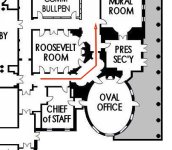
One fun anecdote that comes to mind on that subject. When I did a short stint operating on The West Wing I had a devil of a time negotiating the corridor outside the Oval Office during walk and talks. That part of the set accurately mirrored the actual White House floor plan, where the corridor took a set of 45 degree turns. I was very used to backing up around 90 degree corners but this 45 degree business was exceptionally hard to get used to, and that piece of corridor was short enough that I couldn't use the side walls to help orient me into a straight line once I'd made the turn. I used to practice it at lunch without the rig on just to get the route burned into my brain. Ultimately I think I ended up counting my steps to know when to make the second turn into the straightaway. It was always something of a nailbiter to pull off consistently. There's a situation where a good spotter would have made all the difference, but unfortunately the individual tasked with that was not good. In fact he once piloted me right into a wall which nearly caused a collision with one of the leads, who promptly retreated to his trailer until we had "worked it all out".
 

Attachments

  • wwing.jpg
    wwing.jpg
    43.8 KB · Views: 0
Last edited:
It's not so much about literally seeing one's feet as seeing what obstacles are within the vicinity of said feet. Our peripheral vision is quite wide, one can "feel/sense" objects of a certain size from well beyond what we perceive as the scope of our vision, albeit without much detail. As a result, a look backwards doesn't have to be an entire rotation of the head, often a half-rotation will deliver the basic data of "large object I need to avoid is 8 feet away".

I think we're on the same page. When gimbaling and facing forward, I can avoid obstacles and do stairs, etc

The issue I'm facing is pretty specific in terms of operating in an art gallery and backing up to or sliding next to a painting or sculpture within a few inches. I want to exploit all the space I can, because things can be a bit tight. But ultimately if I damage an artwork then that's the ball game. Spotters i work with in these cases generally stop me way before I would stop myself, but that's understandable because if they halt me at the last moment there's no guarantee I won't push through a bit. So there's no substitute for having eyes in the back of your head.

but certainly, in lower stakes scenarios I have been surprised by how good my spatial awareness is without looking. With a brief glance to the side at the start, I can usually gimbal backwards and sideways filming a wedding dance without running into any of the spectators surrounding me. Similarly, going backwards on the sidewalk or street isn't a real issue and intermittent glances can detect trees, etc
 
One fun anecdote that comes to mind on that subject. When I did a short stint operating on The West Wing I had a devil of a time negotiating the corridor outside the Oval Office during walk and talks. That part of the set accurately mirrored the actual White House floor plan, where the corridor took a set of 45 degree turns. I was very used to backing up around 90 degree corners but this 45 degree business was exceptionally hard to get used to, and that piece of corridor was short enough that I couldn't use the side walls to help orient me into a straight line once I'd made the turn. I used to practice it at lunch without the rig on just to get the route burned into my brain. Ultimately I think I ended up counting my steps to know when to make the second turn into the straightaway. It was always something of a nailbiter to pull off consistently. There's a situation where a good spotter would have made all the difference, but unfortunately the individual tasked with that was not good. In fact he once piloted me right into a wall which nearly caused a collision with one of the leads, who promptly retreated to his trailer until we had "worked it all out".

Interesting solution! Out of curiosity, why didn't you don Juan it? Would that have made it easier to handle the corridor? Was there an operating advantage from facing forward in terms of framing?
 
Ahapert.

I think CP has said most of it.

My observation is that you will need two people and your high end client should be able to pay for it.

Either develop a relationship with someone who can spot you properly

..or change the mode of operation the gimbal with a controller, wheels whatever.. then you can concentrate on the path (you could even tape or drop some marks on the ground) and avoiding obsticals while he/she points the camera remotely. Or even save your back and get them to be the human dolly while you twiddle the controller.

I think extraction of more money from the client is the key inovation you are looking for.

Technically Im all over one person carrying while another operates the 'head' - certainly a head operater is a boon when in don juan positions

OK, you've convinced me -- I should definitely buy these glasses and try them out because they cost as much as or less than the day rate of the person I'd need to do their job, so it's worth a shot. My rate is already a stretch for the client, so if I tell them they need to increase their budget I might just innovate myself off their call sheet
 
My thought was more tripod oriented outside. Something like strapping a Gratical over your eye instead of watching a monitor in a fixed position. Like a permanent viewfinder that you do not have to try and stay close to.
 
Agree with Sam on how best to go about it--the two-person operation of the gimbal is really a wonderful tool, although it still requires two individuals to be really thinking as one (vs someone just lugging the thing around without considering shot design). But yes that does mean more humans and more dollars.

re: the West Wing and Don Juan...very few Steadicam operators feel they can operate as well in DJ as in Missionary and many avoid it completely. I have a few friends who have managed to never do it once across multiple decades. I used to do it when there was really no alternative for me--fast moves up and down stairs for instance (the shot leading Ed Norton downstairs in American History X was a well-known one, although I personally think I didn't do a particularly good job with it). For normal speed backing up shoots I'd always walk backwards to have better control of the rig. Maintaining headroom in particularly is tough in DJ, as it is effectively reversed, your hand tilts the post down to tilt the lens up.

In the workshops, I always thought it was kind of fun doing the exercises where we'd switch, DJ, etc., but that wasn't "for real". I also remember wanting to try operating goofy foot to see what it was like. It didn't last past that... Although one of my buddies, who actually ran that workshop, had an example where he had to operate goofy to pull this shot off(something about the way he had to turn when he got to the top of a staircase, I believe).
 
I love you guys, but a dual operator setup is not the right fit for this type of shoot. I've done it on occasion for this client on shoots where it was impossible to operate the rig with a single operator. It took a lot of takes and coordination. But the shoots I'm discussing now are very fast-paced and there isn't time to deal with a second operator even if the money were there.

It's also worth noting that the issue I'm trying to address is minor. None of my producers have noticed a problem, and I'm 98% happy with what I'm getting at these shoots. The problem manifests itself here and there where for a couple seconds I'm not adjusting frame or my frame is drifting, and then I correct after I've settled into my new position.

It makes me feel better that even Charles can't reliably get good spotting. I have a spotter available to me at these shoots but I've chosen to forego it because i wasn't satisfied with the results. I thought the spotting wasn't working out because we were a bunch of no-talent ass clowns, but if Charles was being crashed into walls by a union AC or grip on West Wing then I don't feel so bad!
 
I wonder about tape string or beanbags on the ground

2nd acs have tiny sanbags. and T thingies

.Also having the monito low to allow flicking from floor to vision simply?

I dont know your gimbal build but it on a monopod with the monitor near the bottom like a trad steadicam might be a consideration)

Also it is my beleif that having a long rig (gimpal plus monopod with mass at the bottom .. batts,, monitor) will lead to less fatiguing and more accurate operating.

Especially if you can program in a default tilt to be added to follow/single operator mode

That gimbals dont run easily from remote batteries that could be used to fingle the CofM is a crime showing that gimbal designers have never operated.

===
.
I think anyone can satnd in front af a million dollar art work to stop you knocking it.. get thier staff to do that t least?
 
Back
Top