SCARLET / EPIC swiss army knife camera details announced

As before, nice looking specs but call me when they start shipping.

I don't think RED will ever sell a ton of anything. The $3,750 which is the cheapest "advertised" working configuration is still a prosumer price, which is a very small market, and 3k is not a popular format. I have yet to hear a client ask to shoot a commercial in 3k...LOL it's either 35mm or 1080.
The sensor is 3k. The effective resolution will probably be a little above 2k. 2k is just a bit bigger than 1080 so the 2/3" Scarlet should be able to slip easily into a 1080 HD workflow. All other things being equal 3k footage down-sampled to 1080 should look much better than footage shot by a native 1080 camera, especially considering the cameras currently in the prosumer realm. If the Scarlet was released today the EX1 and 3 would probably be its biggest competitor since the EX cameras have 1/2", full raster 1080p imagers and record to a full raster codec.

A lot can change though between today and when the Scarlets hit the street.


-A
 
Kinda curious what the fixed lens on the Scarlet will actually be. Will it just be an ambiguous zoom
lens number from 1-99 or, maybe I'm dreaming here, will it be like a selectable 18-55mm that
approximates the 18-55. I guess one can always match a still cam lens image up to the equivalent
zoom lens number as well.
 
I don't think RED will ever sell a ton of anything. The $3,750 which is the cheapest "advertised" working configuration is still a prosumer price, which is a very small market, and 3k is not a popular format. I have yet to hear a client ask to shoot a commercial in 3k...LOL it's either 35mm or 1080.

You don't get asked for either of those, either. You deliver an HD product or an SD, that's it. Your arguement against ACQUISITION or ORIGINATION doesn't apply to FINAL DELIVERY.

Whether you know it or not, shooting 3K that's an actual 2k is still going to yield much better results than anything below a RED at this moment. In short? It's going to stomp on anything Panasonic, Sony or Canon has to offer right now EVEN at 2/3". And that's just REDCODE 42.

The S35 Sensor sees RC80, better than what we get now with a current RED ONE.

So yeah, you won't hear a client ask to shoot a "commercial" in 3K. Acquisition and Delivery are two different things.
 
The fact is that the people that buy the fixed lens camera, who are in a low budget but with a lot of enthusiams, will most likely eventually buy a higher priced camera and all the accesories. That was the pourpose behind Scarlet in the first place. Build up from the bottom towards a Red One or better. Now is multple choice higher priced Scarlets with unknown priced accesories. I am sure that there are many more thousands of individuals, especially the new generation of young students starting out, than there are ones with over $12K to spend in their pockets, especially with the economy the way is going.
 
As before, nice looking specs but call me when they start shipping.


The sensor is 3k. The effective resolution will probably be a little above 2k. 2k is just a bit bigger than 1080 so the 2/3" Scarlet should be able to slip easily into a 1080 HD workflow. All other things being equal 3k footage down-sampled to 1080 should look much better than footage shot by a native 1080 camera, especially considering the cameras currently in the prosumer realm. If the Scarlet was released today the EX1 and 3 would probably be its biggest competitor since the EX cameras have 1/2", full raster 1080p imagers and record to a full raster codec.

A lot can change though between today and when the Scarlets hit the street.


-A
You beat me too it. Lol. I was out doing Phantom tests. I pretty much re-iterated what you said but again, this is accurate.

I really don't think the EX1 or 3 would hold up to Scarlet in the end, and you couldn't even argue price between the EX1/3 vs SCarlet because the 2/3" Scarlet STILL costs less.

Media's cheaper, etc etc.

Anyway, we're both on the same page.
 
The fact is that the people that buy the fixed lens camera, who are in a low budget but with a lot of enthusiams, will most likely eventually buy a higher priced camera and all the accesories. That was the pourpose behind Scarlet in the first place. Build up from the bottom towards a Red One or better. Now is multple choice higher priced Scarlets with unknown priced accesories. I am sure that there are many more thousands of individuals, especially the new generation of young students starting out, than there are ones with over $12K to spend in their pockets, especially with the economy the way is going.

Our Niche is one smaller than your statement. Granted, I'm no manufacturer but Capitalizing on those that spend the hardcore money on larger cameras is where I would be focusing. Those are the ones that will put your product to proper use and pay you for it, so long as it holds up.

Sure, the little Fixed Lens Scarlet will be great when it finally hits. But it's clear why the S35 version is slated to be the first one out. But tomato tomatoe.
 
I couldnt agreed more with Kholi. Red is a PRO Digital CINEMA company. I hope they know that by unleashing red 2/3" to the prosumer market, the amount of support that they need will increase very sharply. They also introduced few different codecs at ridiculous useless resolution (ok your project 9k image ) while the workflow for the RED ONE is not even stabilized yet. Not to mention how that super high resolution is going to wreck havoc on your NLE and your computing hardware.

These 14 -16 year old that is so excited about the cheap Scarlet, I hope they do not get their dream crushed when they venture into the pro realm, where a top handle mount costs $450, a EVF mount is $1200, a complete set of IR filter for the sensor is $1700 (yes, there is not build in ND for the red one), $1500 for 2 batteries and a charger ....etc. You guys see the mess here or the chaos thats going to emerge ?

Not to mention, 2/3" ? what is so revolutionary about that ? If RED is going to swing it, might as well bump the price to $6000 and offer a s35mm fixed lens scarlet. Canon already has a $2650 35mm camera, all they have to do is make the housing bigger and make it into a fully functional camcorder. Just like Arri, Panavision and other high end cnema companies out there; they are all very specialized and concentrated on their specific core competencies. You will not see Arri selling a prosumer camera or JL Fisher competing with indie dolly.

I would suspect a lot of the proposed system will not make it beyond the rendering and maybe some early prototypes. For example, what kind of battery system is that they are using ? Some proprietary system ?? Is Anton Bauer and V mount standard not enough ??

For damned sure. The creature comforts you get with an HVX200? Gone. No more Internal ND filters! None of that stuff. Now you need to shell out for external peripherals. Well, you see it above.

As far as the Batteries go, I'm pretty sure you'll be able to use some of the existing RED peripherals such as the V Mount plate and DRIVE. That's actually pretty exciting to me.
 
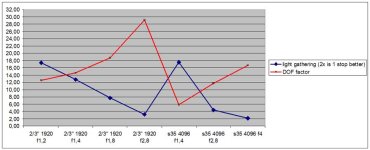
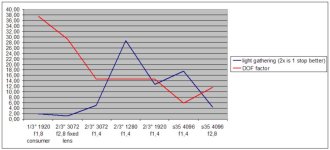
You might find this interesting. It's a comparison on actual physics of DOF and light gathering based on aperture and pixel size. I ignore sensor techology differences in this calculation. You will see that there is a reason the 2/3" camcorder exists. You will also see that a fixed lens f2.8 2/3" should not be better than a 1/3" f1.8 consumer camera in light gathering and will only achieve marginally shallower depth of field.

The second graph compares 2/3" 1080p with s35 4k based on the pixel size and the actual aperture used.
 

Attachments

  • lightdof1.jpg
    lightdof1.jpg
    73.8 KB · Views: 0
  • lightdof2.jpg
    lightdof2.jpg
    71 KB · Views: 0
Last edited:
For example, what kind of battery system is that they are using ? Some proprietary system ?? Is Anton Bauer and V mount standard not enough ??

So because something is standard does that mean there is no need for improvement? So what if it's proprietary, if its cheaper, lighter, stronger, smaller, isn't that worth changing?

I think the idea here is not just seriously improving the tools but changing the way we think as well.
 
So because something is standard does that mean there is no need for improvement? So what if it's proprietary, if its cheaper, lighter, stronger, smaller, isn't that worth changing?

What are the chances that something proprietary in an vendor monopoly is cheaper than something widely available from many manufacturers? The development cost is much higher. The market is much smaller. Even if we take for granted that the manufacturer will not take advantage of the monopoly, it's economically illogical.

If a standard exists, it makes sense to support it. It saves development cost and you can pass the saving to your customer. The actual product will be more affordable and more depedable due to heavily tested technology in real field application. The customer could use existing batteries which makes use of existing investment or find and rent batteries cheaper. And you are supporting a wide industry that lives on supplying batteries, which is a good thing, especially in these times. I know many do not share this way of thinking but I'm the kind of guy that tries not to buy wine, meat, vegetable, bread etc from large supermarkets. There are specialised businesses for these products that need support and typically provide superior products.
 
One thing I haven't been able to figure out: the original announcement had the Scarlet with interchangeable C- and B4 lens mounts, if I remember correctly. The Dec. 3 version stripped out mention of lens mounts for the Scarlet, so are we to infer that the Scarlet can take advantage of the Nikon/PL/etc. lens mounts? If so, wouldn't they have to build the mount around an optical system, to keep the Scarlet's S16-sized sensor from turning every lens into a super-tele?
 
Thought I'd finally chime in, having followed this.

I think it's great what Red is trying to do. But a lot of people who blindly jump onto this bandwagon aren't being realistic, or understanding that even Scarlet is for the most part a professional camera. It's not a prosumer camera like the HVX170, EX-1, etc. It won't be designed for the "plug and play" generation (not an insult, I'm a proud member). Even the "complete kit" Scarlet is going to take some peripherals ($$$), and a robust system ($$$) to cut, and an experienced editor to work with. Maybe that's you, and that's fine, however:

To all of you lamenting the purchase of your HVX200a's, HMC150's, EX-1's, Canons, etc. I say, for the love of God, why? Your camera is out now, not next December. Your camera takes gorgeous video in the right hands, at 1080p (the industry delivery standard for most of us, for the next several years). Your camera works great, and is likely easy to work with, and cut. To buy extras for your camera will cost you very little, compared to the pro stock gear. Your camera is made by a reputable company with decades of the highest professional backing. There's not a single thing wrong with your camera, not one!

Love your camera! Get out and shoot!
 
I don't think anyone should lament the purchase of their camera (unless they don't like their camera). It's a camera you have now, that can make you money now, and when scarlet comes around (or whatever else) you will have money then to buy one if you like and if you feel it will be appropriate for your needs.

I know more than a few people who fully intend on purchasing a Scarlet in the future (if it ends up being what they are expecting) but just bought an HPX170 (for example) b/c they needed something now, to tide them over until then.

Scarlet, Epic, etc, etc, etc are all another option for us to choose from. For some it will be right, for others it will not. But, everyone will benefit from the release of these cameras should they perform anywhere near as well as expected, b/c prices will be driven down, and technological advances will move much faster as a result if RED can indeed make at least a somewhat successful entrance into this larger market. Everyone will win if they are successful. Whether you buy one of their cameras or not.

Later,
Jason
<still happily shooting away with his original HVX200 and will continue to do so for the foreseeable future>
 
Last edited:
I love my original HVX 200 and it will be working harder than ever in the next few months. The problem with a lot of people dreaming of Scarlet is that they are expecting it to make them an overnight filmaker sensation because it shoots so close to film for a price they can afford. A lot of newcomers that at the moment don't even own the simplest camcorder are dreaming that Scarlet will come packaged with magical powers and their stories will be told with Oscar quality results. Many will be able to accomplish wodrful results and as many will never get anywhere. Scarlet is far far away and between now and then we have to come back to reality and work with the tools we have right now.
 
The problem with a lot of people dreaming of Scarlet is that they are expecting it to make them an overnight filmaker sensation because it shoots so close to film for a price they can afford. A lot of newcomers that at the moment don't even own the simplest camcorder are dreaming that Scarlet will come packaged with magical powers and their stories will be told with Oscar quality results.

Totally agree John. They seem oblivious to the talent and support gear needed to create great productions. A lot of ether being pumped into the camera atmosphere by RED, it is brilliant marketing, I have to agree but the harsh light of reality will shine on many once they do their first shoot. High resolution and accurate color does not an accomplished filmmaker make.

Dan
 
true. and by the same token, a motivated filmmaker could do well with less than a single Scarlet in his aresenal, as well.
 
The performance of an imaging package is still quite important. A good camera will create a very dramatic result out of an everyday location with little or natural light, just because it has the right mix of spectrum response and dynamics. Very few cameras have the pixel quality that is required for recording some subjects. Studio situations look ok in most cameras because even the worst sensors can be fixed if enough uniform light is available, but take a camera out before dawn or in an abandoned building near dusk, and see how they compare in chroma and how natural and interesting one camera might look vs another.
 
Back
Top