
Navigation
Install the app
How to install the app on iOS
Follow along with the video below to see how to install our site as a web app on your home screen.
Note: This feature may not be available in some browsers.
More options
You are using an out of date browser. It may not display this or other websites correctly.
You should upgrade or use an alternative browser.
You should upgrade or use an alternative browser.
OK, so... fastest lens adaptor PERIOD?
- Thread starter USLatin
- Start date

Ryan Patrick O'Hara
Veteran
Lens adapter thread is at the bottom of the film making thread category. This may help you find test results and information which may help you.

Ryan Patrick O'Hara
Veteran
Which is fastest? Well let's say a Brevis leaves Chicago at 3:15pm going 45mph west, and a Letus leaves LA at 5:00pm going 55 mph going east......................
:huh:
:huh:

The Brevis is the fastest. It only loses .5 stops WITH a 50mm prime attached, whereas the Letus Extreme loses .5 stops with no lens attached.
I think they claim with no lens attached. Add the lens and its a different story - more glass, more light loss , and thats where the extra $ on a f1.8 lens comes into play rather than a cheaper f2.0 for example.
Ryan Patrick O'Hara
Veteran
would 2.8f zooms work on low light conditions?
I want to get a pair of excellent zooms to cover all lengths but the Ninkon 2.8f's are already out of my budget. How many stops would I lose with them on? And what about the longer lengths where they will lose even more light?
That depends which camera you are using, and what you consider low light conditions. Zooms over f/2.8 (f/4, f/5.6) I consider useless... unless you are shooting primarily outdoors on bright days. I've shot lot's of films with the Redrock (which I know is about a stop slower then those faster boys) and I've had light packages with a couple 1ks, 650's, 300's and I was still wide open on an f/2 lens.
Think of it this way, if you walk into a room and think it's low light, most likely it's to low for an adapter camera combo.
Do you need zoom lenses? A set of faster primes would be the way to go, unless you can't afford them. A f/2.8 zoom might let you get away with using a zoom, but again I believe you said you could not get one. (By the way I think f/2.8 is pushing it, in low light situations.
When dealing with prime lenses, yes, the higher the focal length (and lower) the more the lenses tend to become slower and slower. Fast lenses are cheapest around 50mm and either increase in price, or just speed as you move in either focal length direction away.And what about the longer lengths where they will lose even more light?
As far as zoom lenses, some of them are rated with two minimum f-stops. One for the wide zoom focal length, and then a slightly slower one for the maximum zoom focal length. They do make zooms which do not 'darken' when zooming through the range of focal lengths.
Did I make sense?
 rogar-Shock(DBG):
EDIT: Should this move to 35mm adapters?
Last edited:
As far as zoom lenses, some of them are rated with two minimum f-stops. One for the wide zoom focal length, and then a slightly slower one for the maximum zoom focal length. They do make zooms which do not 'darken' when zooming through the range of focal lengths.
Did I make sense?
To clarify this a bit, on lower end zoom lenses you may noticed that the iris will start to close as you zoom in. This is true on the HVX, DVX, A1, XL2 etc.
That's why when looking at zoom lense you see that they give 2 f-stops, like f3.5-f5.6 or something like that. It means that the iris can remain open at f3.5 when you're at the widest end of the zoom range and it will not open more than f5.6 at the telephoto end. More expensive lenses will allow you to have a constant f-stop through the entire zoom range (usually f2.8, I haven't seen any faster lenses; if there is those would cost an arm and a leg).
Ryan Patrick O'Hara
Veteran
To clarify this a bit, on lower end zoom lenses you may noticed that the iris will start to close as you zoom in. This is true on the HVX, DVX, A1, XL2 etc.
That's why when looking at zoom lense you see that they give 2 f-stops, like f3.5-f5.6 or something like that. It means that the iris can remain open at f3.5 when you're at the widest end of the zoom range and it will not open more than f5.6 at the telephoto end. More expensive lenses will allow you to have a constant f-stop through the entire zoom range (usually f2.8, I haven't seen any faster lenses; if there is those would cost an arm and a leg).
Haha, Yes. That is what I was trying to say. Thanks for wording it a bit better.

Hey thanks Ryan, and you did make complete sense. Jade, thanks for adding to it. I understand now... the iris closes as you zoom... I was hoping that would be the case but I was scared to ask.
So let me just ask while I still have you guys here:
_ The camera is the HVX
_ The adapter is the Brevis
_ The lights will be 1000w Kino, 500w Kino, Alzo 800w and Richard's 575 HMI for 1500w in a fresnel
Will these suffice if they turn out to be a matching pair and sharp enough as they seem to be:
http://www.bhphotovideo.com/bnh/con...&A=details&Q=&sku=36956&is=GREY#goto_itemInfo
http://www.bhphotovideo.com/bnh/controller/home?O=WishList.jsp&A=details&Q=&sku=124669&is=GREY
I looked at their F stop rating but couldn't find the open-zoomed F stop, just the one 2.8f listed, then the 2.8f - 22f that you can set it to. On the wide one it seems I might have to set it to about 3f or slightly higher to avoid softness, but I might still be able to get away with 2.8f since we are only shooting 2MP while these are easily used with at least 5MP and higher pro-sumer still bodies given their price and people still think they are sharp enough... maybe not sharp enough for 8MP and higher but hey... that's not an issue for us... right?

Dan Vance
DVXUser Sponsor
To clarify this a bit, on lower end zoom lenses you may noticed that the iris will start to close as you zoom in. This is true on the HVX, DVX, A1, XL2 etc.
That's why when looking at zoom lense you see that they give 2 f-stops, like f3.5-f5.6 or something like that. It means that the iris can remain open at f3.5 when you're at the widest end of the zoom range and it will not open more than f5.6 at the telephoto end. More expensive lenses will allow you to have a constant f-stop through the entire zoom range (usually f2.8, I haven't seen any faster lenses; if there is those would cost an arm and a leg).
I don't mean to confuse the issue, but I don't think the iris actually closes when you zoom--I think it 'appears' to close. The reason that long lenses tend to be slower than wide lenses, and the reason for the two f-numbers on zooms, is due to the fact that the f-number is defined as the (effective) focal length divided by the diameter of the entrance pupil. The maximum diameter is determined by the diameter of the glass, of course, and how wide the aperture can open. Say a lens is designed to have a maximum opening diameter of 25mm and it's a 35 to 75mm zoom. At the wide end, the f-number is 35/25 = f1.4, but at the long end it's 75/25 = f3.0.
When a lens is designed to have a constant f-number over the zoom range, it's done by sacrificing the speed at the wide end, to match the full zoom f-number
This is an oversimplification of course, but the important point is that f-number = focal length/diameter.
(This is also why it's really hard to make lenses faster than f1.0: Their diameter has to be larger than their focal length, which is quite a trick (but not impossible)).
So if you have your lens wide open on a camcorder and you see the f-stop increasing as you zoom in, the iris is not closing, the camera is just telling you what your new f-number is, based on the focal length you're zooming to. The aperture diameter (iris) is staying the same (wide open).

Dennis Wood
DVXuser Sponsor
Dan, that's close enough The great thing about our new imaging element, CF1Le is that it shines with even slow zooms offering both excellent light efficiency, and in most cases (even f3.5 wide angle zooms), zero vignetting. We've tested on both flipped and non-flipped Brevis applications with the same surprising results. In fact, when it comes to wide angle zooms, I can say that the zoom lenses perform better than the primes at the same f-stop. Makes no sense, but it's well documented by our users. Don't assume that the f3.5 lense actually causes 3.5 stops of loss when used by an adapter...in our application it's only about 1.5 stops. Contrary to popular opinion, the relationship between light loss and f-stops on 35mm adapters is not anything like you'd see on a film/digital camera.
These observations can be used to your advantage when using the Brevis. A 50mm f1.4 lens that is soft at wide open aperture can be stopped down to f 2.8 with a near-zero increase in light loss .... meaning a potentially much sharper image with no penalty in light loss! Again, it makes little sense logically until you connect your camera/Brevis system to a scope and watch what happens between f1.4 and f2.8!
Another advantage seldom discussed is that our flip system offers not one, but two points of adjustment to make sure off-center imagers (common on the HVX200 and HV20) can be corrected. This means less zoom in will be required by your video camera, which means better light efficiency there too. Video cameras will see up to a stop loss as they go from full wide to full zoom. Camera's like the HV20 which are constant aperture, don't necessarily lose a stop, but the edge falloff at full zoom (bare camera) is huge.
The great thing about our new imaging element, CF1Le is that it shines with even slow zooms offering both excellent light efficiency, and in most cases (even f3.5 wide angle zooms), zero vignetting. We've tested on both flipped and non-flipped Brevis applications with the same surprising results. In fact, when it comes to wide angle zooms, I can say that the zoom lenses perform better than the primes at the same f-stop. Makes no sense, but it's well documented by our users. Don't assume that the f3.5 lense actually causes 3.5 stops of loss when used by an adapter...in our application it's only about 1.5 stops. Contrary to popular opinion, the relationship between light loss and f-stops on 35mm adapters is not anything like you'd see on a film/digital camera.These observations can be used to your advantage when using the Brevis. A 50mm f1.4 lens that is soft at wide open aperture can be stopped down to f 2.8 with a near-zero increase in light loss .... meaning a potentially much sharper image with no penalty in light loss! Again, it makes little sense logically until you connect your camera/Brevis system to a scope and watch what happens between f1.4 and f2.8!
Another advantage seldom discussed is that our flip system offers not one, but two points of adjustment to make sure off-center imagers (common on the HVX200 and HV20) can be corrected. This means less zoom in will be required by your video camera, which means better light efficiency there too. Video cameras will see up to a stop loss as they go from full wide to full zoom. Camera's like the HV20 which are constant aperture, don't necessarily lose a stop, but the edge falloff at full zoom (bare camera) is huge.
Last edited:
Wow guys! I am so glad we went off topic because we got loads of info that is completely pertinent and will benefit those who read it.
Thanks Dan for getting us there, and Dennis for adding to it. That was very helpful for me. I like understanding things I work with, I hate to just use the stuff.
So While I have you here Dennis, can you buy the Brevis with the CF1Le you just mentioned? It sounds that it might be the best element to start with for my since I am going into Zoom lenses...
And how do you think the CFL1Le will perform with 2.8f Zooms when stopped down a tad to say 3.5f for maximum sharpness? What kind of loss would be expected?
Ryan Patrick O'Hara
Veteran
Hey thanks Ryan, and you did make complete sense. Jade, thanks for adding to it. I understand now... the iris closes as you zoom... I was hoping that would be the case but I was scared to ask.
So let me just ask while I still have you guys here:
_ The camera is the HVX
_ The adapter is the Brevis
_ The lights will be 1000w Kino, 500w Kino, Alzo 800w and Richard's 575 HMI for 1500w in a fresnel
Will these suffice if they turn out to be a matching pair and sharp enough as they seem to be:
http://www.bhphotovideo.com/bnh/con...&A=details&Q=&sku=36956&is=GREY#goto_itemInfo
http://www.bhphotovideo.com/bnh/controller/home?O=WishList.jsp&A=details&Q=&sku=124669&is=GREY
I looked at their F stop rating but couldn't find the open-zoomed F stop, just the one 2.8f listed, then the 2.8f - 22f that you can set it to. On the wide one it seems I might have to set it to about 3f or slightly higher to avoid softness, but I might still be able to get away with 2.8f since we are only shooting 2MP while these are easily used with at least 5MP and higher pro-sumer still bodies given their price and people still think they are sharp enough... maybe not sharp enough for 8MP and higher but hey... that's not an issue for us... right?
Those lenses have a good range and are as fast as you are going to get. If you must use lenses, those don't look bad. They are a two touch lens which is great, and they are consistent through out the focal length, which is also a plus.
As far as your lighting, it really does matter how much light you have but it also really matters how you use it. You can light with what you have but probably not any wide shots.
Those kino's are very soft and have a very fast light falloff. You can't throw that light very far.
I would recommend testing. All you really need is a light meter and know what your camera's ISO rating is when you have a 35mm adapter on.
Yes, the Kinos are not much help at all on wides... though they can fill nicely on medium shots.
Thank you for your reply about the lenses! Could you tell me what is a "two touch"? And when you said "consistent through the focal length", what exactly is it you are saying stays consistent? It can't be focus, or light loss... ?
Oh! And Dennis! Just to make sure, since the Le GG says it is for large cameras:
Does it works fine with the HVX? I am sure it does but just checking everything now.
Last edited:
Ryan Patrick O'Hara
Veteran
Two touch means the focus ring is separate then the zoom ring. Many medium and low cost photography lenses have what's called "push pull" zooms. The focus ring turns normally but can be pushed forward or pulled back for the zoom function. Many people buy these lenses not thinking, and realize the follow focus does not work with it. Not to mention critical focusing is out the window.Could you tell me what is a "two touch"?
Here is an example. See that large textured ring in the middle. That turns for focus and slides up and down the lens body to change focal length. See the 80 and 200 marks? This is an f/2.8 80-200mm zoom lens, but push and pull. Not the two touch, two ring lens.
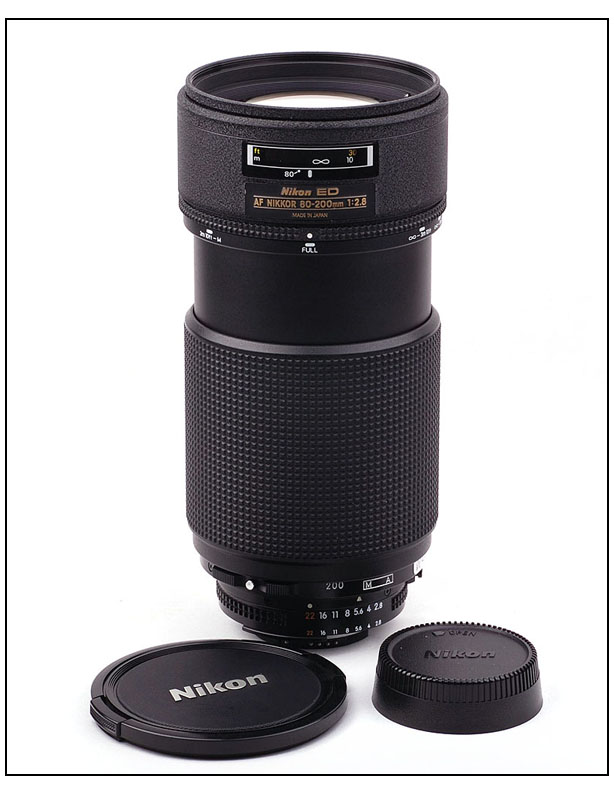
Remember the jabber Jade and I were talking about?And when you said "consistent through the focal length", what exactly is it you are saying stays consistent? It can't be focus, or light loss... ?
The lenses you have selected to not have the two f-stops listed meaning it is a 2.8 all the way from widest to longest focal length. This is good because if you are zooming in a shot, you won't have to worry about pulling your exposure as well.To clarify this a bit, on lower end zoom lenses you may noticed that the iris will start to close as you zoom in. This is true on the HVX, DVX, A1, XL2 etc.
That's why when looking at zoom lense you see that they give 2 f-stops, like f3.5-f5.6 or something like that. It means that the iris can remain open at f3.5 when you're at the widest end of the zoom range and it will not open more than f5.6 at the telephoto end. More expensive lenses will allow you to have a constant f-stop through the entire zoom range (usually f2.8, I haven't seen any faster lenses; if there is those would cost an arm and a leg).
Last edited:
Oh!!! no way! so these are some of those! NICE! I didn't think I could afford consistent zooms!!! That is excellent!! That is just great! I mean... if it is accurate then I will not have to worry about the iris on them... just set it to their widest sharp setting and take it from there only with the HVX's aperture. This eliminates an other source of confusion and mistakes for matching and so forth... well I mean if they both truly have equal light loss then if they are both set the same it would eliminate having to math exposure when swapping lenses...
I hope they turn out to be exactly the same... all that I should worry about then is their sharpness... hopefully there will not be any vignetting or other weird lens bugs... they sound to be good enough... for film look anywhhhay...
And about Two Touch... yes, my dad had a zoom like so I was looking for two grip surfaces thinking that would be easier operation like the HVX and not knowingly I was also saving myself from getting a lens that would only follow focus like a prime hehehe
Thanks for clearing both of those out for me!!!
So what do you guys say? How likely does it seem to you that these might turn out to be too soft with the Brevis?
I hope they turn out to be exactly the same... all that I should worry about then is their sharpness... hopefully there will not be any vignetting or other weird lens bugs... they sound to be good enough... for film look anywhhhay...
And about Two Touch... yes, my dad had a zoom like so
I was looking for two grip surfaces thinking that would be easier operation like the HVX and not knowingly I was also saving myself from getting a lens that would only follow focus like a prime hehehe Thanks for clearing both of those out for me!!!
So what do you guys say? How likely does it seem to you that these might turn out to be too soft with the Brevis?