
Navigation
Install the app
How to install the app on iOS
Follow along with the video below to see how to install our site as a web app on your home screen.
Note: This feature may not be available in some browsers.
More options
You are using an out of date browser. It may not display this or other websites correctly.
You should upgrade or use an alternative browser.
You should upgrade or use an alternative browser.
Which to choose...Flolight or KinoFlo???
- Thread starter eppdidit
- Start date

Green Hornet
Veteran
MattinSTL said:Any 21" 55w 4-pin (german style) compact flo tube should work. You can give yourself an upgrade just by trying a different tube next time.
I believe these are 2 pin.

mine are 4 pin.
Barry_Green
Moderator
The CaseLite and Diva use 4-pin u-shaped lamps, I believe the FloLight uses the exact same lamps.

MattinSTL
Sound Modulator
I've played with a biax or two over the past year and a half... trust me there are about 10 choices of lamp that will work in your Flo-Light. If you want the highest lumens combined with highest CRI then you will get a Kino tube... if you want a tube that's a true 3200k or 5600k then you will get a Osram Studioline Biax... if you want to save money and get true 3200k or 5600k then you get GE Cinema Plus... if you want to save the most money then you get Dulux... this still doesn't cover half of your options.
Any tube that is 21" long, 55w, twin tube, and looks like this at the bottom will work. That is a german 4-pin. Flo-light uses the exact same sockets that I do... and so does Kino and Mole. It's a 2G11 socket.
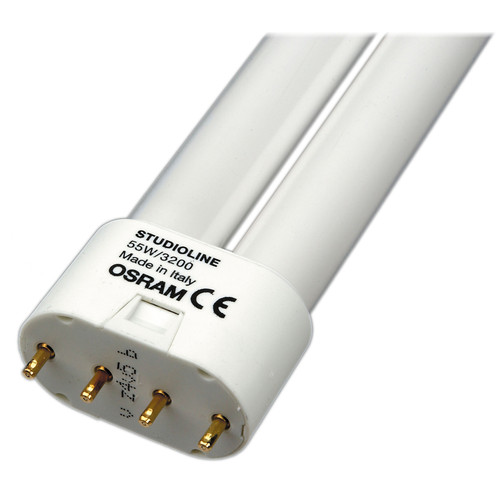
Any tube that is 21" long, 55w, twin tube, and looks like this at the bottom will work. That is a german 4-pin. Flo-light uses the exact same sockets that I do... and so does Kino and Mole. It's a 2G11 socket.
Last edited:
Green Hornet
Veteran
MattinSTL said:I've played with a biax or two over the past year and a half... trust me there are about 10 choices of lamp that will work in your Flo-Light. If you want the highest lumens combined with highest CRI then you will get a Kino tube... if you want a tube that's a true 3200k or 5600k then you will get a Osram Studioline Biax... if you want to save money and get true 3200k or 5600k then you get GE Cinema Plus... if you want to save the most money then you get Dulux... this still doesn't cover half of your options.
Any tube that is 21" long, 55w, twin tube, and looks like this at the bottom will work. That is a german 4-pin. Flo-light uses the exact same sockets that I do... and so does Kino and Mole. It's a 2G11 socket.
Thanks,
Not sure why I thought it only had 2 pins. I even had to do a re-check (thinking that maybe the 4 bank was different) but they are just like you show.
It's good to know that other lamps will work as well.

Mr. Blonde
RED Advocate
I'm definitely picking up some of those flolights....

Tim Otholt
Member
I think I'm the only one who hates the 21" 55w 4-pin (german style) compact flo tubes. I think Diva Lights, or anything else using the 55w 4-pin tubes suck for location use.
The 3200k Kino and 3500k GE Biax tubes are slightly magenta. Dimming these bulbs only make the magenta worse. Kino says it doesn't show up on film - but if you are shooting video, trust me, it shows up.
If you are mixing tungsten and the Diva lights together, white balancing out the magenta cast doesn't help - taking out magenta by doing a white balance on the Biax bulbs will only make the tungsten heads look green. This is made worse if you are using a Panasonic camera, as the cinematrix modes boost red. You need to add some 1/8 to 1/4 plus green on the 55w 4-pin bulbs to correct the magenta cast.
The daylight (5500k bulbs) are pretty good actually - still not HMI quality, but still usable.
In terms of durability, the 55w 4-pin tubes are not safety coated - a *very* slight tap on the bulb and it shatters into a pile of glass. My grip and electric crew have broken 8 or so 55w bulbs this year alone.
I'd rather take a regular 2'x4 or 4'x4 kino select system (not the Kino fotoflo) anyday over a diva 400. The tubes are safety coated, you can use switches to do the same effect as dimming, the tubes can be removed to be taped directly to walls, the inside of (parked) cars, etc. And the 'tungsten' tubes don't have a magenta cast. Comes in a variety of colors - 2900k, 3200k, 5500k, green, blue, red, yellow, etc.
Tim

bcheong
Well-known member
I think I'm the only one who hates the 21" 55w 4-pin (german style) compact flo tubes. I think Diva Lights, or anything else using the 55w 4-pin tubes suck for location use.
The 3200k Kino and 3500k GE Biax tubes are slightly magenta. Dimming these bulbs only make the magenta worse. Kino says it doesn't show up on film - but if you are shooting video, trust me, it shows up.
If you are mixing tungsten and the Diva lights together, white balancing out the magenta cast doesn't help - taking out magenta by doing a white balance on the Biax bulbs will only make the tungsten heads look green. This is made worse if you are using a Panasonic camera, as the cinematrix modes boost red. You need to add some 1/8 to 1/4 plus green on the 55w 4-pin bulbs to correct the magenta cast.
The daylight (5500k bulbs) are pretty good actually - still not HMI quality, but still usable.
In terms of durability, the 55w 4-pin tubes are not safety coated - a *very* slight tap on the bulb and it shatters into a pile of glass. My grip and electric crew have broken 8 or so 55w bulbs this year alone.
I'd rather take a regular 2'x4 or 4'x4 kino select system (not the Kino fotoflo) anyday over a diva 400. The tubes are safety coated, you can use switches to do the same effect as dimming, the tubes can be removed to be taped directly to walls, the inside of (parked) cars, etc. And the 'tungsten' tubes don't have a magenta cast. Comes in a variety of colors - 2900k, 3200k, 5500k, green, blue, red, yellow, etc.
Tim
You're not the only one Tim - I completely agree with you about the 55w biax tubes. The T12 tubes in Kino Select systems I think are far better. I'd take a short 4 select over a Diva anyday.

Cool Lights
DVXuser Sponsor
It's hard to argue with the pros. And this is an interesting subject too! One that I spend quite a bit of time thinking about. There are other interesting points of view too on this subject like from a manufacturers perspective. When making a decision about what to manufacture, I look to where the momentum is because thats how we get return for our investment and that's normal. So, an interesting question is why aren't there more T12 type fixtures out there? Because if that's where the momentum was, we'd have one to offer in a heartbeat. We know where to find ballasts, we know how to make the tubes, etc. We also know how to make a usable fixture too for an economic price. But the ironic question to ask when considering what to offer is "which came first, the market or the demand?"
You, as a user and customer also have to look to your preferences for tools and how they behave but also it can be helpful to see where all the R&D dollars and product development are going to see where the momentum is--to understand why there aren't more T12 type fixtures out there on the market and whether its the best investment or not for you.
When I (as a buyer) am choosing what to buy, I think about my preferences and criteria but I also look to the supply side to see what's going on if its a big investment. The scarcity of something might actually chase me off from buying something and rightly so if I think there's little future in it. If I can only get it from one or a couple of manufacturers, the standard is aging or whatever I may choose not to go that route.
When I (as a manufacturer) give thought to what to manufacture, the supply side is relevant too of course. Not too much supply? What about demand? Short supply and big demand: Obviously, that could be a good thing if you want to join in and believe that you can make an offering to help drive the market into commodity status (i.e. lower the price and/or raise the perception of value received in the product) than the existing ones which may actually increase the market for the item--its called "making a market." In this case, you would say that the supply came first, helped lower the cost and the demand followed. Short supply and demand not great? Hmm. Might not get our engineering money back in that case and it all depends upon if we can make the market with lower price or whatever can drive that.
Anyway, back to the linear tube type fixtures. The T12 tube has a lot of acceptance among those that actually use film (and of course can be used in video mediums as well). The T5 55w biax CFL tube is easily the standard in the television industry and is gaining quite a bit of popularity in other digital mediums as well (and is also used in some filmmaking too).
Maybe the film people aren't wrong but nor are the television people. Both groups are pros and both know what they're doing within their own mediums to get the best results. Most on this board consider themselves "filmmakers", but actually fall into the television crowd (from a technical standpoint) because of the type of cameras they are using.
Every major pro lighting manufacturer carries a version of a fixture using the 55w tube--many only make a 55w biax version and most do not make a T12 fixture at all. Most of the development of new fixtures and tubes has gone toward the T5 CFL side of which the 55w biax tube is part of. The ballasts are more efficient and very affordable too. There are continuous T5 dimming ballasts available for those that like it. Clearly, the momentum of future development is on the side of the T5 CFL type fixtures. As a lighting manufacturer I hear people's preferences and I also go with where I sense the momentum is going. I prefer that the two are in sync. But that's not always the case.
Thus, the tube manufacturers follow whats going on as well and more tube manufacturers make suitable high CRI 55w (and other wattages of course) CFL biax tubes in more appropriate color temperatures like 3200K or 5600K. The suitable linear 2 foot and 4 foot T12 tube makers are fewer. In particular, the 75w T12 tube is only made by Kino Flo as far as I know. Thus, if you're concerned about supply issues, future, etc. the 55w tube has more overall acceptance and availability.
All this is to say, I guess from the perspective of the manufacturers and their engineers they have the perception that the T12 tube is not the future. They also have the perception that digital production is the future. T12 is definitely not going away in because of its legacy commercial use in office buildings, warehouses, grocery stores, etc all over the world; but unless some manufacturer makes a larger market for T12 fixtures in filmmaking / television, it's doubtful that you'll see many more offerings in that area. When considering which came first--the market or the demand, most opt for the demand and then make the appropriate supply because they like the momentum thats already in play there.