indieGuerilla
Member
Hello everyone, If you have a small soundroom or screening room I have a little trick that can help out and make it sound larger. This actually makes the soundstage in your listening area sound larger than it really is. In some cases it can make the sound from your speakers sound like it is coming from outside the confines of your listening room.
A few companys in the past actually sold stereo systems that utilized this technique.
If you have an amplifier or preamp with a digital sound processor built in then this trick isnt needed for you. You most likely have a feature (or two) that widens your soundstage built in. Some amps and home theater systems have a feature that is actually called "WIDE". That feature just enhances stereo seperation.
This simple method of enhancing your stereo seperation does the same thing, (for the most part).
I hope I can explain this so the folks who understand how a speaker makes sound arent bored and those who dont arent confused. If you dont understand anything or have questions just ask and I will help you figure it out.
If you have an amp or stereo with outputs for two different pairs of speakers then it is real easy. It is even better if you can adjust the volume and tone qualitys for each pair independantly.
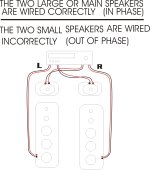
For those of you with outputs for two pairs of speakers just simply wire the main pair of speakers correctly. When I say correctly I mean red wire to red terminal, or + to + and - to - (positive outputs from your amp to positive inputs of your speakers) and of the same for the negative terminals . Now wire a second pair of speakers incorrectly or out of phase. This means red amp outputs to black speaker inputs, and black amp outputs to red speaker inputs. Take the smaller speaker that is wired up to the left amp outputs of your amp and place it near the large speaker on the right side of your room.
Take the other smaller speaker and wire it up out of phase as well and place it near the large speaker on the left side of your room.
And thats it. Why this works is the sound that is to be heard dominantly from the left side of the soundstage is canceled (or reduced) by the out of phase speaker that it is set beside.
I know I am not explaining it very clear so here is another way to explain it.
Lets say you are playing back a conversation between a man and a woman. The mans voice was recorded with a mic on the left and the womans voice recorded with a mic on the right. But some of the mans voice was picked up by the mic on the right side, and some of the womans voice was recorded by the mic on the left. The small out of phase speaker cancels that little bit that was intended for the speaker on the other side.
Now if you have only one pair of speaker outputs it is a little harder. You would essentially take a pair of speaker leads and tap into the right side speaker and take those leads and hook it to an out of phase speaker on the other side of the room. The tricky part here is that when you hook more than one speaker to one amp output you change the load that is drawn from the amp. Depending on how you wire it you can increase, decrease, or leave the load unchanged. By changing the impedance of the speaker system that you connect to your amp you can potentially overload it and cause damage. Some amps automatically detect an unsafe load and switch off. If you dont understand the whole amp load and speaker impedance thing I dont recomend trying the second method.
The picture shows how to wire the first method. Notice the red wires are conected to the black terminals of the smaller speakers. and vice versa.
Try different placement of the smaller speakers and see how it affects your soundstage. I recomend trying facking the smaller speakers facing the fronts of the larger speakers. This just helps in the soundwave cancelling procces.
Everybody seems to know a guy who has the awesome stereo or a room full of different speakers. Maybe you know someone who builds custom speakers. Those folks can most likely help with this or help to explain it clearer than I have. Anyway, Let me know what you think of this info. If it goes over well or there is some interest I may post some plans for sub boxes, studio monitors, and some other audio projects. Thanks for looking, IG