Does the Letus Extreme fix the flaw of all vibrating adapters?

marco0782

Well-known member
My Letus35FE did this, and my Brevis35 does this too: when you stop down past f/5.6 a static grain pattern will show. From what I hear this doesn't happen with rotating glass adapters.

This is a big concern to me and the reason I have an SGpro on order, because sometimes I would like to shoot at f/8 or f/16 with my primes and I can't.

Does the Letus Extreme fix this?


Marco
 
Depends on your shutter speed; if you're using a very high shutter speed and f/8 or f/11, it's grain city.

On 1/60th, it looks like you can go to f/4 safely, and maybe to f/5.6. Much beyond that the fixed smudge pattern starts to become too visible for my taste.

You can of course push the HVX aperture anywhere you want, it's the Nikon/Canon lens aperture that you have to be cautious with.
 
Thanks Barry. It seems that with vibrating adapters the grain doesn't travel far enough to disappear from view at f/5.6 or smaller.

Like with a real 35mm camera, there are many situations where you may want deep focus and it's not achievable with vibrating adapters.
 
I agree, but then the widest you could get would be around 35mm. I would like to stage a shot with my 20mm, for example, that has a subject in the extreme foreground, a subject in the middleground and then a subject in the background. Some people will say, well with a wide angle lens everything is in focus anyway hence no need to stop down, but that's not true if you are very close to your subject. Depth of field is a product of focal length and subject distance.

I'm not trying to take away from all the excitement surrounding the Letus Extreme because it does look pretty awesome. But coming from someone who has filmed 60+ hours of footage with vibrating adapters I have encountered more than a handful of situations where I wanted to stop down and couldn't. In those situations I would not have been satisfied by removing the adapter.


Marco
 
Not accurate at all though. The stock HVX lens goes to 4.2mm, which equates to about 18mm on a 35mm movie camera.

In still-camera terms it about matches a 30mm lens, but a still camera and a movie camera don't have the same field of view. So -- a stock HVX will give you a wider field of view (and deeper depth of field) than a 35mm adapter using your 20mm lens.
 
I think you're confused; field of view is irrelevant here.

From Panasonic's specs: "35 mm Still Film Equivalence 32.5 to 423 mm"

When they state that, they are not talking about field of view but rather focal length. So if my lens is a 20mm still photo lens, that would equate to a wider angle of view than a 32.5mm still photo lens, correct? I know this to be true because using my 20mm Zeiss I can get significantly wider than I can with the naked camera. An added benefit is that my Zeiss lens corrects for distortion much better than the Panasonic/Leica lens does.


Marco
 
Last edited:
Well, no, field of view is *everything* here.

When Panasonic's talking about 35mm still equivalence, they're talking about a lens on a 35mm still camera.

If you put that same lens on a 35mm movie camera, it won't be anywhere near as wide! 35mm movie film is less than half the size of a 35mm still frame. So the field of view is very different.

So let me restate it in a different, and hopefully more understandable, way: if you put that 20mm Zeiss lens on a movie camera, and you compared what you can see through the viewfinder against what you can see on the HVX (with no adapter, just set at 4.2mm) which do you think will give you the wider field of view? The wider-angle shot? The more in-focus depth of field? The HVX will. Because the field of view of its 4.2mm lens is about equivalent to an 18mm lens on a movie camera.

Neither will match what that 20mm does on a still camera, of course, but that's a fake comparison -- movies don't use the same field of view as still cameras. In other words, a 35mm camera is not a 35mm camera -- movie frames are very, very different than still frames.

So -- if you wanted to get the same wide-angle field of view on the HVX as what you're used to getting from that lens on your still camera, you'd take off the 35mm adapter and put on a Century .6 wide angle. That'd give you what you're looking for.

If you want to get the same panoramic view on a movie camera, you couldn't use that 20mm lens. You'd have to use a 12mm lens.

Trust me, I know exactly what you're asking for, and I even have a Zeiss 20mm, and a 35mm movie camera, and a 35mm adapter, and an HVX, and a 35mm still camera. What I'm talking about here is very relevant.
 
Barry, I know what field of view is, but you're still confused.

You said "So -- a stock HVX will give you a wider field of view (and deeper depth of field) than a 35mm adapter using your 20mm lens."

Well, I just took the time to take a still with my Brevis and 20mm Zeiss lens and then a still with the HVX zoomed all the way out after removing the adapter. Here is what I got:

20mm.jpg

Brevis with 20mm Zeiss

HVX.jpg

HVX at 4.2mm


Marco
 
What's not being taken into account here is to what extent each of these adapters actually uses the full 35mm frame. In my tests with the redrock a Nikon 28mm came very close to the full HVX at wide angle. Not quite all the way, but a 24mm Nikon was definately wider. This was empirically tested.

In tests I just ran with a Brevis and an SG Pro, the SG Pro was zoomed in more on the 35mm frame, so an 85 on a Brevis might look more like say a 65 on an SGPro.

Didn't compare the Brevis with the Redrock, nor either with the naked HVX.


Lenny Levy
 
I have to zoom in on the Brevis GG quite a bit since the HVX sensor is off-center. But you are absolutely right. Barry was assuming that 35mm adapters restrict you to the frame size of motion picture film. They don't, and they shouldn't.

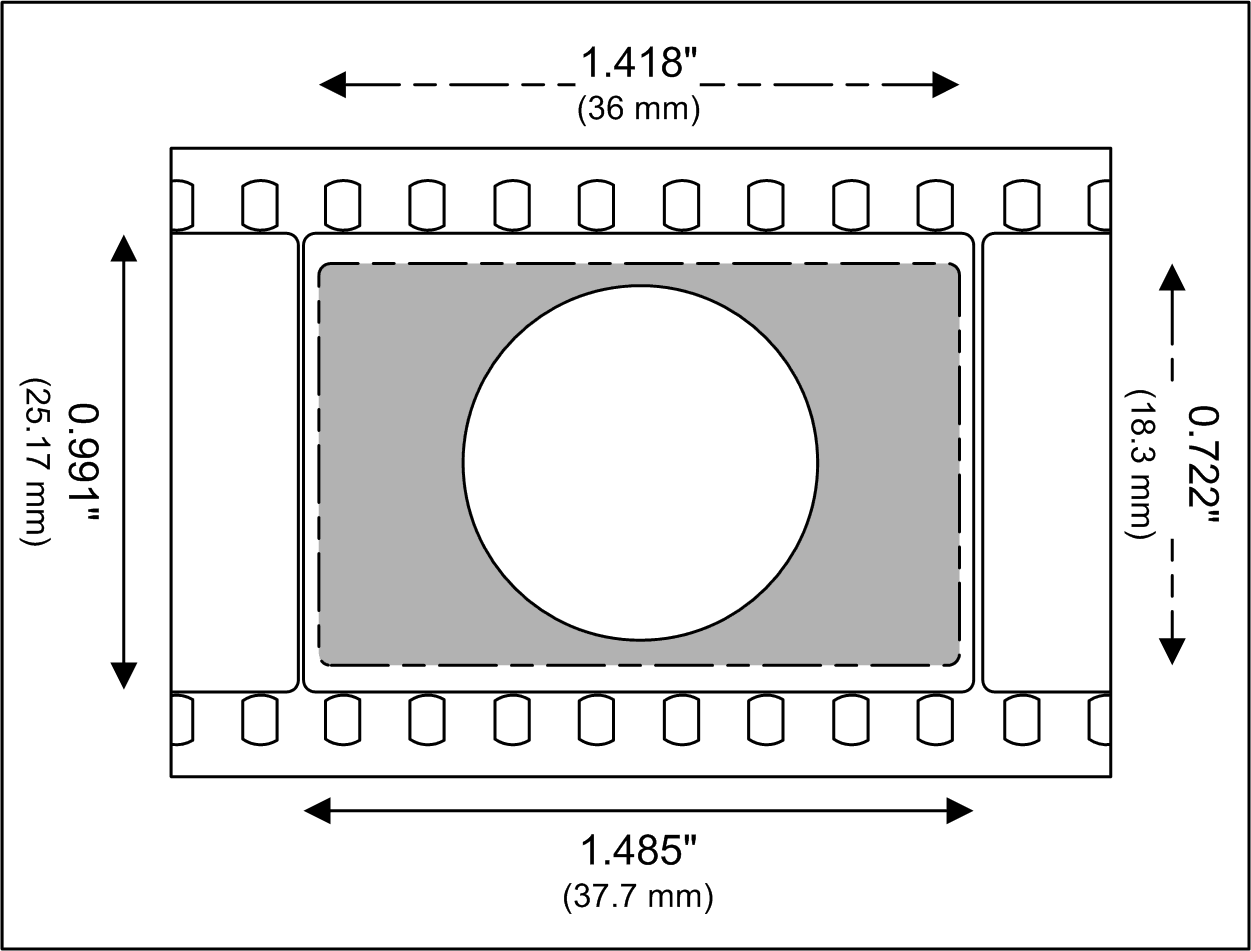
With the Brevis I'm able to get a VistaVision-like frame size, which is roughly the same width as 35mm still film and slightly less tall due to the aspect ratio:
VistaVision_8_perf_35_mm_film.png


Marco
 
Lenny, if you were zoomed more on the SG, then the same lens viewed on a Brevis should look wider, no? In other words an 85mm on the Brevis would look like 105mm on the GS (using your variance).

Not to confuse the issue, but one of the results of our extensive (and ongoing) research into the CINEFUSE imaging elements is to ensure full frame performance with all the possible variations of camera and lens out there. With a fast lens, you can expect to exceed the FOV of a 35mm SLR lens on film, particulary when framing 16:9.
 
"Marco, if you are shooting with a 20mm on your adapter anyway, you already have a really deep depth of field don't you?"

No, not exactly. A 20mm lens has more depth of field than a 50mm lens but since depth of field is a function of focal length *and* subject distance, you can get really close to your subject with a 20mm and this will make your depth of field shallow. In a case like that I would need to stop down to f/8 or below to achieve deep focus.


Marco
 
Last edited:
"In other words an 85mm on the Brevis would look like 105mm on the GS (using your variance)"

You are both right. I think what he meant is that an 85mm lens on the Brevis and a 65mm lens on the SGpro produce an identical image due to the different frame sizes.


Marco
 
Sorry, haven't been confused once in this thread.

You're correct in pointing out that the Brevis doesn't match the field of view of a movie frame. While you say "it shouldn't", I say it should; anything else is incorrect. It's a 35mm adapter, right? Now, if Cinevate wants to market it as a VistaVision adapter, then the idea of using all 36x24 makes sense. But when you use larger than 22x18 you're not emulating the look of a 35mm movie camera -- which is, I believe, the goal of what most people are trying to accomplish when using a 35mm adapter.

As I said before, a 35mm still camera will show a wider field of view. That's what you've demonstrated, because the Brevis more closely emulates a 35mm still camera, not a 35mm movie camera. Put that same lens on a movie camera and you'll see that everything I said was spot-on.
 
Barry, we fully support both 35mm still and 35mm motion frame sizes. I suspect that if we did otherwise, folks would complain about zoom factors and the like. When used with a PL or OCT19 mount, the adapter does not have a zoom factor. The same is true for 35mm SLR image sizes. DOF gets potentially shallower as the film plane increases in size..so why not use the largest one possible for that format? I was drawn to designing an adapter actually based on my own love for SLR film portraiture. To me, it represented an opportunity for 24 portraits per second :-)

For Marco to spend $$ on a fast SLR format 20mm and then functionaly limit that lens to 35mm or 40mm would get us into some bad press. I'd go a step further and say that if you have a given image cone to work with, why not push the envelope a bit with respect to horizontal FOV so that 20mm can used a bit more like an 18mm if desired? The only reason industry limits SLR image size to 36mm wide is that the SLR image cone spec. is designed to cover the 24x36mm frame. Being that most are shooting 16:9 framing, we can slightly widen the image frame beyond 36mm without exceeding the boundaries of the image cone. It is true that building in zoom factor will hide an adapter's issues with edge falloff and/or vignetting, but this comes at a significant loss in horizontal FOV. It may also hide a lens' edge softness at open apertures, but I'd rather see a lens stopped down a few stops, than cut FOV.

I'd throw out the example of the Still-motion.ca crew doing wedding work, both stills and video, using several Brevis adapters and the XH-A1. They leverage a large investment in fast EOS glass for use with both the still photographers and videographers on a shoot. When then throw a 28mm lens on, they know their FOV will be as good or greater than the same lens on a full frame EOS camera body.
 
Sorry, I shouldn't have said you "don't" support it -- obviously you do, by just zooming in to the proper frame size.

For Marco to spend $$ on a fast SLR format 20mm and then functionaly limit that lens to 35mm or 40mm would get us into some bad press.
See, this is the part I have a problem with. Bad press? For being accurate? I have to reject the premise of the statement here. Let's turn it around another way:

If a professional movie cinematographer was hired for his first job with a Brevis, and the producer said "what lenses do you think you'll need", then that cinematographer might reasonably assume that hey, 35mm adapter = 35mm field of view, right? So he'd say "just a standard complement, get me an 18mm, 25mm, 35mm, 50mm and 85mm." Well, using the 36x24 frame size, he's going to find out that he's got ridiculously wide angles and no telephoto to speak of at all! The field of view wouldn't match what he's come to expect, what his decades of experience have taught him... and he's gonna be rather ticked off. He'll probably go on CML and spread some bad press there.

I guess it's all down to a matter of perspective. The mini35, which heretofore has been the "gold standard", does the job of emulating a 35mm movie camera field of view. It's a professional tool designed for pros who know what they're doing and know what to expect. The MovieTube does the same thing. It's what I, and any other 35mm film shooter, expect. So this notion of "let's make the ground glass way bigger and not emulate 35mm movie shooting at all" idea is just foreign to me, and counterproductive. No wonder we get posts in the forum saying "how come this adapter footage always has super-hyper-shallow depth of field and doesn't look like a movie?"

For pros, precision counts. For those who haven't shot 35mm film and have no idea what the field of view is supposed to be (for a movie camera), I guess it doesn't matter.

So again, if you want to take advantage of the larger frame size, I'd almost suggest you market it as a VistaVision/65mm adapter too. When zoomed out so that the full screen is using 36x24, you get VistaVision/65mm field of view and depth of field. When zoomed in so that the full screen is 22x18, you get 35mm field of view and 35mm depth of field. Do some testing and figure out what the appropriate zoom settings should be for each camera and publish those.

Otherwise, the "wider at all costs" idea just does a disservice to any shooter who knows intuitively what a given lens looks like on a movie camera.

Does that make more sense?
 
Barry, when i receive my letus extreme, is there a way know exactly how far one should be zoomed in on the GG to produce this correct field of view?
 
Back
Top