Amiga - the little computer that could

  • Thread starter Thread starter DC
  • Start date Start date
Ming said:
I've still got my Amiga 1200- is it worth anything?
Definitely. Since those systems/components are becoming increasingly rarer, the values are starting to go up.

What are the specs?
 
AmigaOS 4

By Jeremy Reimer


Sunday, January 21, 2007
An exercise in computing, not nostalgia

The Amiga computer has long been the subject of intense nostalgia in the hearts of anyone who owned one. Released in 1985, only a year after the original Macintosh, the Amiga featured vivid color graphics, 4-channel stereo sampled sound, and a graphical, preemptive multitasking operating system that seemed to come from years in the future. Yet the Amiga languished in obscurity, meriting barely a footnote in most books on the history of the personal computer. In the story that arose of the battle between Bill Gates and Steve Jobs for domination of the computing universe, there was seemingly no room for a third protagonist.


Despite this neglect from the popular press, the Amiga prospered. Its excellent graphics and sound made it the best platform for gaming in the late 80s. Later, when improved, expandable versions of the Amiga were released (such as the redoubtable 3000), the platform found a niche in the burgeoning field of digital video. NewTek's Video Toaster replaced hundreds of thousands of dollars worth of custom video editing equipment with a $5,000 box and opened up the field to a new generation of professionals, much as the Macintosh did with desktop publishing.


However, the platform was owned by one of the most dysfunctional and poorly-managed companies the world had ever seen. Commodore International's upper management, put in place after a power struggle that wrested control of the company away from its original founder, Jack Tramiel, were ridiculously (and some would say maliciously) incompetent. The new management cancelled popular products, replaced them with inferior ones, axed the research and development budget, and basically ran the company into the ground. Commodore declared bankruptcy in 1994.


What followed was a saga of twists and turns too complex to relate here. Many companies made attempts to revive the Amiga, and for a while there was a significant market for processor upgrades and other enhancements for existing Amiga computers. However, there were no companies—not even Gateway, the final and current owner of Commodore's old assets—that managed to come out with a new Amiga computer and operating system. This finally changed in 2002, with the release of the AmigaOne PowerPC-based motherboards from a UK company called Eyetech.


The AmigaOne motherboards were ready, but the operating system wasn't, so they came bundled with Linux instead. By the time a second batch of motherboards were ready (the Micro AmigaOnes, in a 15cm square MiniITX form factor) the OS had been delivered in beta form, and I wrote a review for Ars on the combination of AmigaOne hardware and OS4 Prerelease Update 1.


os4_microa1.jpg

My Micro AmigaOne, in its compact MiniITX case.


Now, Hyperion Entertainment, Inc., developers of the new AmigaOS 4 operating system, have announced that the final release version is available for download from their web site. The operating system is a free upgrade for registered users of any of the prerelease versions of OS4, which were bundled with every AmigaOne motherboard and assembled computer sold.

Installation

The operating system comes in an 46MB downloadable archive that expands to an .ISO file suitable for burning to CD-R. The resulting CD is viewable under any operating system, and contains installation instructions in HTML format that can be copied to another computer and viewed or printed out at leisure—the instructions can also be viewed directly from the CD during the installation process.


To install the OS, the CD is placed in the drive of an AmigaOne computer and booted—the AmigaOne uses its own BIOS that is based on a heavily-modified open-source project called UBoot—and it is easy to use the menus to select CD booting.


The CD boots quickly, and the user is presented with some basic options such as country, keyboard type, and time zone. For installation on a blank hard drive, a new partition must be created with Media Toolbox, the graphical partition manager. The procedure is not difficult as long as one follows the instructions closely. The only tricky bit is the requirement to install a second-level booter file from the CD—it would be nice if this was done automatically.
After this step, all that is left is to wait for the installer to copy over the operating system's files, which takes about 30 minutes depending on the speed of the hard drive. Once installation is complete the user takes the CD out of the drive and reboots the system.
The operating system and its unique features


The default OS4 desktop


The new version of OS4 features many changes, both subtle and significant. The OS sports a more polished look, thanks to a new set of icons: everything from the drawer (folder) icons to the RAM disk has a shiny, polished appearance.
AmigaOS handles task-switching slightly differently than most OSes. Almost every application has the ability to open not on the main user interface screen (called Workbench) but in its own full-screen graphics mode, in much the same way as games open a separate screen when they are normally run. The user can then quickly switch between all running full-screen applications by pressing Left Amiga-M (the left Amiga key from the traditional Amiga keyboard is mapped to the left Windows key on PC keyboards). Switching is instantaneous (barring delays for a CRT monitor to resync to a different resolution) and screens can be dragged up and down (or even left and right, which is a new feature of OS4) to reveal what is running underneath.


On the Workbench itself, windows are manipulated in the usual way, using the title bar to move the window around and dragging the bottom right corner to resize. On the upper left is the close widget, wisely placed far away from any other widgets to prevent accidental clicking. On the right hand side, however, the features are somewhat different. The Iconify button minimizes the window to a single icon on the desktop. The window-stacking button pushes the window below other windows, like putting a piece of paper underneath other papers. Windows that are already underneath other windows when clicked will come up to the front. Windows can be selected and moved around while still underneath other windows, which can be handy in some situations. Anyone who has worked with layers in Photoshop will pick up the idea quickly.
The final OS release adds some new widgets to the default set, which enable even more window functionality for all programs that use the Magic User Interface (MUI) libraries, a popular set of GUI development libraries that have been integrated into the OS. The new widgets offer more options for window menus, either off (by default, an application's menus are activated by a right click), in the traditional place at the top of a window below the titlebar, or on the bottom, left, or right of the window. Other widgets include a window refresh button and a button to move a window to a different screen.


AmigaOS comes with a scripting language known as AREXX, and most applications understand and can integrate with it to extend their functionality and hook together with other apps. REXX was invented by IBM and was included in later versions of their OS/2 operating system, but the Amiga version has a number of enhancements.


A minor feature of AmigaOS but a neat one is that each file has a "comments" field in addition to its common attributes such as size and file type. The user or the application can set the comments field for any file—the web browser AWeb handily adds the full URL for any file downloaded over the Internet, so the source is easy to find again.


Changes from the previous updates

New features since Update 1

Many aspects of OS4 have changed since my last review. Most significant is the addition of a JIT compiler, called Petunia, to the 68k processor emulator for classic Amiga programs. When running programs written for a 68000 or 68020, this provides an significantly faster (on the order of five or six times or even more) emulation of the processor. If you combine the fast CPU emulation with the fact that all API calls, display drivers, OS functions, and even some libraries are PPC native, it makes "emulating" old Amiga applications seem almost as fast as running fully native apps. For example, the MP3 player AmigaAMP is a 68k application, but upgrading to the PowerPC decoding engine is as easy as dragging and dropping the mpega.library file to Libs:. Once this is done it is nearly impossible to tell the difference between this and a fully native application.


Also a welcome feature are 3D display drivers. Classic Amigas with third-party graphics cards used special 3D libraries to make use of their advanced graphics features. OS4 now supports Warp3D, one of the more popular of those libraries.

New features since the last update (Update 4)

There are a few small, but welcome updates with this final release of OS4. Mousewheel support is now nearly universal amongst all applications, both native and emulated. New device drivers are available for the ITE IT8212 IDE and SCSI 53C8xx controllers, as well as a floppy drive for those who still have files on 3.5" disks. Applications that used the old "HAM" modes of the classic Amiga chipset to get high color depths are now supported by the 24-bit modes of the operating system. The file system has been upgraded to 64-bit in order to support file sizes larger than 2GB, important when burning DVD images (the OS has native support for DVD-RW, which is handy when backing up). The JIT compiler for emulating classic 68k Amiga applications has also been improved, and is significantly faster in this release.

Hyperion's biggest change since Update 4 has been the integration of a new memory system, which increases speed significantly and also adds limited forms of memory protection.

The original AmigaOS was designed for the 68000 chip, which had no memory management unit (MMU), and so like the original MacOS it had no memory protection (unlike the original MacOS, however, it had preemptive multitasking and automatic memory allocation for all applications). Applications were able to access any part of memory they liked, which led to an extremely fast system but one that was susceptible to instability from buggy programs.

With Update 4, Hyperion has changed the memory system somewhat from the old model, using the MMU to add a limited amount of memory protection for parts of applications. In addition, the new memory pool model reduces RAM fragmentation and speeds up most operations twentyfold. For an operating system that was already fast, this brings things up to ludicrous speed.

Adding full memory protection would break too many existing Amiga applications, a problem Apple faced with their doomed Copland and Gershwin projects. Eventually Apple gave up on the idea of bringing old applications into a new environment, and scrapped Copland in favor of the brute force solution: launching an entire copy of the Classic OS in a virtual machine. Hyperion decided against such a solution for AmigaOS 4, although rumors are that AmigaOS 5 will use such a system. This was probably the best choice, given that many Classic Amiga programs are no longer under active development and cannot easily be recompiled for a new operating system.

Many small tweaks and fine-tuning have taken place throughout the operating system. For example, the old OS had both "Tools" and "Utilities" folders which were an artifact from much earlier Classic Amiga versions. They have since been merged into a single "Utilities" drawer.
 
Last edited:
Applications: online

An operating system is useless without applications. The finest, most exciting OS in the world would be nothing more than a novelty without applications to run under it.

Fortunately, between classic Amiga applications and native, PowerPC-compiled programs, OS4 has applications available in all major categories.

Surfing the web


Web browsing is one of the most important applications of any operating environment these days, and the Amiga is no exception. Unfortunately, at the moment the available web browsers for OS4 are still lacking some important features, the most notable being CSS support. Surfing the web without CSS makes most sites look a little funny, but it does not prevent access to any content.

Fortunately, multiple efforts are under way to fix this problem. The developers of AWeb, the open-sourced PowerPC-native web browser, are working on porting the KHTML rendering engine to work with that browser, much as Apple did when originally developing Safari. The long-standing bounty to port Mozilla/Firefox to AmigaOS is still active, although one of the developers of OS 4 believes that it will be easier to wait until Firefox 3 is released before porting, as that version will have a redesigned cross-platform imaging engine. Lastly, IBrowse 3.0 is under development, which will be fully PowerPC native and support CSS. IBrowse 2.4 was recently released, just in time for bundling with the final version of OS4, and it includes many updates to fix JavaScript issues with certain sites. I have found that with a combination of IBrowse and AWeb I can view most web sites, including the content management systems needed to post stories to Ars Technica.


AWeb surfing the community portal AmigaWorld.net

E-mail


E-mail has always been something the Amiga does well—some of my friends at my Amiga user group who have largely moved to PCs still keep an Amiga around to handle e-mail messages.

A popular classic application is YAM, which stands for Yet Another Mailer. It runs fine on OS4, although lacks some modern features such as HTML support.

SimpleMail is compact yet has plenty of features The fully PPC-native SimpleMail is a tiny application (around 400KB) yet has all the features one would expect from an e-mail program, including HTML message support, multiple account handling, and even a spam filter.

Internet Relay Chat (IRC)


The classic AmiIRC served most Amiga IRC users well for many years, but when development languished the community called out for an alternative. Coming to the rescue was one James Carroll, who started development of an OS4 native client amusingly called WookieChat.


os4_wookie.png

The legendary WookieChat

The Wookie, as its fans call it, started out as quite a minimalist client, but James kept on updating it, and today it is one of the most full-featured clients on any platform. A simple text-based scripting system allows a Wookie user to automatically connect to all servers and channels, including any required nickname registration confirmations, every time the program starts up. Not only can typed URLs be double-clicked on to open in the browser of one's choice, but WookieChat keeps a log of all URLs typed in that channel that can be browsed at the user's leisure.

The program has so many nice little touches that it has become my IRC client of choice, replacing mIRC on Windows. The program is free but James, who goes by the IRC nickname of jahc, asks that people who like using the program send a small donation to him via PayPal. New versions come out all the time—I still haven't upgraded to the latest beta yet.

Instant messaging


In the instant messaging world, there are two major options: the free classic program Jabberwocky, which connects to multiple services (MSN, Yahoo, AIM, and ICQ) via gateways through the Jabber network, and the brand new multiclient program Epistula, which is available for OS4 only. Jabberwocky is more of a workhorse, with few of the fancy features like emoticons and other visual goodies that characterize modern IM clients. Epistula has lots of features, but is still very new and some features are still not yet implemented or working correctly.


One nice feature (or lack thereof) of all these IM clients is their lack of advertising. Jabber servers, for example, are operated for free by IM enthusiasts (often, they have web-based portals as well).


os4_epistula.png

Epistula multi-client messenger. Some names have been blurred to protect the guilty

Applications: productivity and desktop


Word processing


Word processing is a key component of any computing experience and, along with the spreadsheet, was one of the personal computer's first genuine killer apps. The Amiga has had graphical word processors for longer than Windows, and some of them survive to this day.


AmigaWriter.

AmigaWriter, sold by Alinea Computer, is the most up-to-date word processor of the bunch. It allows direct importing of Microsoft Word files, supports footnotes and endnotes, and has a spell checker. The program works quite similarly to Adobe Framemaker in that catalogs (styles) of text and paragraph formats can be quickly accessed, applied to areas of text, and imported into new documents.


FinalWriter 97


Another Amiga favorite is Final Writer 97. As its name implies, it has not been updated for nearly a decade, yet it has all the features that one would expect in a word processor, including word count, spell checker, grammar checker, style sheets, document comparison features, and even a readability index (it's always yelling at me about overuse of the passive voice). I had problems getting Final Writer to install on my original version of OS 4 (Update 1), but it turned out the problem was a UBoot printer setting that was easily fixed. The new memory protection features of OS 4 Final caused problems with FinalWriter, but a patch is already available to trick the program into behaving properly. Sadly, the makers of Final Writer, Softwood, went bankrupt some time ago, and the whereabouts of the source code to their products (including both Final Writer and the spreadsheet Final Calc) is still unknown.


A new office suite that includes a powerful word processor is the cross-platform Papyrus Office package, which was recently released in an Amiga version. It reportedly runs fine on OS 4 but I was not able to obtain a copy for review.
Graphics

There were many graphics packages available for the Amiga, as it was a popular platform for digital imaging, both 2D and 3D. Despite the popularity of Photoshop on the Macintosh and later Windows, most made no attempt to mimic that program's user interface, preferring to go their own way.


Photogenics 5


One such package is Photogenics, written by Paul Nolan. I tested version 5, and found it to be an interesting merging of Photoshop and natural-materials drawing programs such as Fractal Design Painter. The program supports layers, alpha channels, and multiple undos, making it easy and fun to play around with.


The most fun to be had, however, is with the special filters, such as the starburst effect, or the too that acts like a virtual finger, smudging the image underneath it. Like Photoshop, it includes a handy Save For Web feature that optimizes the files for the Internet and provides estimations of download time for various speeds of connection.
Desktop publishing


PageStream 3 desktop publishing package


While the Macintosh led the way in the desktop publishing revolution, the Amiga had plenty of capable DTP applications of its own. One of the best actually started life out on the Atari ST platform, but really came into its own on the Amiga. PageStream, originally released under the name Publishing Partner, has evolved over many years to become a powerful DTP package, even rivaling industry stalwarts like QuarkXPress in terms of features.


I tested out an older version, 3.0, and it worked well under OS 4. Version 4.1 is currently the latest release available in an AmigaOS version, but the latest release, 5.0, is currently in beta testing—with both a classic Amiga version and a fully PPC native OS 4 release nearing completion.


PageStream 5's big claim to fame is that it allows the user to open, edit, and save PDF files directly without having to import or export to that format, an extremely handy feature. It has some other nifty features such as the ability to insert text boxes anywhere on the page by simply typing in text.
Media player

os4_dvplayer.png

DVplayer for OS4.


OS4 Final comes bundled with a copy of DVPlayer, a native OS4 media player program based on open-source code. DVPlayer supports direct playing of DVDs, and plays video files compressed with MPEG 1, MPEG 2, VideoCD, DivX, XVID, Cinepak, Indeo Video, PCM, and MPEG Audio (Layer1-3) codecs. DVPlayer supports overlay and triple-buffering on OS4 Final.


Other media players include the aforementioned AmigaAMP, a clone of WinAMP that plays MP3 files. While still a 680x0 program, there is a PPC native MPEG decoder library that gives it native performance.
Text editing


The full version of the GoldEd text editor.


The Amiga has had many great text editors over its history. CygnusED was a favorite of many with its blistering speed and extensibility through AREXX. It absolutely flies through all kinds of operations such as mass search and replace. It is available in a Classic Amiga version, and a native PPC version made specifically made for OS4 is now available as well.


My personal favorite is an editor called GoldED, which has been around for some time and is now offered as part of the Cubic IDE software development package for AmigaOS. The editor is a Classic Amiga application, but you'd never guess it based on the speed at which it flies through common tasks. The editor is available for free in a basic version, but the commercial version has all kinds of extra goodies, including syntax highlighting, HTML tag buttons (which makes it a very good HTML editor) and other enhancements.
Miscellaneous

There are many other small utilities and useful little applications available for the Amiga and OS4. WarpView is a small, but high-tech image viewer that uses OS4's 3D libraries to display pictures that can rotate around in space and zoom in and out smoothly. AmiPDF is an excellent and fast PDF reader that is bundled with the operating system.


This review would not be complete without a mention of the greatest third-party application of all time, which I will refer to only by its initials: TFB. It provides a big red pushable button and hours of mindless entertainment.

Available hardware


As discussed earlier, OS4 will only run on AmigaOne motherboards, which are specially customized reference PowerPC designs that use UBoot as a BIOS. Unfortunately, OS4 will not install on any other PowerPC hardware, including older PPC Macintoshes. The OS is sold as a bundle with AmigaOne hardware, much like Apple does with OS X, and Amiga, Inc. wants to limit the operating system to licensed hardware only.

This would not be such a big deal, except that the single company that produced AmigaOne motherboards and systems in the past, UK's Eyetech, has ceased production of the systems. So for the moment, one cannot buy new AmigaOne hardware anywhere. The whole situation is reminiscent of the South Park episode where Cartman buys out a theme park and then advertises how great it is and how nobody else can come.

Fortunately, there is no shortage of people who are attempting to bring out new AmigaOne hardware in the new year. Hyperion has stated that they expect new hardware to be available soon, and I certainly hope that their promises prove to be accurate.

Many people have argued that Amiga, Inc. should abandon the PowerPC idea and switch to Intel processors and standard PC motherboards, as Apple has done. For their part, Hyperion states that they do not currently own the rights to port AmigaOS 4 to the x86 platform, but will not comment further on the subject. While I really like my Micro AmigaOne for its tiny size and low electrical power requirements, I would absolutely love to run this OS on the fastest and most readily available hardware I could get my hands on.

Still, the PowerPC does have some advantages going for it. Since all the early Amiga hardware accelerators were PPC-based, there is a wide library of classic programs that already take advantage of the more modern processor. In addition, as the PPC moves even more into the embedded space, Freescale is developing "systems-on-a-chip" that combine the CPU, the memory controller, and even things like Ethernet connectivity on a single die. This presents opportunities for ultra-small computing that OS 4 can take advantage of, such as PDAs and cell phones. Of course, it makes a great desktop operating system as well.
 
Last edited:
Conclusions

The release of AmigaOS 4 proves one thing: you can't keep a good platform down.

But is AmigaOS merely a fun hobby OS to play around with, or does it offer real value? My answer is that it is a little of both. As a fan of alternative platforms, you won't find many that are more esoteric than AmigaOS. But beyond being different for the sake of being different, OS4 provides something more interesting: a chance to experience a whole new way of computing.

Because the OS and its applications take up so few resources, it is possible to run an entire suite of programs—my typical usage is ten or so pages up in a browser, an IRC client, an MSN client, a text editor, a command shell, a 2D graphics editor, an e-mail client, a word processor, and a media player—and still have all these elements fit in a mere 256MB of RAM. Because the system never pages out to disk, switching between these applications is instantaneous: I cannot physically hit the Amiga-M switching keys faster than the OS can respond. This is a marvellously enjoyable way to work: you are never waiting on the hard drive or the operating system when you switch from one task to another.


Of course, there are many things that OS 4 can't do very well at this point in time. The biggest drawback is the lack of a CSS-compatible web browser, although this issue is being worked on and will hopefully be rectified soon. There are other gaps in the Amiga's software lineup, most notably video editing, which is a shame as the Amiga originally jump-started the digital video industry.
In my original review of the OS 4 beta and AmigaOne hardware, I compared the OS to riding around in Half-Life 2's dune buggy: intense fun, but one has to be prepared to flip over quite a bit. Well, with the final release of OS4, imagine that the dune buggy has been finely tuned so that it hardly flips over at all any more. It's still just as much fun, but now the OS is useful for actual work.

As an experiment to see if it was possible, I switched over my daily writing workflow—which involves editing HTML, discussing stories in IRC and MSN, using FTP to put draft copies on a server, editing and resizing graphics, and using the web-based content management system—from a Windows XP box over to AmigaOS 4 on my AmigaOne. Not only was it possible to do this, but having done so I feel no urge to switch back. It is nice to not have any distractions when working—there is no waiting for the system to swap out when switching between major applications, no constant reminders for updates or to download new virus definitions (there are no viruses or malware available for OS4, and unlikely to ever be) and even if the worst happens and the system locks up, it takes only seven seconds to reboot and get back to a functional desktop. It's definitely a different way of working, and it can be quite an intoxicating one.


Still, all this fun is a completely moot point if there is no new hardware available to run OS4 on. While I like my Micro AmigaOne, and am considering getting one of the new processor upgrade cards for it at some point, I would very much like to run the OS on newer and faster hardware. While a port to x86 processors would be nice, I don't think it is all that necessary. As long as PPC hardware is available, it is still probably the best choice for new Amigas. With the OS just having completed its transition to PPC, it is a little too early for an Intel switch, although I can see such a thing happening a few years down the road.

As a fan of operating systems in general, I never hesitate to try out new platforms and OSes. I've tried every version of Windows, and most versions of the Classic MacOS and OS X, and for historical reasons sampled both OpenStep and Rhapsody. I've tried countless distributions of Linux over the years, and am quite impressed with the latest Ubuntu release. I've played with BeOS (now Zeta, which I reviewed) and QNX and many other small niche operating systems. All of them have their own unique features and positives.


However, in all these years, there has been only one operating system that has captured my heart. While I missed the glory days of the Amiga in the late 80s and early 90s, and was only introduced to the platform a couple of years ago, I can see why its diehard fans have held on to the OS despite having to wait so long for a new version to be released. Call me crazy, but I'm an Amigan now, and will be as long as I can. This OS has struggled past incredible obstacles—both financial and psychological—just to exist, but I'm already anxiously awaiting its successor.
 
Last edited:
great news, i can´t wait to run amiga os again. after so many years i´m still love the plataform, it was my first computer in the old days, toaster and lightwave where terrific tools back in the early 90´s.
thanks for the info.
 
Pagestream is still kicking? Wow, that's impressive. Did my first DTP with that. Used it and Final Writer all through college.
 
tommyinla said:
Hey DC, does the AmigaOne have PCI slots?
Yes, they sure do.
http://en.wikipedia.org/wiki/AmigaOne


tommyinla said:
I'm wondering how to get an ethernet adapter into my Meega...
At this stage of the game, I would go about it like this (assuming I decided not to towerize my A3000):

Install an X-Surf in an open Zorro slot.
http://amigakit.leamancomputing.com/catalog/product_info.php?cPath=32&products_id=250&osCsid=aac6ce4bc1c4d30821b73b16545fc3d7

---

OR you can go the PCI route (however, I'd highly recommend towerizing your Miggy for this):


1. Install a Prometheus PCI Busboard
http://amigakit.leamancomputing.com/catalog/product_info.php?cPath=51&products_id=200&osCsid=aac6ce4bc1c4d30821b73b16545fc3d7

THEN

2. Install an "approved" Ethernet card.
The prm-rtl8029.device driver should work with all RealTek RTL8029 compatible PCI network cards.

Tested network cards (though others might work):

Genius GE2500-III SE
D-Link DRN-32CT
Wisecom WS-R320CT
Edimax 5200PXA
(all have the RTL8029/RTL8029AS chipset)


OR


1. Definitely towerize and install a Mediator PCI Busboard
http://amigakit.leamancomputing.com/catalog/product_info.php?cPath=35&products_id=518&osCsid=aac6ce4bc1c4d30821b73b16545fc3d7


2. Add 10/100 Ethernet Network Card
http://amigakit.leamancomputing.com/catalog/product_info.php?cPath=32&products_id=63&osCsid=aac6ce4bc1c4d30821b73b16545fc3d7
 
New Southern California Amiga and PPC User Group Announced!
Sunday May 06, 2007

Magnetic Systems, a long time Amiga dealer, is pleased to announce the forming of a New Amiga User Group! The Southern California Amiga and PowerPC User Group. (SCAPUG) This group is devoted to support of Classic Amigas, Next Gen PPC Amigas like Pegasos and Amiga 1, as well as Linux PPC users! We have a fantastic location for meetings which is the Santa Monica Public Library..

Santa Monica Public Library

It;s a lovely 7 million dollar facility, newly built and right by the ocean! We will rent on of the professional meeting rooms for the event, for a special price of $50. this includes a professional presentation system with projector and audio, as well as a white board and excellent seating.. The costs will come out of member dues. there is also a very nice outdoor cafe on the grounds with great food at good prices. Our meetings will be the first Saturday of the month starting in June.

All users are welcome and there will be much fun and help for new Amiga people as well as old! We will focus on demos of Amiga hardware and software with tutorials and upgrade/repair sessions. This is a must attend for all Amiga and PPC fanatics. No red blue nonsense, so OS4, Morphos, Classic, Linux PPC users all welcome! We will do demos of morphos, Os4, old school Amiga, Ubuntu PPC, Gentoo and more!

Please PM me and/or reply on this thread to show interest in this group, questions, or membership details. It is easily reached via the Pacific Coast highway and I-10. Perfect for users in the Los Angeles/San Diego region. Cant wait to see you there.

Long Live Amiga.

http://amigaworld.net/modules/news/article.php?storyid=3751
 
New Hardware Designs and New Hardware Coming from ACK Software Controls, Inc. and Amiga, Inc.

Two New Hardware Designs for the Amiga Operating System are on their way.

Issaquah, Wash and Fonthill, ON – April 22, – After months of designs and negotiations Amiga, Inc. and ACK Software Controls, Inc. are pleased to announce that new hardware is on its way for Amiga users.

“I have been working on these designs with Amiga for almost 12 months and have been able to create two new designs that will fully support the needs and desires of today’s Amiga user, while opening the doors for new users," said Adam Kowalczyk President of ACK Software Controls, Inc.

Initially, two systems will be produced that address two different market needs. The first is a consumer entry design that will offer a complete product with a target price point of $500.00, while the second will be of a power design that would have a target price point of $ 1,500.00. The PowerPC architecture will continue to be the architecture of choice for these new systems.

“ACK and Amiga have spent many months working on designs and working with various manufacturers to create great products with a competitive price point. We will be working with the Amiga retailers over the coming weeks to solidify launch and support plans”, said Bill McEwen of Amiga, Inc.

Manufacturing and final price information along with product launch schedules will be following in the next week.


----------------

Entry Level Design Details from ACK Controls and Amiga
Entry level product ready for Customers Summer 2007

Issaquah, Wash USA – Fonthill, ON Canada April 29, 2007 – ACK Controls and Amiga, Inc. are pleased to announce the base hardware design that will address the needs of the Amiga market as well offering expansion into other markets.

“The first product release is designed for flexibility and meeting the needs of the Amiga user, as well as offer a design that takes advantage of available hardware”, said Adam Kowalczyk President of ACK Systems


This new system will be offered at a suggested retail price of $ 489.00 and be a complete offering excluding monitor in a finished design that will provide customers with everything they need to get started.
  • Flex-ATX form factor motherboard based on the Freescale MPC8349E SoC. (400MHz to 667MHz depending on requirements and price target)
  • 1 (one) DDR2 DIMM slot expandable to 1GB using unregistered DIMMs.
  • 1 (one) 66MHz PCI slot for use with readily available graphics cards.
  • 2 (two) 33MHz PCI slots for additional expansion.
  • 2 (two) 10/100/1Gb Ethernet Ports.
  • 4 (four) Hi Speed USB ports.
  • 2 (two) serial ports.
  • 4 (four) SATA ports provided by a Silicon Image Sil3114 controller.
  • Onboard sound provided by a C-Media CMI8738.
  • Socketed EEPROM for U-Boot firmware.
  • Atmel ATC2408A serial EEPROM (1kb of non-volatile storage)
  • Dallas DS1339 RTC with battery holder.
  • Standard ATX power supply connector.
“Amiga is please to be working with ACK Controls and believe that by using flexible designs and aggressive manufacturing practices we will be able to deliver to our customers a great product at a great price”, said Bill McEwen of Amiga, Inc.

Manufacturing partner and final ship schedule will be following soon.


--------------

Power System Design Details

Issaquah, Wash USA – Fonthill, ON Canada May 7, 2007 – ACK Software Controls, Inc. and Amiga, Inc. are pleased to announce the specifications for the new Power System.


“While targeting the needs of today, we wanted to challenge ourselves to design for the future as well.”, said Adam Kowalczyk President of ACK Software Controls, Inc.

This new system will be offered at a suggested retail price of $ 1498.00 and be a complete offering excluding monitor in a finished design that will provide customers with everything they need to get started.

Power Design Specifications PowerPC board:

• Based on the P.A. Semi PWRficient PA6T-1682M dual core 64 bit CPUs clocked at 2GHz.
• RoHS compliant ATX form factor.
• Four (4) DDR2 DIMM slots.
• One (1) PCI Express x16 slot for high performance graphics cards.
• One (1) PCI Express x2 slot for high performance I/O cards.
• One (1) PCI Express x1 slot for standard I/O cards.
• One (1) PCI 32 bit slot for legacy cards.
• Six (6) USB 2.0 ports.
• Two (2) Gb Ethernet ports.
• Two (2) UART ports for serial connectivity and debug.
• One 8Mb Flash EEPROM containing U-Boot firmware.
• Four (4) SATA II ports based on the Silicon Image SiI3132 (x2)

“This new design offers the Amiga user a new choice in hardware. Amiga believes that this new system will address the needs of the Amiga user today and into the near future.”, said Bill McEwen of Amiga, Inc.

About Amiga

Amiga, Inc. is the world’s premier provider of multimedia enabling technologies. For almost two decades its award-winning software has been a mainstay for motion picture studios, multimedia creators, and digital entertainment enthusiasts around the world. Today Amiga builds on this legacy leading the way in multimedia development by providing developers with hardware-independent technologies for writing and porting applications to new platforms and interactive devices. For more information visit www.amiga.com.

About ACK

ACK Software Controls, Inc. specializes in the area of embedded controls design for use in automation systems where low-power consumption and reliability is an absolute must. Concentrating on design for manufacturing with local manufacturing facilities has allowed ACK to quickly and cost-effectively develop solutions for customers with low-volume requirements. By integrating hardware, firmware, and device driver engineering capability in-house, ACK can provide complete turn-key solutions to customers.
 
Last edited:
Ralph Oshiro said:
Amigas are funner than crap! I loved my Amiga and wish I still had it. I had some artificial intelligence software for my Amiga that was probably the most fun I ever had with a computer with both hands on the keyboard. When are the new Amigas and the new OS due to be out?
I don't know what it is about the line "Stop killing young girls" that makes me want to see your film.

-Nate
 
Amiga 1200? What about the original, wasn't it the Amiga 500? Where you had to load the operating system off a floppy disk...

Amiga 1000 was the first, followed by the 500 and the 2000. I had the use of a neighbor's 1000 and my own 500, followed by a 4000, then jumped ship to mac. They were pretty amazing machines for the time, but they fell behind towards the end.
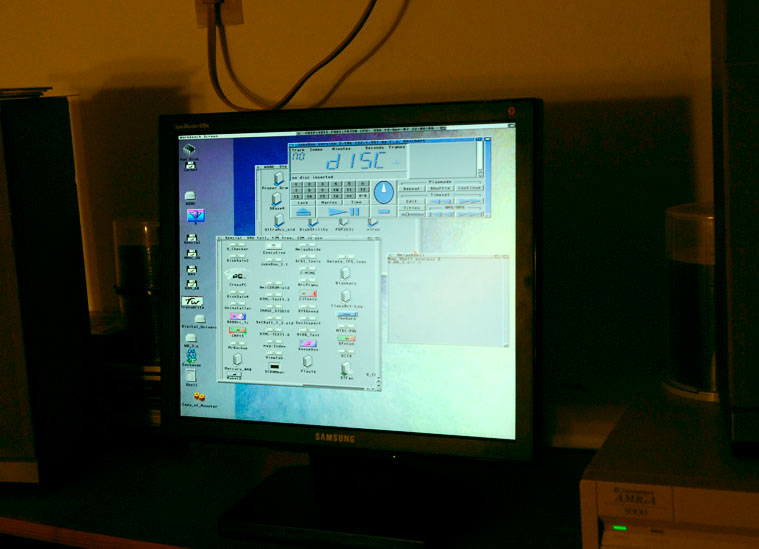
That's essentially correct. Here's a quick history lesson on the models:

http://www.amigahistory.co.uk/comamiga.html


Here's a great history lesson on the people who made it happen:

PART 1:
http://arstechnica.com/articles/culture/a-history-of-the-amiga-part-1.ars/1

PART 2:
http://arstechnica.com/articles/culture/a-history-of-the-amiga-part-2.ars/1

PART 3:
http://arstechnica.com/articles/culture/a-history-of-the-amiga-part-3.ars/1


It's a shame that even to this day, years later, there is still so much infighting and lawsuits over the Amiga brand that so little has developed for the platform. Hardware, no software. Then software, no hardware. And we thought Commodore was bad! The bitter fighting continues . . .
 
An open letter to the Amiga community

An open letter to the Amiga community

[FONT=Verdana, Arial, Helvetica, sans-serif]Amiga Inc[/FONT][FONT=Verdana, Arial, Helvetica, sans-serif] An open letter to the Amiga community[/FONT]
​
[FONT=Verdana, Arial, Helvetica, sans-serif]
10/2/2007
[/FONT] [FONT=Arial, Helvetica, sans-serif]
Over the last several months and in fact couple of years, Amiga has continued our software and business development and generally kept quiet. This path of quietness was chosen so that we communicated only when there was a development that culminated in a product that could be purchased.

In recent weeks, our being quiet has been interpreted as weakness or an open invitation to attempt harming our business relationships and opportunities with partners and customers.

Amiga is dedicated to providing a new operating system and digital environment for the Amiga community and the broader public, and to delivering products and services that are used by a variety of third party consumer electronics companies.

Amiga has never wavered from the path that was laid out and will deliver on that promise.

I am writing this letter to all in the Amiga community, past, present and future. We have learned a great many lessons over these years together. We made many mistakes, and not every partner we selected turned out to be the best or the most ethical. We can certainly point fingers and blame others, but it really does not matter. What matters is that contrary to a great deal of the nonsense that I am reading lately, Amiga at no time has ever abandoned our goals, the Amiga community and our dream. I recently read a post about how OS 4 should power a phone, and somehow this is supposed to be an epiphany that the Amiga OS could power more than a desktop. This has long been part of our core business plan, Amiga entered into and paid for an agreement to develop a pilot of an embedded version of OS 4 in 2005. Amiga lost a deal worth more than 250,000 units because the development was not properly handled. Amiga has been working and negotiating with third party OEM’s and ODM’s for far more units than the iPhone® has shipped and we still are unable to provide the product. The people who are being hurt are the legitimate third party developers who worked hard on OS 4.0, the customers that we are losing and the community.

No one wants to see OS 4.0 shipping more than Amiga does. Amiga tried for more than 3 years to work on and work with the necessary parties to reach that goal. Millions of dollars were offered, and refused, millions of dollars offered to make sure that the third party developers were paid, and yet without the third parties being consulted Amiga efforts are denied and frustrated. With these activities and continued efforts Amiga is the one that is portrayed as being in the wrong by those who are driven by self-interest and who do not care about the best interests of the broader Amiga community. We want to be particularly clear on the following point: Contrary to what has been said in public forums, Amiga has never expected to or tried to take intellectual property rights or money away from the legitimate, independent third party developers who worked (and continue to work) on OS 4.0, In fact, if our last offer had been accepted, these developers would have either been paid by now, or at least would be seeing a revenue stream, and millions of customers would have Amiga running on their systems – whether computers, mobile devices or phones.

In fact, Amiga’s consistent position has been that Amiga would assume all of the legitimate third party contracts and make sure that all legitimate outstanding amounts are paid.

What many of you do not seem to understand is that KMOS (now known as Amiga, Inc.), which acquired the tangible and intangible assets of the Amiga business in 2004, was and is a company with new financial wherewithal and new strengths. We have added people with proven records and they are keeping us focused as a company. We are able to focus our attention on developing products and technology that will drive revenue and our future as a company.

For those of you wanting to point fingers and blame Amiga for the fact that OS 4.0 is not shipping, you are pointing your fingers at the wrong people, and frankly I am not going to sit quietly any longer and let this unfounded criticism continue.

New hardware is indeed being developed, and we have selected the first 3rd party manufacturer that will build in high quantities, and yes, this new hardware is being delayed because OS 4.0 is needed to complete the package and to resolve certain technical issues. As I said before, no one wants OS 4.0 shipping more than Amiga.

The OS 4.0 situation could be resolved very quickly. We have tried. We were forced to take a legal course when the other side would not even mediate (which the contract calls for). This situation can still be resolved without the courts, but it cannot be a one sided solution.

With regard to recent comments about Tao and Intent, the reality is that Amiga does not support Intent and we have not since before Tao was forced into receivership. We have been working on our “AA2” solution for Amiga Anywhere. We wanted to keep quiet about it until the SDK and documentation were completed and made public when it was ready to ship. However, because of recent posts where incorrect statements have been made, we want to let you all know that Amiga Anywhere is not dependent on intent and that the new solution is in the pipeline .

My last point concerns a recent post about another company making offers for Amiga. This is categorically false. A bona fide offer was never received. Amiga received a letter that asked for our financials. In the phone conversation that followed, we explained to the contact at the other company our current valuation based on the last round of funding we had completed, and then gave them the current valuation on the round that is in the process of closing, and we were told that there was no way they could even get close to those numbers.

Amiga is making great strides and technical progress on our products and services, and with the partners and companies that Amiga has amassed not only in the cell phone space, but in other consumer electronics disciplines as well. With the new people who have joined, our recent acquisition in India, Amiga is opening the doors to a long term strategy that the community can support, respect and be proud of.

One of my frustrations lies with the fact that this Amiga team sacrificed a great deal to deliver on our promises. I want to thank the loyal members of the Amiga community for sticking with us through thick and thin.

Bill McEwen
[/FONT]
 
Ooooooh. I wonder my 3000 would still boot after years in my parents' basement. My career in 3D rendering started and ended on the Amiga -- would love to see my "Enterprise Blows Up Cow" animation again.
 
Back
Top