
Navigation
Install the app
How to install the app on iOS
Follow along with the video below to see how to install our site as a web app on your home screen.
Note: This feature may not be available in some browsers.
More options
You are using an out of date browser. It may not display this or other websites correctly.
You should upgrade or use an alternative browser.
You should upgrade or use an alternative browser.
10 most wanted DIY parts for independent filmmakers
- Thread starter Cool Lights
- Start date


Spartacus
Veteran
Still good for you, bro!JasonFox said:I actually have an LCD with s-video in and it's working okay with my DVX. Not very bright though.
I have to use the focusassist, tape measurement and the 17" Sony (well, the sony not on camera of course hehehe)
That´s the point, for SD there´s already a lot to choose from, for HD work there´s the SWIT and the Marshall, well at least in the sub 2K range...
Carlos_E._Martinez
Well-known member
JasonFox said:I actually have an LCD with s-video in and it's working okay with my DVX. Not very bright though.
After my experience with my TVOne LCD screen, which has both composite and S-Video inputs, and noting little difference between them, I think there are S-Video inputs which are not really so.
That is it is not implemented as an Y/C input, but as a composite input.
Whatever it is, my Philips PET1000 monitor, with composite input, has a much better quality image than the TVOne in S-Video.
Last edited:

MattinSTL
Sound Modulator
Cool Lights said:Do they also suck because of the small cell size? Do people prefer a 1" x 1" type or is the 1/2" x 1/2" x 1/2" thick cell size (like home depot type) good too for other uses if they come in black? I'm making egg crates now for sale as an accessory and the 1/2" cell type seems to be very common. You don't see the larger cell sizes on pro fluorescent fixtures that often from the survey I took. In fact the 1" eggcrates are usually always fabric and on a softbox of some kind. Would the 1" cell size be better for a flo?
Here's a post from February from me... regarding eggcrate. Gotta' get credit for my R&D you know! ;-)
MattinSTL said:Even though the Kino stuff is silver it still controls spill better then you'd expect... those eggcrates are parabolic cross-section. A normal fabric eggcrate is simply blocking light at a 90 degree angle... but the DEPTH of a fabric eggcrate is what gives so much control.
The Kino egg crate is made from the same insert you see in an overhead 2x4 office flo light... in a drop ceiling. If you take that thing out you can even see how it's been cut from a larger piece.
The best source for this material is Scientific Lighting Products<click that.
I've experimented with a crap-ton of this material in all types. One thing that you will find about that eggcrate is that it soaks up light... if you flip it over you'll see that you're actually blocking up to about 60% of the actual light transmission.
There is an ultra thin blade aluminum eggcrate that passes much more (I've used it and I like it)... but you really need to double stack it for an effective light spill control. You won't find any eggcrate that's more then about .5" thick (unless you get big square openings then you can get 1" deep)... The stuff comes in straight blade and parabolic so you can still tweek the results.
The best way to cut it is with a good bandsaw that's got a sharp blade... another option would be a really high tooth-count carbide blade in a table saw... but if you do it like that then finger retention is your own responsibility.
Anyway... roam around that site. You can find the exact product that Kino uses there... plus some better alternatives. For the record... a 2x4 piece of the specular silver that Kino uses costs something like $30-40(ish)... and the aluminum bladed stuff is $50+
Still... if you're into DIY then this could be a really cool source for you.
Last edited:

Cool Lights
DVXuser Sponsor
Oh yes, I think I remember that post.
So you like the deeper ones is what I draw from this research you did. The common ones I've found over here are the 1/2 x 1/2 x 1/2" "ultra thin blade aluminum" as you referred to it, but I can get others made too and honeycomb is no problem also. They'll powder coat it any color you like too. I specified black on the ones for my fixtures.
I would think a 1/2 x 1/2 x 1" thick would really block too much light but you've stacked them two deep and feel it to be effective apparently. I think we can also get the parabolic larger cells like kino is using pretty easily too from what i've seen.
Also, I wouldn't discount the 2x4 styrene plastic diffusion material at home depot either. That stuff is great when you want more light transmission but need it smoothed out more for whatever reason. Comes in all types of grades from translucent to practically transparent.
Easy to cut too, just score it and break.

IBEJohnson
Well-known member
Hey guys,
I have a feeling I'm going to get abused for this one, but... can we move this monitor discussion somewhere else? Frankly I don't care what section it's in. DIY? Sure. But it seems to be taking over this thread, and while we agreed that it's relevant, I feel like we're losing focus on everything else we've discussed.
Just my thoughts...
E

j
Veteran
"I'm making egg crates now for sale as an accessory and the 1/2" cell type seems to be very common. You don't see the larger cell sizes on pro fluorescent fixtures that often from the survey I took. In fact the 1" eggcrates are usually always fabric and on a softbox of some kind. "
That seems like the way to go...
-j
That seems like the way to go...
-j
MattinSTL
Sound Modulator
The thin aluminum is the best choice for this type of eggcrate... as I was saying earlier... the plastic parabolic COSTS YOU about 50-60% of your light's output. It's an illusion that the parabolic eggcrate is as open as it appears to be... look at it from the back side.
The eggcrate that Kino is using is not very effective and it's more for the appearance of "value added" accessories then it is for a practical impact on how the product is used... that's a long way of saying those don't do much.
What makes the fabric eggcrates so effective is the depth of the cells... if you have 1" thick material (thin aluminum here not plastic parabolic) then .5" cells will still pass nearly equal light... it's just that the angle of distribution will go down... meaning the flo will shoot more light direct ahead with less spill... at .5" cells and 1" thick section that may limit the flo too much... but in the thin spar aluminum you won't lose even HALF the light that you will lose in the plastic or polystyrene version of any parabolic.
Scientific Lighting Products also has all forms of honeycomb and even ROUND grid... anything you can dream up. Honeycomb grid looks the coolest but devours the most light. If you look at the white balancing things that can go on the end of a lens... they even have those by the sheet. You can get lighting control with NO cell if you like... they have LEXAN sheet composed of pyramid and parabolic pyramid lenses... so that the appearance is that of textured glass... and this will still direct the light forward with NO cells.
Those modifiers work much like the 3M privacy screens for computer monitors... but they aren't as effective as the cells for total spill control.
The semi-flat black powdercoat is a standard finish... and 24" x 48" sheet gives you a lot to work with for under $50.
What you can get from SLP is unlimited. I had 10 completely different types of eggcrate at one time.
Cool Lights
DVXuser Sponsor
This is the unfinished thin cell aluminum, no doubt that your talking about (before powder coating). It can definitely be fabricated here in 1" thick if necessary and a frame fashioned around it to make it more usable.
The only thing is, every fixture has a different width and different type slide-in adapter. Does anyone know the exact width of a kino diva 4x55 eggcrate? And does it slide in or just attach to the front somehow?
The only thing is, every fixture has a different width and different type slide-in adapter. Does anyone know the exact width of a kino diva 4x55 eggcrate? And does it slide in or just attach to the front somehow?
Attachments
Last edited:
IBEJohnson
Well-known member
Can someone please explain to me what an eggcrate does? My guess would be to create a harder light source, but I'm not sure.
Cool Lights
DVXuser Sponsor
One thing I don't understand about eggcrate use though is: when you have barndoors available, why would you need an eggcrate? I ship all my lights with barndoors but still have customers asking for eggcrates so we're doing that too. To me, if you have one you don't need the other. Where am I wrong on this? I've mostly always found the barndoors to work for me anyway.
I can definitely understand the need for a slide-in styrene diffusion panel though, from time to time, to act as a dimming or smoothing function based on the grade of panel you use.
I can definitely understand the need for a slide-in styrene diffusion panel though, from time to time, to act as a dimming or smoothing function based on the grade of panel you use.

bilgami
Veteran
how about one of these http://www.optexint.com/sales/easyrig.html id love to make one of these.
Cool Lights
DVXuser Sponsor
bilgami said:how about one of these http://www.optexint.com/sales/easyrig.html id love to make one of these.
Seems like we see a new idea for a rig quite often. I wonder how many variations are out there really.
MattinSTL
Sound Modulator
The kino Diva eggcrate velcros on as best I remember from last time I used one. The parabeam lights have an extruded aluminum track that's part of the light design.
Why eggcrate? With the flos I'm not exactly sure... but in a normal situation eggcrate controls spread first... which then controls spill. Generally speaking... you could accomplish much of that with barndoors, but they would have to be HUGE to do the same job effectively.
Set up one of your lights like you have in your sig... then set the barndoors for optimum spill control... now walk alongside the light and watch for the point where you can see the tubes (or the mirrored surface)... that is the point where spill will escape when the light is on.
If you pop in an eggcrate you'll see that it accomplishes the same (or better) results through the inverse of the barndoor geometry... as you get closer to the cells you can see through them... this is where light will come out or spill... now look across the grid... see how fast the cells close off everything so that all you see is the grid itself? That tells you that any light emanating from behind that part of the grid... from this angle... can't come over here and add to the spill.
Cool Lights
DVXuser Sponsor
Right, that's true about the mirrored barndoors. I can see your point. Could be counter productive at times to have anything but a black barndoor.
I struggled a lot when specifying these lights whether to do the mirroring or not. On the one hand, a barndoor is supposed to be for spill control. On the other hand, with a flo, you're looking at increasing efficiency as much as possible so most of the solutions add the polished aluminum mirrors to the barndoors.
The optimum solution would probably be a way to easily remove the mirroring when you don't need it but I didn't see an effective solution for that other than velcro.
MattinSTL
Sound Modulator
You'll still like the eggcrate if you see it used... I don't know if .5" cells in .5" thick material will get the point all the way across... but it should still be really obvious when you try it out.
A grid still controls spill better then barndoors... even black ones. In my opinion a softbox is basically worthless without a grid. With giant barndoors on a flo you're definitely getting there... but if you can come up with a good grid system I think you'll be surprised to find yourself using it all the time.
For regular softboxes a grid was always something that I put off... they seemed so expensive to me for a little wad of fabric... but now after being on a lot of pro stuff I see that the grids give you a level of control that has to be experienced to understand. The best looking lighting setups we do have all independently lit elements of the frame... you can still get a reasonable shot by using a bit of spill between lights, but when you see a shot that's layered by isolating the lighting from each other... you'll love grids... at least for key if nothing else.
Lately I'm seeing some stuff on History/Discovery where the crew was a little sloppy on this stuff... if anybody from there reads this and wants to PM me... I'll tell you which episodes and which segments and you'll see you should use us more! ;-)
But it's really about lighting separation... and grids are really important for that.
Cool Lights
DVXuser Sponsor
I'll get a 1" thick one to try out then.
MattinSTL
Sound Modulator
.75" cells by 1" thick would be good.
.5" cells by 1" thick would definitely be interesting though... with that you'd probably be controlling spill almost 100%! That would be a great accessory option for your lights! See I LIKE the mirrored barndoors! That was a good move... Lowel offers those for the caselights and calls them "intensifiers"... because yeah, flos don't really "punch"... so anything to bring up the light more is appreciated... but there will be times when you want a soft light to be really controlled... and not spill up things around an actor... and at those times... the grid will rule.
Man... keep us posted on this. I think a framed grid of 1" thick aluminum cell would be a KILLER option for the lights I see in your sig.
Cool Lights
DVXuser Sponsor
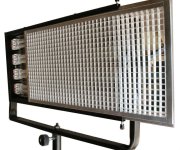
Your enthusiasm makes me want to try it then ;-) When I tried the one in the picture I could see some extra control on the sides but I wondered when I paint it black if that would suck up too much light.
I'll call them up on Monday and see what we can get and try to get a sample made up in 1" thick by .5" cells. If they can't do that I'll try for the .75 cells / 1 inch thick. I think I'd be pretty much the only one with a thick, framed option if I did this and maybe they could be adapted to other units pretty easily.
The mirrored barndoors really increase the surface area of light output more than they act as barndoors. Another interesting accessory might be those velcroed on strips of silver mylar material on the corners of the barndoors similar to the flolights units. Makes one complete surface all the way around. Really behaves similar to a softbox without diffusion material at that point.
I'm sure you tried the styrene 2x4 translucent diffusion panels of different grades. What did you think about those? I really like that for when you need a bit of smoothing out but don't want to lose any light output to silk.