
Navigation
Install the app
How to install the app on iOS
Follow along with the video below to see how to install our site as a web app on your home screen.
Note: This feature may not be available in some browsers.
More options
You are using an out of date browser. It may not display this or other websites correctly.
You should upgrade or use an alternative browser.
You should upgrade or use an alternative browser.
Brevis 35 vs. m2 redrock adaptor
- Thread starter sbrown86
- Start date

Lenilenapi
Carbonite Member
Just a note of caution about these tests.
The M2 takes alot of care to make sure the achromat to M2 distance is ideal for edge to edge sharpness.
Also both adapters I'm sure need to have the focus setting on the HVX absolutely exact for sharpness.
If anything was off that could bias the test.
I don't mean to disparage Richards test, just to maintain a healthy sketicism until more people have done this. Remember the first head to head tests of the HVX agains the HDV camera.
It certainly does seem to need less light that though and be a comparable image.
I am curious as to how it could need so much less light.
I mean what do we have here -
- A lens that has to focus at the same distance and make an image the same size in each adapter.
- A groundglass and a way of moving it
- an achromat
- a method of connecting the achromat to the groundgless.
Only the latter 3 could be different.
The mounting method is a matter of covenience but shouldn't affect performance unless alignment is wrong.
The achromats could be different, but they also should be interchangeable as they are focusing on the same size image the same distance away, so that would be an interesting test.
That leaves only the groundglass. Could that alone be responsible for the light level difference? (It could make a noise differences or introduce different problems at different shutter speeds.)
The Brevis I believe has different groundglass options which are supposd to be easy to switch) I wonder if one is better for low light but has any disadvantages - hence the other choices and the point about the Brevis having a problem in bright daylight using HVX ND.
Could that problem affect an overxposed part of an image shot in low light?
There's more to learn with careful testing.
(I hope to have a Brevis soon to do my own comparisons. Its a week overdue at the moment and I'm not get any response from Dennis.)
Barry_Green
Moderator
The differences in light level should only boil down to two things, really:
1) the amount of light that gets passed through the ground glass
2) the zoom setting you're required to use to get proper framing
If one adapter requires you to zoom in to Z80 or so to get proper framing, and another can get proper framing at Z40, then that right there would result in about 1.5 stops of better light performance for the second adapter. Keep in mind that the further you zoom in, the smaller the maximum-open iris you can maintain; at Z40 you can probably hold f/1.6 but at Z80 you're probably more like f/2.8. That's a 2.5 stop difference.
Second, it's up to the transmissive properties of the ground glass. The more transparent the ground glass is, the softer the image is going to be, but brighter too. And Dennis' observation about halos and smearing will come into play. The denser the ground glass the sharper the image will likely be, but then again, it'll be darker and grainier. Interchangeable ground glasses, such as the Brevis approach, sound quite interesting because it'd let you fine-tune your adapter to meet the specific needs of the shot.

Dennis Wood
DVXuser Sponsor
Len, the problem with using a camera's ND filter is that it reduces exposure after the GG which hides the fact that the gg is actually overexposed. If one thinks of the diffuser as film, it becomes more clear that you must avoid overexposing it. If you want max DOF, that means the 35mm lense should be close to wide open...and you should control exposure then with an ND filter over the 35mm lens in bright conditions, just as you would as ND on your video camera to avoid high f stops and the aperture blade diffraction that results.
The second and third diffuser options will lose a bit more light, meaning another .5 stops or so each. Regardless, all three are very efficient with respect to light and manage the image much differently than a spinning element system.
Barry, good point on the zoom-in. It's never really discussed.
The second and third diffuser options will lose a bit more light, meaning another .5 stops or so each. Regardless, all three are very efficient with respect to light and manage the image much differently than a spinning element system.
Barry, good point on the zoom-in. It's never really discussed.
Christopher Barry
Veteran
My Brevis setup works out to be:
Zoom 75
Manual Focus 10
I found it interesting to observe Richard's vignette test. M2 had what I see as a light fall off to the edge, which would then raise the question: How far do you zoom in for optimal M2? The following vignette test, "input: 9, input tolerance: 29", pronounced what I just raised in respect of light fall off edge to edge on the M2.
I am not looking to start a war or debate, just my observations. I would like to learn more about what I am seeing/observing.
Interesting. I'd love to see some comparisons of all the 35mm adapters out there right now. That would include shooting resolution charts, macbeth color chip charts, exposure tests, contrast comparisons, etc.
EDIT: The brevis website seems to be down?
Also, it seems like these adapters have a habit of causing highlights to blow out much faster than normal? Is this just me? It could very well be due to the fact that highlights are blooming and losing detail I suppose.
EDIT: The brevis website seems to be down?
Also, it seems like these adapters have a habit of causing highlights to blow out much faster than normal? Is this just me? It could very well be due to the fact that highlights are blooming and losing detail I suppose.
Last edited:
peter orland
Well-known member
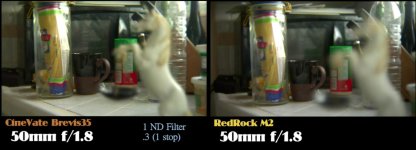
It's very hard to tell anything from this test but judging only on the clip...
It appears that the Brevis seems to be handling the contrast differently than the M2, particularly in the low mids to shadows/underexposed areas of the picture. If you look at this (assumed uncorrected) shot side by side, the pasta packet in both shots is very similar (other than the focus/dof difference), and to a lessor extent the green/red container to the right. If you then look to any of the shadow areas, not the hard black but the darker shadows, the Brevis is exposing them brighter and allowing more detail to be captured than the M2. This wouldn't be a problem (maybe at times even an advantage) for when you are shooting WYSIWYG unlit scenes, but for any shooting that you needed/wanted to control the lighting/contrast it would be awful. I believe this is why a test of this nature will show the Brevis to "appear" to be doing a better job as it is capturing into the shadows and showing some detail, but I certainly wouldn't want that kind of "assistance" on anything that was lit well. The Brevis is also doing something similar with the highlights which is why it needs stopping down in relation to the M2, and I'm only guessing, in relation to what the correct light reading/output really is, kind of like what gain does without the noise. Also, to my eye the pasta packet is exposed very similar in both clips, and this is only 1 stop difference, not 2.5, for what it matters.
Taking into account the quicker setup time, lighter weight, an apparent built in light enhancement feature, less likely to draw attention to it self, as the author of this test claimed, the Brevis would suit the run and gun/doco style much more than the M2. For controlled "cinematic style" lighting and shooting, with better handling of the contrast/dynamic range, and greater DOF at the same F stop I would prefer the M2.
Personally I think more testing is needed before any factual opinions can be reached, because as someone who has shot with both these (and the P&S) adapters, once set up right, they all take good pictures.
Pete
Attachments


Thanks for this great shootout. I noticed 2 things :
1. At the beginning the Brevis seemed to crop a little bit the picture (28mm is wider for the Redrock). But with the picture with the frame on the wall the difference is less apparent. Have you changed the camera's zoom ?
2. Outside even with the ND filters the Brevis pictures are over-exposed, the highlights are burnt compared to the Redrock where latitude seems better. Do you think it's possible to get a better latitude with the Brevis ?
Thank you very much for this review, I was waiting for something like this for so long !

rgdfilms
Wet poodle
Hey kstewart, to answer,
For those beginning shots with the guy wearing the Nike shirt (that's dvxuser AbstractTheory.. btw) I was zoomed in a little further on the HVX than with the M2, that was a mistake I noticed later.. the other shots after that collection are all zoomed the same. Those outside blown out shots were there because I was trying to show brightness levels and wasn't using a real monitor outside. I wanted to keep the outside stuff all at f/4. I was trying to show that with the Brevis, even with an extra ND filter, it still wasn't darker than the M2. You can definitely get better latitude with the Brevis like the M2. One thing I wasn't doing in the beginning was stopping down the HVX to f/4-5.6. The HVX stayed wide open.. I've since corrected this issue and notice better latitude and control. So now when I shoot it is a combo of choosing my f stop on my Nikkor, usually between f/2-4, then I throw on one or two ND filters, then I adjust my HVX between f/4 and f/5.6. Similar to the M2, although with the M2, I found that I never bothered or needed extra ND filters on the front of my 35 lenses.
For those beginning shots with the guy wearing the Nike shirt (that's dvxuser AbstractTheory.. btw) I was zoomed in a little further on the HVX than with the M2, that was a mistake I noticed later.. the other shots after that collection are all zoomed the same. Those outside blown out shots were there because I was trying to show brightness levels and wasn't using a real monitor outside. I wanted to keep the outside stuff all at f/4. I was trying to show that with the Brevis, even with an extra ND filter, it still wasn't darker than the M2. You can definitely get better latitude with the Brevis like the M2. One thing I wasn't doing in the beginning was stopping down the HVX to f/4-5.6. The HVX stayed wide open.. I've since corrected this issue and notice better latitude and control. So now when I shoot it is a combo of choosing my f stop on my Nikkor, usually between f/2-4, then I throw on one or two ND filters, then I adjust my HVX between f/4 and f/5.6. Similar to the M2, although with the M2, I found that I never bothered or needed extra ND filters on the front of my 35 lenses.
Thank you Richard, ewplaning the way you proceed is very helpful ! Doing this kind of reviews requires a lot of time and money (!), it would be great if Wayne Kinney could send you a SGPro examplar to add it, as his adpater seems very interesting too !
Anyway, thanks again for your efforts !
Kristin
Anyway, thanks again for your efforts !
Kristin

Well done RGD someone mentioned already just to take the time and effort to do this is a great gesture for the community. I thought the shots gave a pretty fair indication of what was going on. I agree with you the DOF seems more shallow on the M2.
 and thanks for all the hard work

samchasedp
New member
Thanks so much RGD for doing that test. It was the first I was able to find and I've been waiting with baited breath to see them side by side. I'm off to Pakistan in a month to shoot a feature on the HVX w/ 35 PL adapter (and Zeiss Super Speeds), 35mm film, consumer Mini DV and Super 8 film...whew, talk bout mixed (up) media and it's all going to be blown up to 35mm print. One thing that has rarely been mentioned in this forum is the vignetting issue with the M2. Light sensitivity aside (I'll have a full lighting crew so not too worried) I think there are only two real issues here: Visible Grain and Vignetting. The M2 has terrible vignetting which can be seen on every clip on their website whereas the Brevis seems to have none. The drawback for the Brevis is that it seems to show grain much faster which will be a major problem for blowup or HD projection. Which of the 2 Brevis GG's have you found to show less grain in high light situations?