16:9 adapter + squeeze w/sony camcorder

paulgabel

New member
Greetings all,

I'm aware that this forum is for DVX users so I apologize in advance.

I was wondering if I could receive quick advice. To achieve the 2.35:1 aspect ratio I had purchased for my 30mm Sony PC-350 handycam a century-optics 16:9 adapter that I would use while the camera was in 16:9 mode.

I filmed some test shots in which the scope was quite lovely.

However, while watching in Post, I noticed a great deal of stigmatism along the edge of the picture. This even with the camera lens zoomed out entirely. Is this symptomatic to anamorhpic lens or is it because of the small mm size of my camera lens? Should I drop this dream of capturing 2.35:1 on my handycam? Or, is there a way to beat the above stated logistics?

Best to you all,

Paul
 
You might want to post a grab of a frame which illustrates the problem.

One question would be are you using any sort of step up/down ring to attach the adapter to the camera? This could cause problems as the adapter to camera distance would no longer be correct.
 
16:9 adapter + squeeze (astigmatism)

16:9 adapter + squeeze (astigmatism)

Thank you for responding,

Yes, my camera does require a ring with a slight step-up (30mm to 37mm) for a successfull attachment with the 16:9 adapter. Could this be the cause?

To help matters, I will shortly make available a video-grab that depicts the problem.

But here is a link to the adapter in question:

http://www.schneideroptics.com/ecommerce/CatalogItemDetail.aspx?CID=1069&IID=1753


Again thanks!

Paul
 
It is highly possible that the ring is the cause of the problem. I would recommend communicating with Schneider's support people to ask what the range of acceptance that the adapter has in terms of spacing to the camera.
 
Greetings khmuse,

I took your suggestion by contacting Century Optics. I'm am currently waiting for their reply.

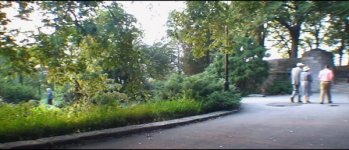
And here are the images you requested. As you can see there is distortion to the left and the right of center....

thanks again,

Paul
 

Attachments

  • 2.35 example.jpg
    2.35 example.jpg
    173.2 KB · Views: 0
  • 2.35 example 2.jpg
    2.35 example 2.jpg
    200.2 KB · Views: 0
In your first post in this thread, you indicated that you were experiencing "...stigmatism..." which I took to mean astigmatism. What I am seeing from these grabs is simply a poorly focused image. Is it the poor edge sharpness what you sense as the problem?

Are you familiar with the concept of how an anamorphic adapter effects how one focuses on an image?

Keep in mind that an anamorphic adapter is effectively a wide angle lens only in the horizontal axis. This causes the focal plane to be different between the vertical and the horizontal axis.

In order to focus properly, you need to establish focus in both axises and then set the focus to the geometric mean of the two points. Then, you need to stop down enough to get both points within the depth of field of the focal length and distance combination that you are using in order to assure a sharp focus in both planes.

To better understand these points, frame up a focus chart and watch what happens when you focus the lens with a wide open aperture. You will find one point where the vertical lines are focused and another where the horizontal ones are. Obviously, this is contradicting set of requirements. If you split the difference (or better yet, find the geometric mean) you will be at the best compromise point between these two extremes. Now, as you stop the lens down, you will find that at some point, both sets of lines will be in focus. This is the maximum open aperture (minimum f number) that you can use for this combination of distance and zoom. Continue testing at different distances and you will soon begin to understand the issues surrounding the use of an anamorphic adapter.
 
That is right. The distortion, which you pointed out to me as being the result of poor focusing, is the very thing that I misjudged as astigmatism around the edges.
Unfortunately, this is a real consequence to my misunderstanding of anamorphic lens. The scenes that these images were grabbed from were in fact, filmed while auto focus and exposure was activated.
 
Never, never try to use auto focus with an anamorphic adapter. The camera can't possibly accomplish the task correctly.

Try the steps that I outlined and I think you will have much better results.
 
it almost looks likes your getting chromatic abriviation near the sides. Your also using the adapter in a way its not meant to be used your bound to get some weird side effects.
 
Thanks, I'm now researching the "stop down" method and also, issues regarding the different vertical and horizontal focal planes of the lenses. I'm also looking into other lens effects like chromatic aberrations. Thanks again, you have opened up to me the complexity of optics.
 
I'll post here again if I make any significant improvements or if I have any direct questions with this issue.

best to you!
 
Back
Top