
Navigation
Install the app
How to install the app on iOS
Follow along with the video below to see how to install our site as a web app on your home screen.
Note: This feature may not be available in some browsers.
More options
You are using an out of date browser. It may not display this or other websites correctly.
You should upgrade or use an alternative browser.
You should upgrade or use an alternative browser.
Official Filter - Polarizer - UV - All Filters F.A.Q
- Thread starter SurJones
- Start date
Try searching back through the forum, this has been covered a lot.
here are a couple of threads:
http://www.dvxuser.com/V6/showthread.php?t=48611
http://www.dvxuser.com/V6/showthread.php?t=53268
here are a couple of threads:
http://www.dvxuser.com/V6/showthread.php?t=48611
http://www.dvxuser.com/V6/showthread.php?t=53268

ian lucero
Well-known member
I don't know the difference in quality off-hand but if you can't afford the pricier glass, then buy a cheap one right away. Even just to protect your lens. I think they can be had for $15. The Tiffen filter I got was $40 or $60. can't remember.

SurJones
Veteran
Here is what the features say.
Hi Def filters
•
Hi Def filters do not experience color shift - Specifically designed for use with High Definition filming
•
Optically consistant from filter to filter
•
Formatt filters use the finest materials together with state of the art production techniques; This has resulted in a standard of optical perfection unmatched anywhere else
•
All Formatt filters are manufactured using Water White Schott optical glass that is precision polished and ground to ensure absolute optical flatness and optimum performance
Absorbing Cell Technology
•
The secret to Formatt's consistency in filter design lies in its unique "Absorbing Cell Technology" (A.C.T.); This unique process allows color correct dyes to be applied to optically pure, wafer thin absorbing cells and offers a controllability that ensures the smoothest grad lines and consistent color across the whole filter surface.
•
This process is revolutionary compared with conventional filter dying techniques by eliminating the need to directly coat the glass surface itself; The repeatable performance gained through A.C.T. ensures that at any time you have to swap like filters for like filters mid shoot you can do so with confidence with no discernable differences in color or density.
•
Each filter is guaranteed flatness to a maximum 2-wave value and comes with an individual reading from a laser interferometer; Every filter is carefully verified with a densitometer and spectrophotometer to ensure consistent and accurate transmission, before leaving the factory - the result is an absolute purity of image that eliminates any unwanted colorcast caused by conventional greenish soda-lime glass.
Ultraviolet filters
•
If desired they can be left on the lens at all times for protection
•
Haze filters provide additional benefits of correction for Ultraviolet(UV) light which can register on film and videotape as a bluish cast and can obscure distant details
•
Ultraviolet filters allow you to correct for the UV effect to varying degrees
I bought the http://www.bhphotovideo.com/bnh/con...995&is=REG&addedTroughType=categoryNavigation It has worked well. I can't comment on the need for an hd filter other than mine is not and has been fine.
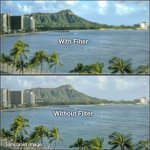
SurJones said:Haze filters provide additional benefits of correction for Ultraviolet(UV) light which can register on film and videotape as a bluish cast and can obscure distant details
LOL, I can't force you to read this statement correctly, in that it indicates you will gain detail and elimitate bluish cast with the filter on, but I would consider since the statement is used to sell the lens, I doubt it would highlight a negative in this way. In fact it uses the word "benefit" in the statement. Secondly, your pic says clearly it is a simulation so I would not go by that.

TedRR
Well-known member
If you look at the picture, it's the same FRAME. Same wave breaking points etc.
This looks to be a mock-up, how would you get the same wave breaks with time to change the filter???
If it's two camera's, how can we be sure fucus is identical?
Just wanted to point out how important "simulation" is.
I'm not saying you don't lose definition, but not in the previous lenses I've owned.
SurJones
Veteran
hehe ya, I know it is a simulation, but still simulation they are good are simulating what you will see.... Now on to matters, if you shoot film, or tape than the filter with haze will benefit you elimanating the bluish cast. But again being 95% of HVX owners haev P2, we should not need to worry about elimanating an issue that tape and film have...Right???
Lenilenapi
Carbonite Member
The haze issue has to do with landscape photography. If you you are shooting something far away there is a build up of ultraviolet light with all that distance. I've never noticed it particularely in video but its probably there. P2 would have nothing to do with it, its just how sensitive the chip is to UV haze.
Most people just use UV filters the same as they would use clear, to protect the lens. It probably does help with UV though I've never noticed the diff.
Most people just use UV filters the same as they would use clear, to protect the lens. It probably does help with UV though I've never noticed the diff.
