The Greatest Low Budget Lighting Item Ever!

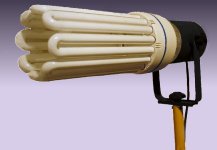
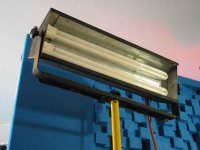
I don't want to sound argumentative, but since when is a 500W bulb (125W compact fluorescent) too much light? Yes, it can be too much if you are in a tight space or if the light is too close to the subject, but I can't imagine raising the light level of even a fairly small room with much less. I've tried getting some punch or raising the light of a room with 4 X 40W fluorescent bulbs. I've tried adding an 85W fluorescent to the mix. Those set ups didn't really work. Fluorescents have a very short fall off and if you want some punch or if you want to raise the light levels of a whole room a bit, then you just might need the 125W fluorescent (I recently bought one and, although I'm still working on getting it set up for a shoot, I think I'm going to find it useful quite frequently).

Again, since when is a 500W (a 125W fluorescent) too much light for even fairly normal types of shooting?
 
Cool Lights Chapter List

Cool Lights Chapter List

Someone asked about what fixtures we build in the video. Here is a chapter list to give you a better idea of what's going on there:

Chapter Description Time
_______________________________________
1 Logo 0:19
2 Disclaimers 1:32
3 Opener 0:38
4 Host Introduction 0:55
5 Video Highlights 1:58
6 Inexpensive Solutions 0:28
7 Scoop Lights 0:40
8 Chinese Lanterns 0:30
9 Ceiling Fixtures 1:45
10 Scoop Demo 1:09
11 Ceiling Fixture Demo 0:58
12 Safety Intro 0:47
13 Electrical Safety 2:57
14 Metal Safety 0:55
15 Bulb Safety 0:37
16 Paint Safety 0:41
17 Halogen Conversions 0:59
18 Halogen Gut 1:53
19 Halogen Rewire 2:09
20 Halogen Reflector 2:02
21 Halogen Prep Barndoor 2:31
22 Halogen Make Barndoor 1:29
23 Halogen Attch Barndoor 1:48
24 Halogen Paint 0:44
25 Halogen Add a Ballast 1:32
26 Halogen/Scoop Demo 2:20
27 Halogen Only Demo 1:08
28 Dimmer Project Intro 0:30
29 Dimmer Parts 0:34
30 Dimmer Wiring 1:13
31 Dimmer Demo 1:38
32 110w Unit Intro 1:00
33 110w Drilling & Prep 2:54
34 110w Power Cord 0:41
35 Soldering Tutorial 2:02
36 110w Ballast Wiring 3:00
37 110w Painting 1:46
38 110w Conclusion 0:28
39 110w Larger Versions 1:14
40 126w Softlite Intro 1:00
41 126w Parts 2:30
42 126w Drilling 1:39
43 126w Socket Wiring 1:55
44 126w Ballast Wiring 3:33
45 126w Painting 2:36
46 126w Dimmer 3:31
47 126w Demo 2:37
48 Fixture Mounting Intro 1:00
49 Mounting Parts 1:27
50 Mounting Prep Washers 0:18
51 Mounting Attach to Box 0:48
52 Mounting Integration 0:47
53 Softbox Introduction 1:20
54 Softbox Drilling & Prep 0:37
55 Softbox Socket Wire 0:58
56 Softbox Ballast Wire 2:24
57 Softbox Test & Paint 1:03
58 Softbox Easier Solution 1:20
59 Softbox Hood Suitability 1:12
60 Softbox Demo 1:36
61 Video Conclusion 0:44
62 End Credits 1:06


One more thing about these garden variety (no pun intended) compact fluorescents, besides the quick fall off, they also start out pretty well diffused. My 125W has a light surface that's about a foot long and several inches around. It's not like I can really get a focused punch out of it (like from a 500W fresnel, etc.) even if I wanted to. The main reason I want a fixture for this lamp is to control spill, not to diffuse it much more (although some nice reflectors should even the output out and add a bit more surface to the light).

I'll try to do some test shoots with the raw 125W bulb tonight and post frame grabs.
 
110watt fixture.

110watt fixture.

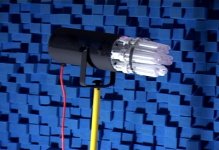
Here's a picture of my 110w fixture using two 55w biax bulbs. Its got a gel frame for slide in attachments like barn doors, etc. I used it mostly for background lighting--just on the floor with a gel on it.
 

Attachments

  • 110w.jpg
    110w.jpg
    52.9 KB · Views: 0
Last edited:
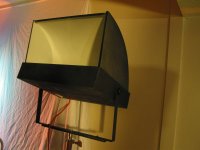
126w softlite

126w softlite

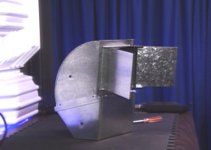
This is the more "Hollywood", oldtime alternative to the modern softbox. Mostly known as the softlite. Has a hood attachment to diffuse the light instead of a silk. Uses 3 42w triple twin tube bulbs and separate ballasts. A very versatile fixture. The version on the right (in the first picture--you can see the small box on the front of the fixture with the dimmer in it) includes a dimmer but that is a very very expensive option. Overall, this is probably my favorite design from the video. The picture on the right is, of course, the raw box just in from the sheet metal shop before we have worked it over in the video...
 

Attachments

  • 126w.jpg
    126w.jpg
    30.5 KB · Views: 0
  • 320Still.jpg
    320Still.jpg
    42.9 KB · Views: 0
Last edited:
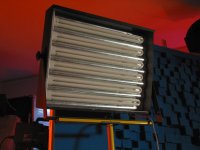
My first fluorescent softbox

My first fluorescent softbox

Quite a monster. Made in a certain size to allow fitting into a softbox hood. Uses 7 of the 42w CFL bulbs with separate ballasts inside the fixture.
 

Attachments

  • SoftboxFixtureWithBulbs.jpg
    SoftboxFixtureWithBulbs.jpg
    37.5 KB · Views: 0
  • SoftboxLavenderBkgnd.jpg
    SoftboxLavenderBkgnd.jpg
    54.3 KB · Views: 0
Softbox: the simpler version...

Softbox: the simpler version...

I had to do this one when I discovered 200w CFLs. Works in a softbox speed mount ring as well as a chinese lantern. I have a 36" nylon one that is rated to 250w so we are well within that margin with a 200w lamp like this one. It does generate heat but not as much as an equivalent halogen.
 

Attachments

  • QtPaintcanSoftboxFixtureLavenderBkgnd.jpg
    QtPaintcanSoftboxFixtureLavenderBkgnd.jpg
    60.4 KB · Views: 0
Last edited:
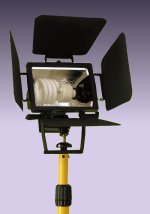
The 30w "halogen conversion"

The 30w "halogen conversion"

When you are thinking about converting to fluorescent and throwing away your halogen worklights, don't do it! You can use that cast aluminum box to advantage. I used several of these little lights all throughout the production of my video because they were so easy to use. I have 8 of them. I'll be selling conversion kits soon as well as just barn door conversion only kits for those that just want to continue using their halogen lights--but I can't really think why though ;-) . Soon I will also have several sizes of these boxes available because they make excellent fixtures. They will have either a mogul or edison base in them, reflector, yoke, switch and powercord. Barndoor kit will be a separate option.
 

Attachments

  • HalogenConversionLavenderBkgd.jpg
    HalogenConversionLavenderBkgd.jpg
    33.6 KB · Views: 0
Last edited:
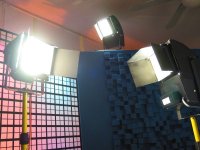
The 330w monster

The 330w monster

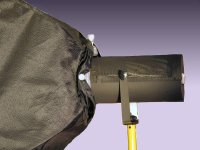
I really only use this one for green screen lighting. It is extemely powerful and not useful when you want a subtle approach to lighting. But I do show you how to build one though and I will soon have the parts for those interested that want to do it for less than the price of those that are currently available. Note the hood attachment I made for when I want to diffuse the light more. A silk would work fine too. Couldn't resist making the hood though. It looks cool...
 

Attachments

  • 330w.jpg
    330w.jpg
    28.2 KB · Views: 0
  • 330withHood.jpg
    330withHood.jpg
    23.7 KB · Views: 0
Last edited:
>>Whats the noise like the these bulbs? how loud are they? I see they say silent but if u put them 1 inch from your ear do you hear anything?

No noise whatsoever and they don't affect wireless microphones. Completely silent. I really love them in a softbox hood or chinese lantern.
 
Wow. Great setups miracom. Anymore info on your Video, like how much its selling for and webiste etc?
 
Everdene said:
Again, since when is a 500W (a 125W fluorescent) too much light for even fairly normal types of shooting?

Sorry if it sounded like I was looking for an argument... I'm sure the 125w bulb will work great... as I said it's something I could possibly find a use for... the only point I was really trying to make is that when people first get into lighting they tend to overlight everything or have totally whacked ratios which look really amature. Since I got the impression that some of these guys are a little new to lighting I just thought a 125w flo source wasn't the best place to start.

Of course I need to explain that I'm coming from a standpoint of always trying to see how much I can get out of everything. I like to use as little light as possible to accomplish the desired look... but that's sure not the only way to do it. I know lots of people that bring high lumens into control with scrims, silks, etc... I just happen to look at this stuff differently.

In my light kit a single 125w flo source w/o any dimming control... would see VERY little use... for you it may get used all the time... different strokes... it's all good.

If somebody gets one of those 125w bulbs I'd love to see a frame grab or 10-30 second video stating distances and F-stop. :)
 
MattinSTL said:
I like to use as little light as possible to accomplish the desired look... but that's sure not the only way to do it. I know lots of people that bring high lumens into control with scrims, silks, etc... I just happen to look at this stuff differently.. :)

Well this is exactly the approach I have been using too. When I first started building my lites I made the 330w 6 bulb biax fixture thinking I would use it all the time. I built 4 of them and really have found them to not be that useful except for green screen situations. I really like my little 30 watt fixtures and have some on the ceiling in strategic places, some on top of sets and some on stands. You would be amazed at how much light that is with the judicious use of your iris settings. It is a "surgical" approach to lighting that involves really starting with a totally dark room and then nothing is lit by accident. And barndoors are crucial! I only lite up the things I want to and in exactly the way I want them to appear on screen. It's really the approach most lighting designers are taking today too. You see very few T.V. programs anymore that have that total bright look (like the Price is Right Gameshow for instance--a really bright show). I also use my 126w softlites quite a bit too for close-in stuff. They wouldn't work well up high on a grid because the fall-off is just too quick for an indirect lite like that one with such a small aperture for the lite to pass.
 
Last edited:
I'm comforted to hear that miracom... I still work with some old school lighting guys and it's easy to use 2K watts worth of lighting even in a sitdown interview... but the whole time I'm shooting I hate the guy for making us all too hot... and then we have to constantly pat 'n powder the CEO's forhead and nose. I guess a 125w flo bulb would be perfect if it's inside of a Chimera... I'm just wondering how many people reading this will get my point about that... about using it in a softbox or punching through a silk.

The common perception of flo lighting is that you don't need diffusion in front of a flo... and I don't know too many guys who have big Chimeras... or that would go to the trouble to make a decent softbox.

If a guy follows through on all of that and actually makes the fixtures as you have... then I'm sure they'd get great results. I've had local producers afraid of my 55w lights until I gel them down "because they're too bright" they would say... of course this is using an open tube with a very high output reflector... I also started including frost gels for the latest buyers so that they could add diffusion to even this little 55w fixture. When I saw people getting excited about the 125w bulb I was imagining how many would stop short of doing what they need to do in order to control it...

I definitely like to bring lighting up to the desired level from nothing... rather then overshoot the lumens and then be forced to either raise the F stop or else gel / silk the lights.

I guess we are in agreement on that... so how do you use that 125w bulb... softbox only? Have you ever put it in a scoop or cyc?
 
MattinSTL said:
I'm just wondering how many people reading this will get my point about that... about using it in a softbox or punching through a silk.

I guess we are in agreement on that... so how do you use that 125w bulb... softbox only? Have you ever put it in a scoop or cyc?

I think you don't really understand it until you start doing it and you either like or don't like the results--starting to see what really works for you. Look at me, Mr. Overkill in the beginning, I designed a 6 55w fixture first and then realized later it just wasn't controllable for most of what I want to do. It's not wasted because I use it for cyc work or if I need to throw lite on a large area.

I've never used the 125w bulb that they are talking about here but I do use a larger 200w (8U) one shown in a previous picture I posted with a corresponding fixture I built for it--that one is in 5000K. It is really only usable in a softbox or chinese lantern for the reasons you stated. I have two lanterns--a nylon 24" and also a nylon 36" which work well for that bulb. Also my 24" x 24" softbox fits over it too--like a glove.

I suppose if I had a lot of room and just wanted to throw out a bunch of light it would be great. It's only really usable in a super-big room or studio though IMHO. I simply couldn't believe until I saw it for myself that a few strategically placed 30w bulbs were all you really need. And if they have barndoors around them--all the better. This contributes even more to keeping the environment "cool" and comfortable for crew and talent alike.

In my video, I made a set that was intentionally hard to lite. There is a translucent acrylic panel in the center of it that has some backlighting. This backlighting makes it really necessary to control where the front lighting is going onto the subjects and the rest of the set. It didn't take much to completely wash out the color gelled backlighting at all. And I wanted it that way to teach people the surgical approach. And also to show that fluorescent light is indeed controllable if you want to.

You see, if you just put a big softbox, or chinese lantern or any other huge source in front of the subjects sitting in that set, the colored backlighting was completely washed out and it really illustrates the need to plan everything out and only use what you can control. When I demo'd the softbox in the video I showed how you had to use cards taped to the sides as makeshift barndoors to keep it from spilling on the backdrop and washing it out. Kind of defeats the purpose of a softbox really and illustrates why the 30w fixtures were more than enough in this setting.

The real uses of these kind of larger lights, to me, would be in a large green screen setting (for instance) or a huge set (like the Entertainment Tonight set on the Paramount lot--anyone seen that?, it is really huge). I would have my 330w fixtures lighting the screen or back cyc and softboxes on a grid lighting the subjects about 12 feet up. None of this would ever work in a small interview set like the one I built for my video though.

Also, no one should sneeze at these lanterns as an "amateur" tool. I saw these all over the place on sets on the Paramount lot recently. Gilmore Girls uses them all over the place on the grid. Not totally sure what kind of lite was inside though. Could have been a flo but it was hidden from view.

If you want a creative and "pro" look you really do have to use smaller fixtures for smaller sets (and aren't many of our venues small really?). Fluorescent really demands a different way of approaching everything--a relearning process. But I have really found it rewarding using it though and I think it really goes hand-in-hand with the new hi-def cams too which will require more soft and subtle lighting.
 
You're a welcome addition to the forum miracom... We're lucky to have you here. (sorry I didn't say so sooner)
 
MattinSTL said:
You're a welcome addition to the forum miracom... We're lucky to have you here. (sorry I didn't say so sooner)

Agreed. That stuff is great, miracom. And, MattinSTL, thank you for all the inspiration you have given to us all when it comes to DIY fluorescent lighting. Nothing but outstanding efforts and advice. I hope to power up my 125W CFL a little later today. Maybe I'm wrong about the drop off and soft nature of the bare lamp, but I doubt it'll behave much like a standard 500W fixture.
 
Miracom,
The video looks like a great idea, but you guys should publish a clouple of saple clips from the DVD so people can get a better idea of what they're getting for $90. If not videos, then at least still shots. I tend to hesitate before spending $90 on a video that I can' preview even a snipet from...
 
k2director,

Not sure what you mean. I have an excerpt on the website and have posted pictures directly in this thread. What are you missing that you still need? The video is packed with information in 89 minutes and well worth the $90 for the sourcing and ideas it gives as well as the know-how. There's a review of it on Amazon where it is for sale too and their will soon be a review of it in a magazine and on other sites too.
 
Back
Top