The Myth Of Dynamic Range

ultanta, Petrus, Noiz2, and all,
Interesting discussion! I appreciate all the explanations. I can see now that that I was oversimplifying things with my 'theory'. I see now what Petrus is saying about quantization noise. Just plug those two words into google and you'll find all kinds of good stuff. Wikipedia has a great explanation.

Noiz2 said:
Or you could just go record and use what sounds best and not worry about it.

I think I like this statement best of all even though I believe it really helps to understand at least the basic theory behind stuff like this although the theory behind filing my taxes always seems to escape me this time of year. :badputer:

-Dan
 
DR.jpg


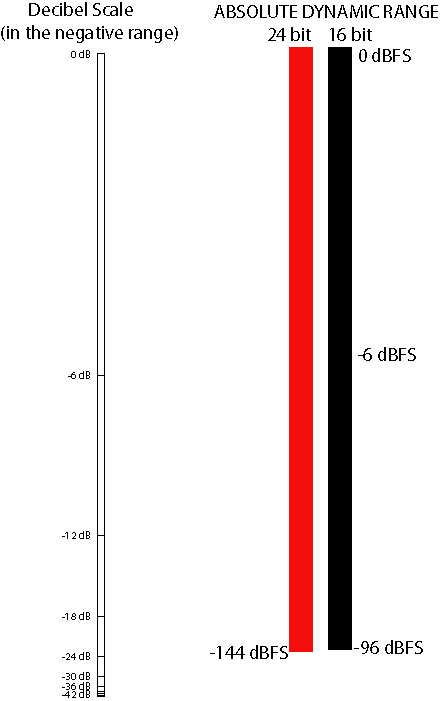
This is an illustration of how the decibel scale looks, and what the difference in dynamic range (in absolute terms) is between 24 and 16-bit digital audio. What's important is that the range in 24 bit is divided into 16 million equal steps, in 16-bit, it's divided into 65000 equal steps. You can see how relatively small even the -42 to -48 dB range is getting on the left. -96 dB is exactly one of the 65000 steps in the 16-bit system, and 256 steps on the 24-bit system. -144dB is one single step in the 24-bit system.
 
Last edited:
Petrus said:
I make no calculations, I try to explain how digital audio recording works, why adding bit depth just adds more dynmic range and does not add "resolution", unless you want to call better S/N ratio "resolution".

You do know, of course, that quantization noise is directly related to resolution, and has nothing to do with dynamic range?
 
Certainly, listening is the best test. But for better or worse, people look at forums like this to help making purchase decisions. And, sure, they certainly should take everything with a grain or ten of salt. But it's still nice to try and keep the terminology and information correct.

Anyway, I record about 20 projects a month where I have a 24-bit primary recording system and a 16-bit backup system fed by the same preamp - same signal level. And I can guarantee you that when the 16 bit system is near peaking, there's definitely not 256 dB of additional headroom on the 24-bit system!
 
I am no sure where your getting this "info" dude, but the range is NOT 0 to 1 it would be 00000000000000000000 (binary) to 111111111111111111111111 (binary). While each bit is either a 0 or a 1 there are 24 of them in a 24 bit word and 16 of them in a 16 bit word. You show me the verifiable standard of FS and I will apologize and admit I'm an idiot. Won't happen because there isn't one. FS could be 100 volts PtoP, or 5 or 1. There is no universal standard. So you do get more dynamic range. Exactly where you chose to take that dynamic range is up to the manufacturer. You are claiming that it is always at the bottom of the scale. I'm saying that that is not nesc. the case. When you bring some facts based on reality rather than your interpretation of how digital systems work maybe we will have something to talk about.

SK
 
ullanta said:
DR.jpg


This is an illustration of how the decibel scale looks, and what the difference in dynamic range (in absolute terms) is between 24 and 16-bit digital audio. What's important is that the range in 24 bit is divided into 16 million equal steps, in 16-bit, it's divided into 65000 equal steps. You can see how relatively small even the -42 to -48 dB range is getting on the left. -96 dB is exactly one of the 65000 steps in the 16-bit system, and 256 steps on the 24-bit system. -144dB is one single step in the 24-bit system.


Well you see this is your first big assumption that is not so. odB is a relative thing, not an absolute. Most mix consoles for instance can go to +24 dB over their reference, so 0 is not the top of the scale. Now move your FS up to +24 and ...Woh you just got 24dB of headroom! wow magic, hod they do that. Simple dB is a RELATIVE scale. dBu has some meaning because it is referenced to a specific signal level for it's 0 . Sound devices uses dBu on its scales but not many others do.

SK
 
Last edited:
Maybe we should go all the way to the beginning to see how the AD converter works. This might clarify the point that Digital audio really works from bottom up, not from full scale down, like some of us seem to believe, as that's what the level meters show.

AD converter is a device where it all starts. It is a device which gives the sample voltage a numerical value. Like computer devices it used binary system for those numbers, but it could be anything, it is just math. Let us stay binary.

There is a range of voltages that the device can accept and it is the duty of the operator to provide those voltages by manipulating the electronics before the AD converter. It is called SETTING THE LEVELS (soundds familiar?).

Ok, a tiny sample is sent to the device. It goes thorough a gate adn if the voltage is big enough it flips the gate and sends out 1. Going thorough a resistor the remainder is sent to the next gate. If there is enough juice left, ths gate also flips. Now the signal is 10, as the flipping the next gate flips the previous to zero. The reminder is again sent to the system, via a bigger resistor. In 16 bit systems there are 16 gates, in 24 bit system 24 gates. Each sample goes thorough the system flipping the gates as it goes, and out comes a binary number ranging from 0000 0000 0000 to 1111 1111 1111 in 16 bit system and 0000 0000 0000 0000 0000 0000 ti 1111 1111 1111 1111 1111 1111 in 24 bit system. In decimal those numbers are 0, 65535 and 16777215.

These AD converters are linear. or try to be as linear as possible (sign of quality). This means that each gate is set 2/1 apart, to flip the next gate the signal has to be twice as high, or twice as loud, if you wish. This in turn means that each additional gate giving one more bit means the signal was 6 dB louder.

If the levela are correctly set, the loudest signal just triggers, or almost triggers the last gate and all the previous gates. Tripping them all gives the 0 dB level on the meters (which measures the dB:s kind of backwards).

It is the nature of the system to give 6 dB dynamic range for each bit, the difference between noise floor and full range is this infamous 16*6 and 24*6 dB (96 and 144, resp).

What happens when the levels are not set correctly? If they are too low, some original signal is too quiet to trigger any gates, just quantization noise is recorded for that, highest level are below max, and we loose something. This is easy to do in 16 bit system. Real world signals do not have a huge dynamic range, in 24 bit system we usually do not loose the quiet end even if levels are lowesh, usually this is done inpurpose, for safety.

What happens if levels are too high? At some point all the AD converter gates are flipped and we get full signal. If the next sample voltage is even higher,we can not flip any more gates, the signal is at the max, we get just a flat top on the waveform. Sharp corners mean high frequenses, what we have is bad distorsion, and clipping.

I hope this clarifies things, even though the explanation about the ADC is a bit (?) simplified.

In the Ullanta's diagram the dB scales do not match. db is dB, the level range reaches down from the 0 dBFS to -96 dBFS on 16 bit system and -144 dBFS in 24 system, even though recorder level meters usually reach only -60 dB or similar, as we usually have all the usefull stuff up there and let the lowest signals fend for themselves, Usually we can not hear them anyhow.
 
Last edited:
Petrus said:
In the Ullanta's diagram the dB scales do not match. db is dB, the level range reaches down from the 0 dBFS to -96 dBFS on 16 bit system and -144 dBFS in 24 system, even though recorder level meters usually reach only -60 dB or similar, as we usually have all the usefull stuff up there and let the lowest signals fend for themselves, Usually we can not hear them anyhow.


The dB scales do not match from the left diagram (dB Scale) to the right diagram (Absolute dynamic range). Sorry, I meant to note that. And, it's not truncated... It just didn't have room for numbers below -48 dB. But it's in scale, and the bottom edge is close to the bottom of the dynamic range (I'd guess most meters - especially analog ones - lack labels at the low end of the range for the same reason... it's hard to squeeze in numbers at the bottom of the range). But they do match between 16 and 24 dB in the Absolute Dynamic Range diagram. That is a precisely scaled demonstration of the difference in absolute range between 16 and 24 bit. Of course, 0dBFS on those scales can be any level; the relative sizes remain the same.

Please tell me if you disagree with the size relationships in the portrayed decibel scale... I was just trying to provide an example of a logarithmic scale.
 
Last edited:
Anyway, Petrus, we seem to be more in agreement than not? At least on the converters, no? Top of the dynamic range is 1111111.... representing 1; and there are some number of steps down (16 million or 65000) to 000000....1, the smallest measurable quantity. And the more bits, the smaller that quantity is.... for each bit, 6dB smaller.

Really, you agree with that, right?

Now, the converter may work from low level to high to pack the bits, or high level to low. I don't think it matters in this conversation... that's an implementation detail.

Say you have a converter that you can switch between 8, 16, and 24 bits at the flick of a switch. I have one next to me. You set your gains, with the switch in the 8-bit position. Everything's nice. The sound levels just barely lap at the peak level.

Now you switch to 16 bits. Do you need to double your gain to get the signal to FS? No FS stays FS.

Now you switch to 24 bits. Do you need to adjust the gain? No. FS remains FS.

Now, in 8 bits, we're losing everything below about -48 dB. In 16 bits, we lose everything below about -96 dB. In 24 bit, we lose everything below about -144 dB. (assume it's a really, really good system that matches theoretical limits).

Adding bits is therefore only adding to the bottom of the dynamic range, no? No matter how many bits I have, the peak level the system can handle remains the same.

Or does your system not work this way?
 
Noiz2 said:
Well you see this is your first big assumption that is not so. odB is a relative thing, not an absolute. Most mix consoles for instance can go to +24 dB over their reference, so 0 is not the top of the scale. Now move your FS up to +24 and ...Woh you just got 24dB of headroom! wow magic, hod they do that. Simple dB is a RELATIVE scale. dBu has some meaning because it is referenced to a specific signal level for it's 0 . Sound devices uses dBu on its scales but not many others do.

Dude... you need to distinguish different types of decibels. When you say "move FS up to +24" what you really mean is "calibrate the system so that the converters consider +24 dB to be FS." But for any sample size, FS is a fixed value - a sample with all 1's. And in the semantics of the dBFS scale, FS is 0dB, or 1. 0dB is indeed a relative thing. dBFS is not.

Secondly, it's unclear if you're talking about preamp headroom or digital headroom in your discussion. They're mixed up. If you set FS to +24 dBu, then +24dBu will be 0 dBFS on your digital meters, and to get 24dB of digital headroom you'd have to make sure your levels are at about -24dBFS.

You're right when you say there's no fixed relation between dBFS and dBu or dBv. You fix that relationship with gains and such to suit your situation. But the dbFS scale goes from 0 to 1. Always. -inf is 0 and FS is 1.
 
Alright Alright....

So after all this, what have we learned?

When you have the opportunity to record at a higher bit depth....DO IT.

that's that.
the end.
done.
good night.

-Dave
 
Got home late tonight. Love the discussion. I have found this article breaks digital audio down to concepts even my wife can get (very smart woman but hates "tech talk").

http://www.dv.com/news/news_item.jhtml?LookupId=/xml/column/rose0505

(Think you need a DV.com account for that link to work. If it does not link right to article, just do a search for "little bits" on DV.com)

Look forward to reading the 2nd page of this discussion over breakfast tomorrow. :D

Cheers
 
wabbit said:
I have found this article breaks digital audio down to concepts even my wife can get (very smart woman but hates "tech talk").

http://www.dv.com/news/news_item.jhtml?LookupId=/xml/column/rose0505

(Think you need a DV.com account for that link to work. If it does not link right to article, just do a search for "little bits" on DV.com)

Nice article Wabbit! So, if you guys like Jay Rose better than me, read what he says in the article:

"Second, because Full Scale never changes, you can move among 16-, 24-, and 32-bit environments without affecting the volume of a signal. Instead, each additional bit lets the computer describe finer slices of the maximum--and that can be very useful because those tiny slices are where noise lives."

"In most forms of counting (money, populations, carbs), you start with a single unit--say, a dollar or person or gram--and add. But digital audio starts with a maximum value and divides. Every bit in a digital audio word is a fraction of the maximum."
 
Last edited:
Maybe you missed some of the article.

". First, it's easy to relate Full Scale to the design limit of any analog circuit. You can send the same audio data to a prosumer mixer or a 1,000-watt PA system and know exactly what to expect: Full Scale will always equal 100 percent of the analog output."

But that 100% is not the same box to box. Exactly why he used the "if" in the next excerpt. !00% on that 1000 watt amp above would light 10 100w bulbs and is probably pushing 150V PtoP.


"If Full Scale equals one volt peak-to-peak, the LSB of a 16-bit word is worth about 1/65,000 volt, meaning the signal is split into slices of .015 millivolt each."

And if it's still foggy the hunk below sort of spells it out.

"Computers add bits in groups of eight, so the next step from 16 bits is 24 bits, which lowers potential noise to about a quarter-millionth decibel per operation. You might think that's quiet enough, but many professional audio systems do their math at 32 bits, nailing things down to a trillionth of a dB. (Nobody needs that much quiet, so system designers temporarily devote a few of those bits to extra headroom.)"
 
And while were at it, a few more quotes from Mr. Rose in his FR2 review.

"Using a -50 dBu signal--standard for most mics--dynamic range was 83.2 dB. Signal-to-noise ratio, also frequently quoted, is dynamic range minus reference level; in this case, 71.2 dB. With the -35 dBu typical of hot mics such as the Sennheiser ME66, dynamic range reached 93 dB"

And

" Although 24-bit files are theoretically capable of 144 dB dynamic range, real-world recording is limited by the circuits; professional 24-bit field recorders get around 108 dB, which means they produce less than half the hiss of 16-bit recorders. "

SK
 
Are you saying any of that contradicts what I've said? Or that Mr. Rose is self-contradictory? I don't quite see your point here...

Sorry, Noizy, but you're still having a lot of trouble understanding the relationship between dBFS and dBu, dbSPL, etc. They're all different, and system configuration/settings modifies the relationships between them at different stages of the recording chain.
 
Last edited:
I'm not confused, except maybe by your position. If I'm not mistaken you are claiming that there is no dynamic range difference (or virtually none) between 16 bit and 24 bit. You seem also to claim that Full Scale is some magic fixed standard that is defined somewhere. You posted quotes from Mr. Rose claiming they support these assertions. I post other quotes from his articles that directly oppose your claims. For instance he specifically talks about the difference in "dynamic range" between 16 and 24 bit. He also talks about exactly what I was talking about, shifting your metering reference and using some of the extra dynamic range to give the user extra head room. I personally don't think he contradicted himself I think you pulled quotes out of context that sounded like they supported your view.

The bottom line is however that 24 sounds better and you should use it if you can. At least I think that is the one thing pretty much everyone agrees on. The argument as to what the exact benefits are is a bit academic in the real world. Some want to call it dynamic range and you want to call it resolution. I could see either as a valid description I just don't buy your arguments of how your view is the only correct one. Both boil down to more sound between the loudest signal you record and where it all ends in digital noise. The difference is small enough that if you don't have a good analog front end you wont hear it.

I wont argue it anymore since I think we are pretty much at a stand still, and it really doesn't matter. But I do thank you for bringing up an interesting topic. A lot of information here no matter how you view it.
SK
 
Noiz2 said:
I'm not confused, except maybe by your position. If I'm not mistaken you are claiming that there is no dynamic range difference (or virtually none) between 16 bit and 24 bit.

No... I'm saying the dynamic range difference between 16 bit and 24 bit digital audio is exactly 1/256th of FS. It's 48dB of difference, too. I'm not arguing that. But the particular 48dB difference between -96dB and -144dB is 1/256 of FS. A very small difference that's clearly not the major reason for quality difference between 24 and 16 bit audio.

You seem also to claim that Full Scale is some magic fixed standard that is defined somewhere. You posted quotes from Mr. Rose claiming they support these assertions. I post other quotes from his articles that directly oppose your claims.

Never. And always? I've been very precise from the start: the dBFS scale is a range from 0 to 1, represented at various precisions. Full Scale is always all 1's and represents 1, or 0dB. The sample size determines how many steps there are between 0 and 1. YOU seem to think I'm saying something about the relation between Full Scale and physical measurements such as dBu or dBFS. I'm not, and I never have. You don't seem to understand that Full Scale is not magical, but is indeed a defined standard. It means something, otherwise it's useless. The defined standard is what I just presented, and what Jay presents in his article.

For instance he specifically talks about the difference in "dynamic range" between 16 and 24 bit... I personally don't think he contradicted himself I think you pulled quotes out of context that sounded like they supported your view.

Where does he do this? I see nothing of the sort in his article. He mentions only "dynamic range" of a recorder's analog components near the end of the article. His examples have analogues of dynamic range - the coin - in which dynamic range is the same regardless of sample size. You're just pulling stuff out of nowhere? Please, indicate anything he says that contradicts anything I've said. I'd really be thankful for you to pointing it out if it is the case. But it's not. I could have pulled out any of his statements; I see nothing contradictory.

The argument as to what the exact benefits are is a bit academic in the real world.
Perhaps to you. I work with audio day-in-day-out and it makes a big difference to me. When you deal with issues of self-noise, s/n ratio, and clipping, you can find much better compromises if you understand what you're doing and exactly what your tools do. I do one thing when I have a lot of dynamic range to work with, and something different when I have more precision. And for these choices I must be informed.

Some want to call it dynamic range and you want to call it resolution.

Sorry, but these have no real relation. They're separate. There's an incidental relationship because of the dBFS encoding, which adds (by definition) 6dBFS of dynamic range whenever precision is doubled. But 6 dBFS doesn't double the dynamic range in the dBFS scale. It adds a small fraction. As Jay's article clearly indicates, too, since you don't want to believe me.

Dude - the terms have meaning. It's exactly the "call it dynamic range, or call it resolution, or call it whatever you want" attitude that triggered my original rant... don't take meaning away from words and make dialog harder. PLEASE don't just settle for "dynamic range is the same as resolution is the same as noise". Otherwise we no longer know what dynamic range, resolution, or noise are, and we've lost our ability to discuss them. As this thread illustrates!

I wont argue it anymore since I think we are pretty much at a stand still, and it really doesn't matter. But I do thank you for bringing up an interesting topic. A lot of information here no matter how you view it.

Any excuse to grind our brains around a bit. In any case, let's all go record nice stuff however we theorize it.
 
Last edited:
Not as an argument but what do you do differently? I ask because I think we may be saying the same thing in different ways. For instance if I'm recording acoustic instruments or an effect that I know is not going to jump off the scale I will record pretty hot, this would I think in your parlance be optimizing for precision. On the other hand if I'm doing very explosive FX's I will record lower, thus optimizing for head room. I also record pretty much everyday, either in the studio or in the field and I'm always interested in anything that will help.
SK


"Perhaps to you. I work with audio day-in-day-out and it makes a big difference to me. When you deal with issues of self-noise, s/n ratio, and clipping, you can find much better compromises if you understand what you're doing and exactly what your tools do. I do one thing when I have a lot of dynamic range to work with, and something different when I have more precision. And for these choices I must be informed."
 
Back
Top