Parabolic softboxes vs. regular softboxes

I will say that I have half a dozen of the new cheap, Chinese "Parabolic" softboxes and I love them. I have three Chimera rectangular softboxes that are gathering dust.
I bought the Chinese ones because they were cheap enough that I could afford to have 2-3 of the same size plus have a few in the smaller/other sizes, they all come with
double diffusion and a grid, the Bowens mount is so much better than dumb Chimera speedrings.

I saw that video and I agree with it to a point, but the difference is for video, a rectangle high quality sofbox like a Chimera can cost 4-8X as much as the Cheap Chinese
Parabolic Round softboxes and the end result is better because I like round catchlights. The cheap Chinese ones won't last as long as a Chimera but at the prices they sell at,
I can get a couple of years out of them, dump them when they have issues and just replace them with new ones.

Overall, I am very happy with them, I have five of the Nice Foto ones in all three sizes and a 47" Laofas. They are the same thing, just different color and logo. I like the 16 rod
system that's fixed in place, no speedring to lose. They are a product where cheap is actually pretty decent, very usable, great results.
 
I thought the difference was supposed to be about the depth of the softbox, because the parabolic adds more distance between the two pieces of diffusion.

But what the video shows is that the difference in depth, being only a couple of inches, is perhaps to subtle to detect.

It's only yesterday that I was considering which would be better for my Aputure 120D -- the 36" octagonal or the 36" parabolic. I think maybe I'll go for the octagonal:

https://www.bhphotovideo.com/c/product/1470392-REG/angler_qo_dp36_button_opening_deep_parabolic.html
vs.
https://www.bhphotovideo.com/c/product/1378957-REG/angler_bb_36db_boom_box_36_bowens.html
 
What do you guys think about this video on parabolic softboxes vs. regular softboxes? The video is specific to photography, but the principles should carry over.

There are differences, but I find things like internal bounce reflectors, shooting into the parabolic vs soft box shooting out, diffusion, siders, and eggcrates make up the bulk of big differences in video.

In drama, it is very rare to get an actor in the exact right spot that subtle differences in the shape of the softbox's parabola/dome makes a difference.

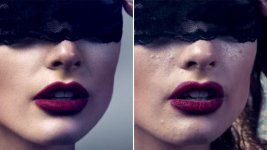
Also, photography ends up relying on photoshop to soften and refine details in the skin, so a lot of photography lighting tips look harsh in video.
photoshop-retouching-before-after-today-150504-tease_881efe171a2fd545d90c6e6b2ff5e5b8.jpg

As AI and face trackers get better for video, perhaps we'll have more easy access to photoshop like refinements in video, we're already on the way.
 
Last edited:
I thought the difference was supposed to be about the depth of the softbox, because the parabolic adds more distance between the two pieces of diffusion.

But what the video shows is that the difference in depth, being only a couple of inches, is perhaps to subtle to detect.

It's only yesterday that I was considering which would be better for my Aputure 120D -- the 36" octagonal or the 36" parabolic. I think maybe I'll go for the octagonal:

https://www.bhphotovideo.com/c/product/1470392-REG/angler_qo_dp36_button_opening_deep_parabolic.html
vs.
https://www.bhphotovideo.com/c/product/1378957-REG/angler_bb_36db_boom_box_36_bowens.html

I doubt if you would see a meaningful difference between the two. To me, overall size of source is more important. I bought three of the 47" Parabolics. Physics say the larger the apparent source, the softer the perceived light.
Or just shoot ants. Then even a regular lightbulb is a huge source ;-)
 
There are differences, but I find things like internal bounce reflectors, shooting into the parabolic vs soft box shooting out, diffusion, siders, and eggcrates make up the bulk of big differences in video.

In drama, it is very rare to get an actor in the exact right spot that subtle differences in the shape of the softbox's parabola/dome makes a difference.

Also, photography ends up relying on photoshop to soften and refine details in the skin, so a lot of photography lighting tips look harsh in video.
View attachment 141240

As AI and face trackers get better for video, perhaps we'll have more easy access to photoshop like refinements in video, we're already on the way.

In the still photo world, it's damn near CGI today. The models are becoming essentially their version of MoCap actors with the CGI bodies/faces mapped on top.
 
What do you guys think about this video on parabolic softboxes vs. regular softboxes? The video is specific to photography, but the principles should carry over.
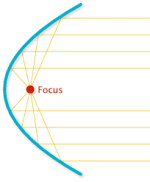
This is kind of interesting. Do people know the true geometric definition of a parabola? I cant remember too well but its about a focus point where all light (or waves which might not be light) will be pushed parallel forward.

Firstly the source bulb/globe needs to be in that focus point, facing backwards.. that focus point is not the back. So clearly his test 'parabolic box' is nothing like a true parabolic box.

No suprises therefore his scepecism.

What is interesting is how a true parabolic reflextor would work - you shoud not even need the front diffusor (?) as one would get an even 'cyclinder' (excluding the centre portion shaded by the bulb/globe) of light.. this could be a fantastic thing as it could (maybe) replicate the sun which projects (to our eyes) parrarlel beams and be good for window shine ins and the like. The light should also have minimal spill.

So a true parabolic light (maybe be some 1950s tungstens) would be a really interesting fixture.

Thinking on softboxes in general mainly we are illuminating the front cloth which can perform in different manners, letting the light pass thorough or scattering it in all directions.

I have a california sunbounce which has a weave designed to widen the light more than make it tall (I dont like it) but it is a good example of the effect of the front fabric weave.

paraboloa.png

 
Last edited:
In the still photo world, it's damn near CGI today. The models are becoming essentially their version of MoCap actors with the CGI bodies/faces mapped on top.

So depressing. We are all unconsciously comparing ourselves to models, and now not only are they completely digitally retouched, they are even going to be completely made up. Perhaps CGI models will be used in certain segments, and then larger brands will use real people in a less retouched way, since "perfection" with CGI models will become less of an ideal, since it is completely easy and fabricated. We'll see.
 
Thanks everyone for your input.

Sure thing!

I tried out a light dome and realized what utter nonsense that deep soft box was. I'd stick to beauty dishes and soft boxes.

In video world, with high powered LED's, we may start seeing more low cost parabolic light modifiers.
 
So depressing. We are all unconsciously comparing ourselves to models, and now not only are they completely digitally retouched, they are even going to be completely made up. Perhaps CGI models will be used in certain segments, and then larger brands will use real people in a less retouched way, since "perfection" with CGI models will become less of an ideal, since it is completely easy and fabricated. We'll see.

I remember reading an article by a photo retoucher, who said that retouching typically adds mass to enhance a models figure as opposed to making them look thinner. I've herd people say that most models are under weight, I'm not sure if that's true or not, as some people are naturally thin or very physically fit.
 
I remember reading an article by a photo retoucher, who said that retouching typically adds mass to enhance a models figure as opposed to making them look thinner. I've herd people say that most models are under weight, I'm not sure if that's true or not, as some people are naturally thin or very physically fit.

Yes, it is an issue still.
 
Back
Top